Category: Budgeting

  • Living paycheck to paycheck: Why it happens and how to break the cycle

    Living paycheck to paycheck: Why it happens and how to break the cycle

    For millions of Americans, payday brings a brief sense of relief.

    Bills get paid, the checking account finally looks healthy again, and for a few days it feels like everything is under control. But as the month moves on, that balance slowly disappears. Rent, groceries, insurance, transportation, subscriptions, and everyday purchases quietly consume the paycheck until there’s little—or nothing—left before the next one arrives.

    Eventually, the cycle repeats.

    Living paycheck to paycheck isn’t always a sign of poor financial decisions. In many cases, it’s the result of rising housing costs, inflation, healthcare expenses, student loans, or wages that haven’t kept pace with the cost of living. People across every income level experience it, including professionals with six-figure salaries.

    The problem isn’t necessarily how much money you earn. Often, it’s how little room exists between your income and your monthly obligations.

    What does living paycheck to paycheck really mean?

    The phrase is frequently misunderstood.

    It doesn’t simply mean having a low income. It means depending on your next paycheck to meet your current financial commitments.

    If missing one paycheck would immediately make it difficult to pay rent, cover groceries, or keep up with monthly bills, you’re likely living paycheck to paycheck regardless of your salary.

    Some households earn $45,000 a year and struggle.

    Others earn more than $150,000 and experience exactly the same financial pressure because their expenses have grown alongside their income.

    The common factor isn’t income—it’s the absence of financial breathing room.

    Why higher income doesn’t always solve the problem

    Many people believe a raise will automatically eliminate financial stress.

    Sometimes it does.

    But many households experience something known as lifestyle inflation. As income grows, spending grows with it. A larger apartment, newer car, more vacations, premium subscriptions, and frequent dining out gradually become part of everyday life.

    Before long, the higher paycheck feels just as tight as the previous one.

    Without intentional financial planning, increased income often creates a more expensive lifestyle rather than greater financial security.

    The hidden cost of constant financial pressure

    Living paycheck to paycheck affects far more than your bank account.

    It influences daily decisions, career choices, relationships, and even physical health.

    Unexpected expenses become emergencies.

    Necessary repairs get postponed.

    Retirement savings are delayed.

    Credit cards become a temporary solution that often develops into long-term debt.

    Over time, financial stress can create a cycle that’s difficult to escape because every setback reduces the ability to prepare for the next one.

    Small changes can create breathing room

    Escaping the paycheck-to-paycheck cycle rarely happens overnight.

    For most people, it’s the result of gradually creating more space between income and expenses.

    That may involve reducing recurring monthly costs, negotiating insurance premiums, refinancing expensive debt, increasing income through career development or freelance work, or simply becoming more intentional about discretionary spending.

    Building even a modest emergency fund can change the entire equation.

    Instead of relying on credit cards when something unexpected happens, savings provide time to respond without immediately creating new debt.

    Progress usually begins with small improvements rather than dramatic transformations.

    Focus on building margin, not perfection

    Many budgeting articles encourage people to cut every non-essential expense.

    While reducing unnecessary spending can certainly help, sustainable financial progress comes from creating margin—not eliminating everything enjoyable.

    A realistic budget should include room for entertainment, hobbies, and occasional treats.

    Financial plans fail when they become impossible to live with.

    The objective isn’t to build the cheapest possible lifestyle.

    It’s to build one that’s financially sustainable.

    Financial freedom starts with one extra dollar

    One extra dollar left at the end of the month may not seem significant.

    But it represents something much more important.

    It means your money is beginning to work for you instead of disappearing as quickly as it arrives.

    That extra dollar eventually becomes twenty.

    Twenty becomes two hundred.

    Two hundred becomes the beginning of an emergency fund.

    Every financially stable household started somewhere.

    Breaking the paycheck-to-paycheck cycle isn’t about becoming rich overnight.

    It’s about slowly creating choices where previously there were none.

    Financial freedom isn’t built in a single paycheck.

    It’s built through hundreds of intentional decisions that gradually give you more control over your future.


  • Needs vs. Wants: How to tell the difference and spend smarter

    Needs vs. Wants: How to tell the difference and spend smarter

    One of the simplest concepts in personal finance is also one of the hardest to apply in everyday life.

    Most people understand that paying rent is more important than buying a new pair of sneakers. But real financial decisions are rarely that obvious. Is your daily coffee a need or a want? What about high-speed internet when you work from home? Is replacing your five-year-old smartphone a necessity, or simply something you would like to do?

    The line between needs and wants has become increasingly blurred, especially as technology, convenience, and lifestyle expectations have evolved. Understanding the difference isn’t about judging how people spend their money. It’s about making sure your spending reflects your priorities rather than your impulses.

    Learning to separate essential expenses from discretionary spending is one of the foundations of successful budgeting and long-term financial health.

    What is a Need?

    A need is an expense that supports your basic ability to live, work, and maintain your health and safety.

    For most households, that includes housing, groceries, utilities, health insurance, transportation to work, prescription medications, and minimum debt payments. These are the costs that continue regardless of whether you’re trying to save money or reduce spending.

    Without them, daily life becomes difficult or impossible.

    That doesn’t mean every version of these expenses is a necessity. Owning a car may be essential if public transportation isn’t available, but choosing a luxury vehicle instead of a reliable used car is a lifestyle decision.

    The category often stays the same, even when the amount you spend changes dramatically.

    What Is a want?

    A want is anything that improves your lifestyle without being essential for meeting your basic needs.

    Dining out, entertainment subscriptions, vacations, designer clothing, gaming consoles, premium smartphones, and impulse purchases all fall into this category for most people.

    Wants aren’t bad.

    In fact, eliminating every enjoyable expense usually creates frustration and makes budgets impossible to maintain.

    The goal isn’t to stop spending on things you enjoy. The goal is to make sure those purchases happen intentionally and fit comfortably within your financial plan.

    Healthy personal finance leaves room for both responsibility and enjoyment.

    Why the difference matters

    Many financial problems don’t begin with one large purchase.

    They develop through dozens of small decisions that feel insignificant on their own.

    A streaming subscription here.

    Food delivery twice a week.

    An upgraded phone plan.

    Several online impulse purchases.

    Individually, each expense may seem manageable. Together, they can quietly consume hundreds of dollars every month.

    Recognizing the difference between needs and wants helps you identify where adjustments can be made without sacrificing your quality of life.

    Your priorities will change over time

    One of the biggest mistakes people make is believing their budget should remain the same forever.

    Financial priorities naturally evolve.

    Someone in their twenties may choose to spend more on travel and experiences.

    Parents may prioritize childcare, education, and family expenses.

    Later in life, retirement savings and healthcare become increasingly important.

    What qualifies as a priority changes as life changes.

    A good budget evolves with you instead of forcing you into the same spending habits year after year.

    How to make better spending decisions

    Before making a purchase, ask yourself a few simple questions.

    Would my life become significantly more difficult if I didn’t buy this?

    Can this purchase wait until next month?

    Will I still value this purchase six months from now?

    Would I rather have this item or move closer to one of my financial goals?

    Those questions often provide more useful answers than simply asking whether something is affordable.

    Being able to afford something doesn’t automatically mean it’s the best use of your money.

    Financial freedom comes from intentional choices

    The difference between people who consistently build wealth and those who constantly feel financially stretched isn’t always income.

    It’s often awareness.

    People who understand where their money goes tend to make better long-term decisions because they’re spending according to their priorities instead of reacting to every temptation.

    Separating needs from wants doesn’t remove enjoyment from life.

    It simply ensures that today’s spending doesn’t prevent tomorrow’s opportunities.

    Financial freedom isn’t built by saying “no” to everything.

    It’s built by saying “yes” to the things that matter most.

  • Zero-Based budgeting explained: A smarter way to manage your money

    Zero-Based budgeting explained: A smarter way to manage your money

    Budgeting doesn’t fail because people don’t earn enough money.

    More often, it fails because every paycheck arrives without a clear plan.

    Money comes in, bills get paid, a few unexpected purchases appear, and by the end of the month many people are left wondering where the rest went. Even households with comfortable incomes can experience this cycle because spending naturally expands to fill whatever money is available.

    Zero-based budgeting approaches the problem differently.

    Instead of asking where your money went after you’ve spent it, this method asks you to decide where every dollar will go before the month even begins.

    The goal isn’t to spend every dollar. The goal is to give every dollar a purpose.

    Whether that purpose is paying rent, buying groceries, investing for retirement, or building an emergency fund, every dollar is assigned a job before it leaves your account.

    What does “Zero-Based” actually mean?

    The name often confuses people.

    It doesn’t mean your bank account should reach zero.

    It means that after you’ve assigned your monthly income to spending, saving, investing, and debt repayment, there shouldn’t be any dollars left without a purpose.

    If your monthly take-home pay is $5,000, your budget should explain exactly what all $5,000 will do.

    Some will pay for housing.

    Some will cover transportation.

    Some will build savings.

    Some will fund entertainment.

    Some will reduce debt.

    When every dollar has a destination, unplanned spending becomes much easier to recognize and control.

    Why this method works

    One of the biggest advantages of zero-based budgeting is awareness.

    Many people think they have a spending problem when, in reality, they have a planning problem.

    Without a clear plan, small purchases rarely feel significant. A coffee here, lunch there, another streaming subscription, a few online orders—they seem harmless individually but often consume hundreds of dollars each month.

    Zero-based budgeting makes those decisions visible before they happen.

    Instead of reacting to spending, you’re directing it.

    That shift in mindset is often more valuable than the budgeting system itself.

    It’s About Priorities, Not Restrictions

    Critics sometimes argue that zero-based budgeting is too strict.

    In practice, it can actually create more freedom.

    Nothing prevents you from budgeting for vacations, concerts, hobbies, or weekly dinners with friends. Those expenses simply become intentional rather than impulsive.

    Financial guilt often comes from spending money that wasn’t planned.

    When entertainment is already included in your budget, you can enjoy it without wondering whether you’re sacrificing more important goals.

    A budget should support your lifestyle—not eliminate it.

    The biggest mistake beginners make

    Many first-time budgeters spend hours creating the perfect spreadsheet, only to ignore it after two weeks.

    The problem isn’t usually the budget itself.

    It’s expecting life to follow the plan perfectly.

    Unexpected expenses happen.

    Cars need repairs.

    Medical bills arrive.

    Birthdays appear.

    Travel plans change.

    A successful zero-based budget includes flexibility. Small adjustments throughout the month aren’t signs of failure—they’re signs that you’re managing real life instead of following a rigid template.

    Is Zero-Based budgeting right for everyone?

    Like every budgeting method, zero-based budgeting has strengths and weaknesses.

    People with regular monthly income often find it easy to implement because they know approximately how much money they’ll have available each month.

    Freelancers, commission-based employees, and business owners with fluctuating income may need a more flexible version based on conservative income estimates.

    The underlying principle, however, remains valuable for almost everyone: intentional spending leads to better financial decisions.

    Planning every dollar builds better habits

    The greatest benefit of zero-based budgeting isn’t mathematical.

    It’s psychological.

    Once people begin assigning purpose to every dollar, they often become more thoughtful about every financial decision they make.

    Saving becomes automatic.

    Impulse purchases become easier to recognize.

    Financial goals become more visible.

    And perhaps most importantly, money begins to feel like a tool rather than something that constantly disappears without explanation.

    Budgeting isn’t about perfection.

    It’s about making sure your money reflects your priorities instead of your habits.

  • How to create a budget that actually works

    How to create a budget that actually works

    Most people don’t fail at budgeting because they’re bad with numbers.

    They fail because they create budgets they were never going to follow.

    A spreadsheet that leaves no room for dining out, birthdays, vacations, or unexpected expenses might look perfect on paper, but it usually falls apart within weeks. When that happens, many people assume budgeting simply isn’t for them.

    The truth is very different.

    A good budget isn’t about restricting your life. It’s about giving every dollar a purpose while leaving enough flexibility to handle real life. The most successful budgets aren’t necessarily the most detailed—they’re the ones people can maintain month after month.

    Whether you’re trying to stop living paycheck to paycheck, build an emergency fund, or simply understand where your money goes each month, creating a realistic budget is one of the most valuable financial habits you can develop.

    Start by understanding your income

    Every budget begins with one number: the amount of money that actually reaches your bank account.

    For employees, this usually means your take-home pay after taxes, retirement contributions, health insurance, and other deductions.

    If you’re self-employed or your income changes from month to month, calculate an average based on the last six to twelve months rather than your highest-earning month. Budgeting around unusually high income often leads to overspending during slower periods.

    Your budget should be built around money you already have—not money you hope to earn.

    Find out where your money is really going

    Before deciding how much you should spend, it’s important to understand how you’ve been spending.

    Review your last two or three months of bank and credit card statements. Most people discover at least one surprise. It might be recurring subscriptions they forgot about, frequent restaurant visits, or dozens of small purchases that never felt significant individually but add up quickly over time.

    Patterns matter more than isolated expenses.

    Once you understand your spending habits, you’ll be able to make informed decisions instead of guessing where your money disappears every month.

    Separate needs from lifestyle choices

    One of the biggest challenges in budgeting is distinguishing between expenses that are essential and those that are optional.

    Housing, utilities, groceries, insurance, transportation, and minimum debt payments generally fall into the “needs” category.

    Streaming services, premium subscriptions, dining out, entertainment, shopping, and vacations are typically discretionary expenses.

    This doesn’t mean discretionary spending is bad.

    A sustainable budget should include money for enjoying life. Eliminating every enjoyable expense often creates frustration that leads people to abandon their budgets altogether.

    The goal is balance, not perfection.

    Give every dollar a job

    Many financial planners recommend assigning every dollar of income to a purpose before the month begins.

    Some money pays bills.

    Some builds savings.

    Some goes toward investing.

    Some covers entertainment.

    When income has a clear destination, it’s much easier to avoid wondering where your paycheck disappeared.

    Budgeting isn’t about tracking money after it’s gone. It’s about deciding where it should go before you spend it.

    Expect the unexpected

    Life rarely follows a perfect monthly schedule.

    Car repairs, medical bills, school expenses, holiday shopping, home maintenance, and annual insurance premiums all appear eventually.

    Instead of treating these as financial emergencies, build room for them into your budget.

    Setting aside even a small amount each month for irregular expenses can prevent them from disrupting your finances later.

    This is one reason many households combine budgeting with an emergency fund, creating an additional layer of financial protection when unexpected costs arise.

    Review your budget every month

    A budget isn’t something you create once and never revisit.

    Income changes.

    Expenses increase.

    Goals evolve.

    Reviewing your budget once a month allows you to adjust before small problems become larger ones. Maybe your rent increased, your insurance premium changed, or you’ve recently paid off a loan. Each of those events creates an opportunity to reassign money toward new priorities.

    Financial planning works best when it evolves alongside your life.

    The best budget is the one you’ll actually follow

    There’s no universally perfect budgeting system.

    Some people prefer the simplicity of the 50/30/20 budget rule. Others like zero-based budgeting or detailed spending categories. Many households combine several different approaches over time.

    The best budget is the one that helps you spend intentionally without making everyday life feel unnecessarily restrictive.

    Consistency almost always beats complexity.

    Even a simple budget followed for five years will usually produce better results than an elaborate financial plan abandoned after one month.

    Creating a budget isn’t about controlling every dollar. It’s about giving yourself the confidence that your money is moving you closer to the life you want.

  • The 50/30/20 budget rule: Does it still work in 2026?

    The 50/30/20 budget rule: Does it still work in 2026?

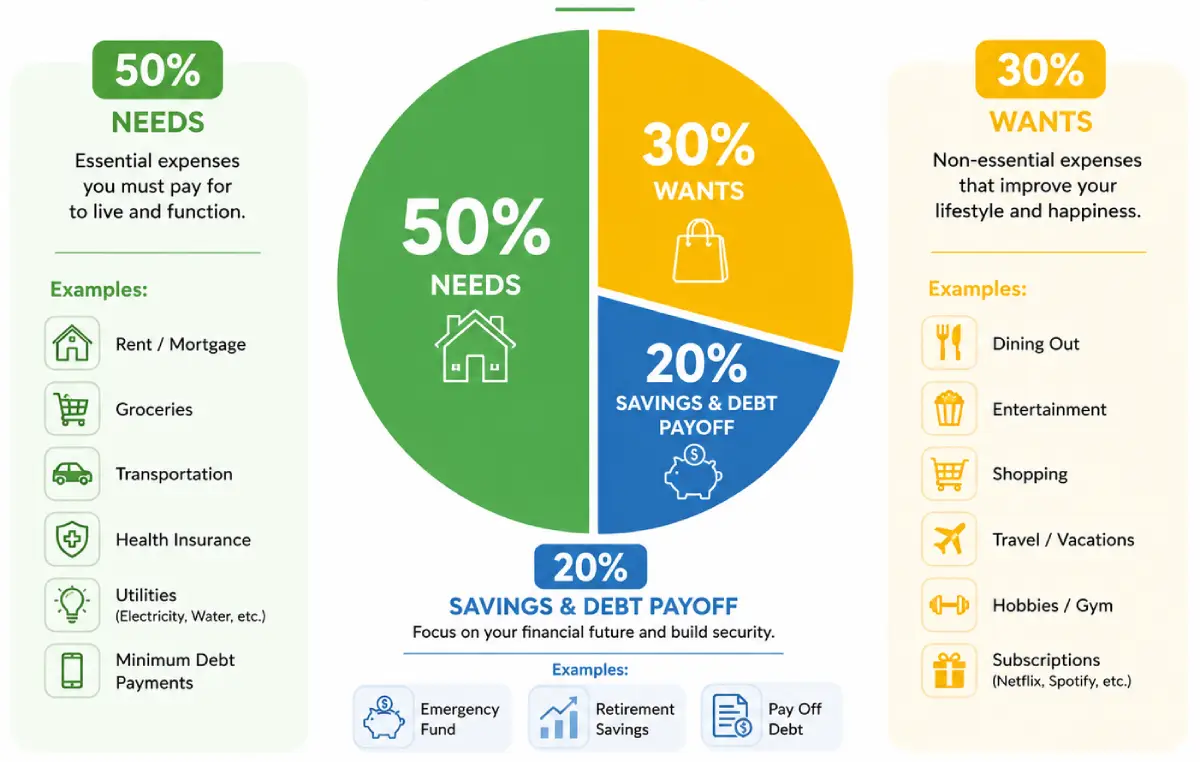
    For years, the 50/30/20 budget rule has been one of the simplest recommendations in personal finance. Financial coaches, budgeting apps, banks, and investment platforms have all promoted it as an easy framework for managing income without becoming overwhelmed by spreadsheets and complicated formulas. Even people who have never created a formal budget have probably heard the advice: spend 50% of your income on needs, 30% on wants, and save or invest the remaining 20%.

    The idea is appealing because it is easy to remember. Instead of tracking dozens of spending categories, you only need to think about three. It removes much of the complexity that causes many people to abandon budgeting after only a few weeks.

    But personal finance has changed dramatically over the past decade. Housing costs have climbed in most American cities, grocery prices remain well above pre-pandemic levels, insurance premiums continue to rise, and many workers are juggling student loan payments alongside higher interest rates on credit cards and auto loans. A budgeting method that worked comfortably in 2015 may feel almost impossible for households in 2026.

    That doesn’t mean the 50/30/20 rule is obsolete. It simply means it should be treated as a flexible guideline rather than a rigid formula. Understanding why it was created—and how to adapt it to today’s financial reality—can make it far more useful than blindly following percentages that don’t fit your circumstances.

    Understanding the three categories

    At its core, the budgeting rule divides your after-tax income into three broad groups.

    The first category, needs, includes expenses that are essential for maintaining your basic lifestyle. Housing, utilities, groceries, transportation to work, health insurance, minimum debt payments, and other unavoidable bills all belong here. If you stopped paying these expenses, your daily life would be directly affected.

    The second category covers wants. These are the purchases that improve your lifestyle but aren’t strictly necessary. Dining out, streaming subscriptions, vacations, entertainment, hobbies, shopping, premium phone upgrades, and many online subscriptions all fall into this group.

    The final 20% is reserved for building your future. That includes emergency savings, retirement contributions, investments, paying extra toward high-interest debt, or saving for major financial goals such as a home down payment.

    The simplicity of these categories is one of the reasons the system became so popular. People rarely fail because budgeting is mathematically difficult—they fail because it becomes emotionally exhausting. Reducing dozens of spending decisions into three larger buckets helps many households stay consistent.

    Why the original formula doesn’t always fit today’s economy

    One of the biggest criticisms of the 50/30/20 rule is that it assumes housing consumes roughly half of your essential expenses. In reality, housing has become the largest financial challenge for millions of Americans.

    According to recent housing market data, many renters now spend well above 30% of their income on rent alone. After adding utilities, transportation, insurance, and groceries, essential expenses can easily reach 65% or even 70% of take-home pay.

    Someone earning $4,500 per month after taxes would ideally spend no more than $2,250 on necessities under the traditional formula. Yet in many metropolitan areas, rent alone can exceed $2,000 before any other monthly bills are considered.

    Inflation has added another layer of pressure. Grocery prices, car insurance, healthcare, and everyday household expenses have all increased significantly compared with only a few years ago. As a result, many families find themselves reducing discretionary spending simply to cover basic living costs.

    This doesn’t necessarily indicate poor financial habits. Often, it reflects economic conditions that are outside an individual’s control.

    Why flexibility matters more than perfection

    Many people abandon budgeting after the first month because they believe they’ve failed. Their essential expenses reached 62% instead of 50%, or they only managed to save 12% instead of 20%.

    In reality, budgeting should be viewed as a direction rather than a scorecard.

    Imagine two households earning the same income. One lives in a low-cost Midwestern city with affordable housing, while the other rents an apartment in New York City or San Francisco. Expecting both families to maintain identical spending percentages ignores enormous regional differences in the cost of living.

    The more useful question isn’t whether your budget matches the textbook formula. Instead, ask whether your financial situation is improving month after month.

    Are your savings growing?

    Is your credit card balance shrinking?

    Are you relying less on debt?

    Can you handle an unexpected expense without panic?

    Positive answers to those questions matter far more than perfectly matching predetermined percentages.

    Adapting the rule for modern households

    Many financial planners now recommend adjusting the percentages to match your current stage of life rather than forcing yourself into an unrealistic budget.

    A recent graduate paying off student loans may temporarily follow a 60/20/20 approach.

    A young family facing childcare costs might operate closer to 65/15/20.

    Someone aggressively paying off high-interest credit card debt could intentionally reduce discretionary spending for a year while directing more than 20% toward debt repayment.

    The percentages themselves are less important than maintaining balance between today’s lifestyle and tomorrow’s financial security.

    The greatest danger isn’t spending 55% on necessities. It’s allowing lifestyle inflation to consume every future raise, leaving nothing available for investing or emergency savings.

    Small improvements often beat major budget cuts

    When people decide to “fix” their finances, they often focus on eliminating coffee purchases or canceling a streaming subscription. While those savings can help, they rarely transform a household budget.

    Much larger gains usually come from optimizing high-cost categories.

    Negotiating car insurance.

    Refinancing expensive debt.

    Reducing housing costs when possible.

    Increasing retirement contributions before lifestyle spending expands.

    Pursuing salary growth through new skills or career advancement.

    These decisions can improve monthly cash flow by hundreds of dollars instead of only a few dollars at a time.

    The 50/30/20 rule works best when paired with thoughtful financial decisions rather than strict deprivation.

    Budgeting should reduce stress – not create it

    The purpose of budgeting is often misunderstood.

    Many people think a budget exists to limit spending. In reality, its primary purpose is to help people spend intentionally.

    A well-designed budget allows someone to enjoy vacations, hobbies, dining out, or entertainment without guilt because those expenses were planned in advance. At the same time, it ensures that future goals—retirement, emergency savings, education, or homeownership—continue moving forward.

    Financial confidence rarely comes from earning a perfect income. It comes from consistently making intentional decisions with the income you already have.

    The 50/30/20 rule remains valuable because it encourages exactly that mindset.

    It provides a simple framework that can evolve as your income, family, career, and financial priorities change. In today’s economy, flexibility has become just as important as discipline. Rather than treating the rule as a strict mathematical formula, think of it as a compass that helps guide your financial decisions in the right direction.