Category: Tested by Fintayo

  • AirTag 2 vs Galaxy SmartTag2 for checked luggage: Which one actually wins?

    AirTag 2 vs Galaxy SmartTag2 for checked luggage: Which one actually wins?

    Your suitcase does not appear on the carousel.

    Everyone else leaves.

    The screen changes to another flight.

    At that point, a luggage tracker becomes much more useful than it looked when you bought it.

    It cannot physically bring the suitcase back. It cannot force an airline to deliver it faster. But it can answer one extremely useful question:

    Where is my bag right now?

    For travellers using an iPhone, the obvious choice is Apple’s AirTag. For Samsung Galaxy users, the closest equivalent is the Galaxy SmartTag2.

    But in 2026, the comparison changed.

    Apple introduced the second-generation AirTag in January with improved Precision Finding range, a louder speaker and expanded Bluetooth performance. More importantly for travellers, Apple’s Share Item Location system is now accepted by more than 50 airlines, allowing passengers to temporarily share the location of a missing bag directly with participating airline teams.

    Samsung’s SmartTag2 remains a strong tracker with UWB support on compatible Galaxy phones, IP67 protection, a replaceable battery and a claimed battery life of up to 500 days.

    So which one would we actually choose for checked luggage?

    The Fintayo test

    This is not presented as a laboratory or physical endurance test.

    We compared both products using their current official specifications and a repeatable travel scenario:

    1. Put the tracker inside a checked suitcase.
    2. Check whether the suitcase is still near you before departure.
    3. Follow its approximate movement through an airport.
    4. Simulate the bag failing to arrive.
    5. Try to locate it remotely.
    6. Evaluate how easily the location can be shared with someone who can actually recover the bag.
    7. Compare battery, durability, ecosystem restrictions and practical travel value.

    For luggage, the most important feature is not which tracker has the prettiest app.

    It is what happens after the bag disappears.

    Quick verdict

    CategoryAirTag 2Galaxy SmartTag2
    Nearby finding9.5/109/10
    Long-distance crowd finding9.5/108.5/10
    Airline recovery integration10/106/10
    Battery9/1010/10
    Water/dust resistance9/109/10
    Ease of setup10/109/10
    Platform flexibility5/105/10
    Checked-luggage usefulness9.4/108.3/10

    Fintayo winner for checked luggage: AirTag 2

    Not because Samsung’s tracker is poor.

    The decisive advantage is airline recovery integration.


    AirTag 2: what changed in 2026?

    The original AirTag already worked well for luggage because of Apple’s Find My network.

    The second-generation version improves the areas that matter when trying to locate something in a crowded environment.

    Apple says the 2026 AirTag uses its second-generation Ultra Wideband chip and can provide Precision Finding from up to 50% farther away than the previous generation. The internal speaker is also 50% louder and can be heard from up to twice the distance under Apple’s stated conditions.

    Its specifications include:

    • Bluetooth proximity finding
    • second-generation UWB
    • NFC
    • built-in speaker
    • replaceable CR2032 battery
    • IP67 water and dust resistance
    • weight of 11.8 g

    For ordinary luggage use, however, the upgraded speaker is not the most important improvement.

    Share Item Location is.

    The feature that changes the luggage comparison

    Imagine this situation:

    You: Barcelona
    Your suitcase: Frankfurt
    Airline system: Bag status unknown
    Tracker: Last seen at Frankfurt Airport

    Knowing that yourself is useful.

    Being able to give that location directly to an airline is far more useful.

    Apple’s Share Item Location allows an AirTag owner to generate a temporary location-sharing link for a missing item.

    Apple says more than 50 airlines now accept these links through their customer-service processes. The list includes airlines such as Lufthansa, Delta, Singapore Airlines and United, and Apple has previously named European carriers including Austrian, British Airways, KLM, Swiss, Turkish Airlines and Vueling among participating or planned participants.

    The shared link:

    • updates when a new location is detected
    • can be stopped by the owner
    • stops once the item is recovered
    • automatically expires after seven days

    This turns the tracker from a personal locating device into part of an actual baggage-recovery workflow.

    That is a substantial advantage.

    SmartTag2: excellent hardware, different ecosystem

    Samsung’s Galaxy SmartTag2 is slightly larger than an AirTag but remains compact enough to disappear inside almost any suitcase.

    Samsung lists:

    Dimensions: 28.8 × 52.44 × 8 mm
    Weight: 13.75 g
    Battery: replaceable CR2032
    Battery life: up to 500 days
    Bluetooth: BLE 5.3
    Bluetooth range: up to 120 m in open conditions
    Water/dust resistance: IP67
    UWB: supported

    The quoted 120-metre Bluetooth figure assumes favourable conditions without major obstacles, so it should not be interpreted as a guaranteed airport range.

    When the tracker is outside direct Bluetooth range, Samsung uses the Galaxy Find Network, relying on nearby participating Galaxy devices to detect the tag and update its location.

    The basic concept is therefore similar to AirTag:

    The tracker does not need its own mobile-data connection. Nearby devices help report where it is.

    For Samsung Galaxy owners, that works very well.

    Where SmartTag2 can actually beat AirTag

    Battery life is one of the clearest advantages.

    Samsung advertises up to 500 days of typical operation and even longer in Power Saving Mode, although actual battery life depends on usage and conditions.

    Both products use a user-replaceable CR2032 coin cell, which makes either far more practical than a rechargeable tracker that may be forgotten before a trip. Apple likewise supports user replacement of the AirTag battery.

    SmartTag2 also includes a physical loop in its design.

    That sounds trivial until you actually attach a tracker to:

    • a suitcase zipper
    • an internal luggage strap
    • a backpack
    • a key ring

    AirTag normally needs a separate holder or accessory when physically attached.

    For checked luggage we would still place either tracker inside the bag, rather than hanging it visibly from the outside.

    An external tracker can be damaged or removed.

    SmartTag2 Lost Mode is genuinely useful

    Samsung has another good recovery feature.

    When Lost Mode is enabled, someone who finds a SmartTag2 can tap it using an NFC-capable smartphone and view contact information or a message previously registered by the owner.

    Samsung states that this can work regardless of the finder’s phone operating system, provided the device can read NFC and has internet access.

    Example:

    This bag belongs to:
    John Smith
    
    Please call:
    +...
    
    Reward offered

    That is excellent for:

    • backpacks
    • keys
    • bags left in taxis
    • luggage collected by the wrong passenger

    But an airport baggage handler does not normally search suitcases by tapping their trackers with NFC.

    For airline mishandling, AirTag’s location-sharing workflow is more directly relevant.

    The airport scenario

    Consider the same delayed bag with each device.

    With AirTag 2

    1. Open Find My
    2. View last reported location
    3. Mark the item as lost if necessary
    4. Create Share Item Location link
    5. Give the link to a participating airline
    6. Airline staff can view the current reported location

    With SmartTag2

    1. Open SmartThings Find
    2. View last reported location
    3. Activate Lost Mode
    4. Give the airline your baggage claim details
    5. Explain where your tracker currently reports the bag

    Both give you useful information.

    Only the first workflow currently has a widely documented direct airline-sharing mechanism.

    That difference is why AirTag wins this comparison.

    Can you put these trackers in checked luggage?

    Yes, subject to the applicable battery limits and airline rules.

    IATA’s current lithium-battery guidance specifically states that AirTags and similar baggage tracking devices can remain active inside checked baggage when their battery falls within the permitted small-battery limits and the tracker uses low-energy Bluetooth.

    The FAA similarly states that baggage location tracking devices powered by small lithium batteries can be permitted in checked bags within its stated battery thresholds.

    This is very different from a power bank.

    A power bank is treated as a spare lithium battery and generally belongs in carry-on baggage, not inside checked luggage.

    So do not confuse:

    Small Bluetooth tracker ≠ power bank

    Always check the operating airline’s current baggage rules before travel.

    Do trackers show your suitcase in real time?

    No.

    This is one of the biggest misconceptions.

    An AirTag or SmartTag2 is not the same as a GPS tracker with a permanent cellular data connection.

    The displayed location is dependent on the tracker being detected by a compatible nearby device.

    That means the app may show:

    Last seen 2 minutes ago

    rather than a continuously moving dot.

    Inside a busy terminal there are usually many phones around.

    Inside:

    • an aircraft cargo hold
    • a remote baggage warehouse
    • a metal container
    • a quiet service area

    updates may become less frequent.

    The tracker tells you the last reported location.

    It does not give you an aircraft-radar feed.

    Which one is better inside the airport itself?

    When your suitcase is nearby but difficult to locate, both trackers offer close-range tools.

    AirTag 2 uses Precision Finding with compatible Apple hardware.

    SmartTag2 offers Search Nearby and Compass View on compatible UWB-enabled Galaxy phones. Samsung warns that accuracy can be reduced by walls, drawers, cars and other physical obstacles.

    For luggage arriving on an airport carousel, both are more than adequate.

    A more realistic use case is:

    App: suitcase is nearby
    Carousel: still empty

    That information can tell you that the bag has reached roughly the same airport even before it appears physically.

    But do not enter restricted baggage areas because your phone shows the tracker nearby.

    The location is information for you and airport staff—not permission to retrieve the bag yourself.

    What about network size?

    This is difficult to compare fairly.

    Apple uses the Find My network, a crowdsourced network of Apple devices that can detect nearby compatible items.

    Samsung uses its Galaxy Find Network, whose effectiveness depends on participating Galaxy users being close enough to the SmartTag2.

    Neither company gives you a useful guarantee such as:

    Your bag will be detected every 37 seconds at every European airport.

    Real-world performance depends on:

    • airport traffic
    • local device mix
    • where the suitcase is stored
    • physical obstructions
    • whether compatible phones pass nearby

    For that reason, we would not assign a precise percentage advantage to either network.

    However, the additional ability to share an AirTag’s location directly with participating airlines gives Apple a practical recovery advantage even after the location has been found.

    The platform-lock problem

    Here is the biggest reason not to choose based only on our overall score.

    Buy AirTag 2 if you use an iPhone

    The 2026 AirTag requires an Apple Account and compatible iPhone or iPad software.

    If your primary phone is Android, AirTag is not the logical choice simply because it wins this comparison.

    Buy SmartTag2 if you use Samsung Galaxy

    SmartTag2 is designed around Samsung’s SmartThings Find ecosystem.

    UWB-based Compass View requires a compatible Galaxy phone with UWB support.

    Other Android users

    A Pixel, Motorola or another non-Samsung Android owner should also consider trackers designed for Google’s Find Hub network rather than buying into Samsung’s ecosystem solely for luggage tracking.

    Google’s current Find Hub supports Bluetooth tracker tags and a crowdsourced network of Android devices, including compatible UWB tracking on supported phones and tags.

    The best tracker is usually the one that integrates properly with the phone already in your pocket.

    Where should you place the tracker?

    Our recommendation:

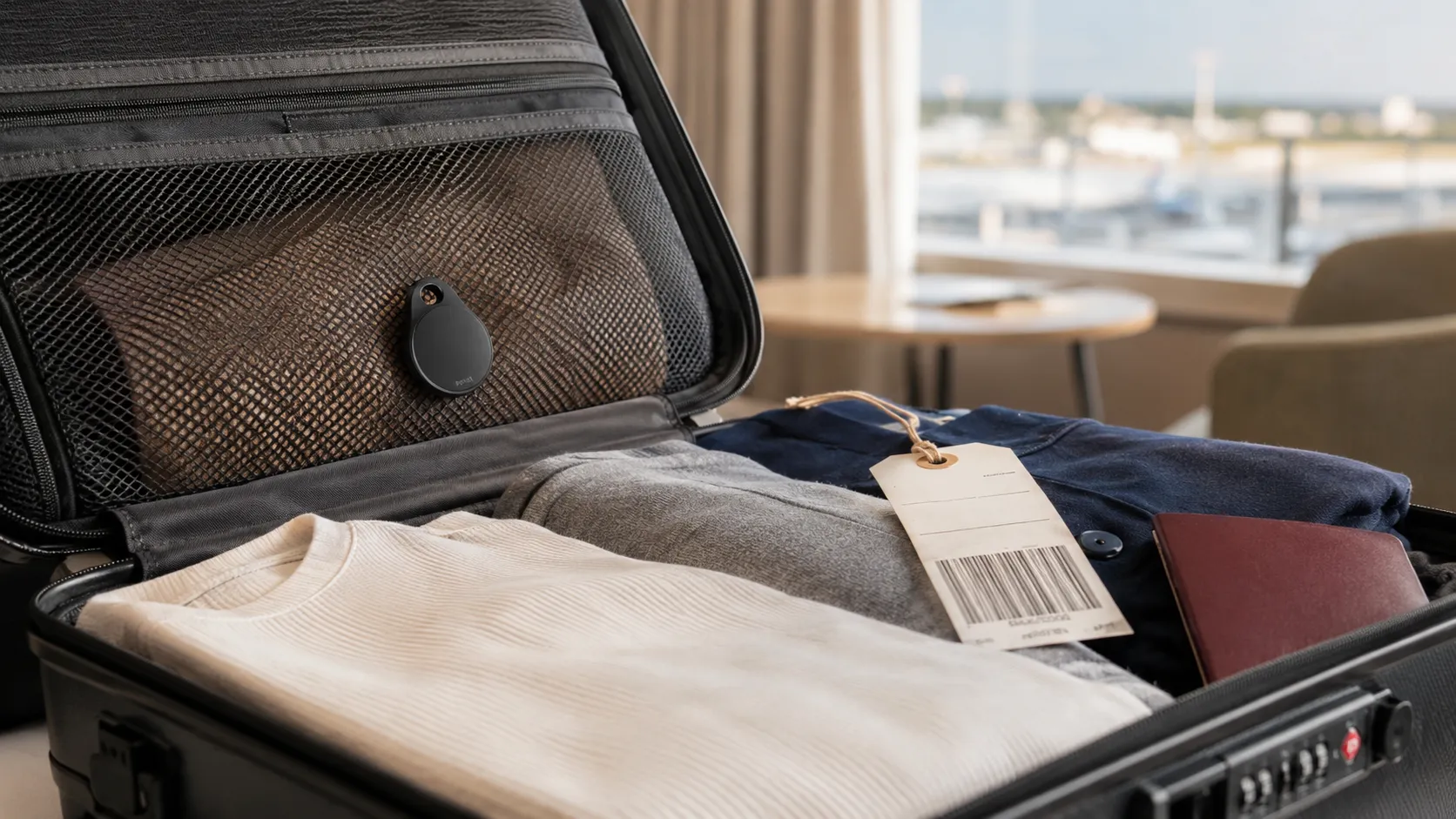
    Inside the suitcase
    Near the upper layer
    Inside a zipped mesh compartment
    Away from liquid toiletries

    Do not bury it inside:

    A metal container
    A toiletry tin
    Several layers of electronics
    A foil-lined pouch

    The tracker communicates wirelessly.

    There is no benefit in making that communication more difficult.

    An internal mesh pocket is ideal because the device stays hidden and secure without being surrounded by dense objects.

    One tracker per suitcase

    For families, do not place all trackers in one bag.

    Use:

    Bag 1 → Tracker 1
    Bag 2 → Tracker 2
    Bag 3 → Tracker 3

    Name them clearly:

    Branko – Black Suitcase
    Ana – Blue Suitcase
    Kids – Large Grey Suitcase

    The wrong naming system becomes surprisingly confusing when three bags stop updating at approximately the same airport.

    Replace the battery before an important trip

    A tracker is inexpensive compared with the value of a missing suitcase.

    Do not try to squeeze the final weeks out of an old coin-cell battery before a long trip.

    Before departure:

    Open tracker app
    Confirm tracker is online
    Check battery warning
    Play sound
    Verify correct tracker name
    Confirm Lost Mode details
    Update phone software

    AirTag alerts the owner when its battery becomes low.

    For a major international journey, replacing an aging CR2032 before departure is cheap insurance.

    Final score

    AirTag 2

    Finding technology:      9.5
    Airline integration:    10.0
    Battery practicality:    9.0
    Durability:              9.0
    Ease of use:            10.0
    Luggage recovery:        9.5
    
    Fintayo score:           9.4/10

    Galaxy SmartTag2

    Finding technology:      9.0
    Airline integration:     6.0
    Battery practicality:   10.0
    Durability:              9.0
    Ease of use:             9.0
    Luggage recovery:        8.0
    
    Fintayo score:           8.3/10

    The Fintayo takeaway

    If you own an iPhone and regularly check luggage, AirTag 2 is currently our preferred choice.

    The hardware improvements are useful, but the real reason is not the louder speaker or the longer Precision Finding range.

    It is this:

    Finding the suitcase is only half the problem. Getting the airline to recover it is the other half.

    Apple’s ability to share a temporary item-location link with more than 50 participating airlines closes that gap better than the competing workflow currently offered by SmartTag2.

    For Samsung Galaxy users, SmartTag2 remains a very good luggage tracker, particularly because of its long battery life, replaceable battery, UWB features and excellent Lost Mode.

    Our buying rule is simple:

    iPhone → AirTag 2
    Samsung Galaxy → SmartTag2
    Other Android → Find Hub-compatible tracker

    And regardless of which tracker you choose:

    Keep the baggage receipt.

    File the delayed-baggage report.

    Follow the airline’s official recovery procedure.

    Then use the tracker as additional evidence showing where your suitcase may actually be.

    A tracker is not a replacement for the airline’s baggage system.

    It is the second pair of eyes you wish you had when the carousel stops moving.
  • Compression packing cubes vs Regular cubes: Which one is actually worth it?

    Compression packing cubes vs Regular cubes: Which one is actually worth it?

    A compression packing cube looks impressive in a demonstration.

    You place several shirts inside, close the main zipper, pull a second zipper around the edge and watch the cube become noticeably thinner.

    It feels like you have created extra suitcase space.

    But three questions remain:

    1. Does the cube genuinely help you pack more?
    2. Is it better than an ordinary packing cube?
    3. Does fitting more clothing into the bag create another problem—too much weight?

    For this Fintayo comparison, we evaluated four common systems against the same type of seven-day travel wardrobe:

    Compression packing cubes
    Regular packing cubes
    Rolled clothes without cubes
    Vacuum compression bags

    The comparison focuses on usable space, organization, weight, wrinkles, accessibility and how difficult the system is to repack during the return journey.

    This is a scenario-based product comparison using published specifications and a repeatable packing framework. Exact results will vary according to fabric thickness, suitcase shape and how aggressively each traveller packs.

    The quick verdict

    Packing methodSpace savingOrganizationEasy to repackWeight riskBest use
    Compression cubesHighExcellentGoodMediumCarry-on travel
    Regular cubesLowExcellentExcellentLowOrganized trips
    Rolling without cubesMediumFairFairLowTravellers spending nothing
    Vacuum bagsVery highFairPoorHighBulky seasonal clothing

    The overall winner is not the method that becomes the smallest.

    For most carry-on travellers, compression packing cubes offer the best balance between saving space and keeping the bag organized.

    Regular cubes remain better when speed, simple access and easy repacking matter more than maximum compression.

    What a regular packing cube actually does

    A regular packing cube is primarily an organizer.

    It separates clothing into predictable groups:

    Cube 1: shirts
    Cube 2: underwear and socks
    Cube 3: trousers and sportswear

    It prevents the contents of the suitcase from collapsing into one pile every time you remove something.

    Regular cubes can also improve packing efficiency because they encourage the traveller to use defined rectangular sections of the bag. However, the fabric and zipper do not actively force air out of the clothing.

    Eagle Creek’s medium Reveal cube, for example, is listed at approximately 25 × 18 × 8 cm and weighs around 113 g. Its main purpose is visibility, separation and organization rather than mechanical compression.

    A regular cube therefore saves space indirectly:

    • clothing remains tightly arranged;
    • empty corners become easier to identify;
    • garments do not spread across the suitcase;
    • the traveller is less likely to disturb everything while searching.

    But it does not make a thick sweater fundamentally thinner.

    What a compression cube changes

    A compression cube includes a second zipper or compression mechanism.

    The main compartment is filled while expanded. After the first zipper is closed, the secondary zipper pulls the top and bottom sections closer together.

    The objective is to remove unused air between garments.

    Thule describes its compression zipper as a system that eliminates excess air between clothes. Its small cube expands to approximately 26 × 18 × 11 cm and compresses to a nominal external profile of roughly 25 × 18 × 3 cm; the cube itself weighs around 80 g. Those specifications describe the product’s expanded and compressed structure, not a guaranteed reduction for every load.

    The medium version is designed for items such as shirts, trousers and sweaters. Thule recommends rolling clothing before placing it inside.

    Eagle Creek uses a similar concept. Its medium Isolate compression cube measures approximately 36 × 25 × 8 cm while expanded and 36 × 25 × 2.5 cm in its nominal compressed configuration, with a listed weight of about 82 g.

    Again, that does not mean every 8 cm stack becomes 2.5 cm thick. Clothing resists compression, zippers have limits and overfilling can prevent the compression zipper from closing.

    Our seven-day packing scenario

    The comparison uses this warm-weather list:

    5 T-shirts
    2 button-down shirts
    2 pairs of lightweight trousers
    1 pair of shorts
    7 sets of underwear
    7 pairs of socks
    1 lightweight sweatshirt
    1 set of sleepwear
    1 gym outfit

    Shoes, toiletries, electronics and jackets are excluded because they distort the comparison.

    We evaluate each method based on six questions:

    How much visible bulk can it remove?
    Does the suitcase remain organized?
    Can one item be removed without disturbing everything?
    How difficult is it to close?
    How easy is it to repack?
    Does it encourage overpacking?

    The purpose is not to create an artificial laboratory percentage.

    It is to determine which system works best during an actual trip.

    Method 1: Regular packing cubes

    The wardrobe is divided into two medium cubes and one smaller cube.

    Garments are folded or lightly rolled, but no compression zipper is used.

    What works

    The bag is extremely easy to organize.

    Each cube has one purpose, and the traveller can remove an entire category without unpacking the suitcase.

    This is particularly useful when:

    • changing hotels frequently;
    • sharing luggage with another person;
    • staying in small rooms;
    • using a backpack that opens from the top;
    • separating clean and worn clothing.

    The cubes also act like removable drawers. They can be placed directly into a wardrobe or hotel shelf.

    What does not work

    The cubes can preserve air instead of removing it.

    A cube filled with neatly folded shirts may look organized while still containing unused space between garments.

    Regular cubes also add their own fabric, zippers and seams. Three cubes may weigh several hundred grams in total depending on the model.

    Tested verdict

    Space: 6/10
    Organization: 10/10
    Repacking: 10/10
    Accessibility: 9/10
    Value: 8/10

    Regular cubes are the best choice for travellers who already fit comfortably within their luggage allowance.

    They improve the trip more than they improve the raw capacity of the suitcase.

    Method 2: Compression packing cubes

    The same clothing is rolled or folded into compression cubes.

    The primary zipper closes the compartment. The secondary zipper is then pulled slowly around the cube while the traveller presses down evenly.

    What works

    Soft clothing becomes more compact.

    Compression is most effective with:

    • T-shirts;
    • underwear;
    • socks;
    • sportswear;
    • lightweight knitwear;
    • soft trousers;
    • packable jackets.

    The compression cube produces a flatter, more stable block than loose rolled clothing.

    That shape matters.

    A suitcase does not only have a total volume. It has a fixed depth. A cube that becomes several centimetres thinner may allow another layer to fit above it.

    Compression cubes retain most of the organizational benefits of regular cubes while reducing bulk. REI’s travel guidance also distinguishes compression organizers as tools that can help reduce packed volume, particularly for soft items.

    What does not work

    The zipper becomes difficult to close when the cube is overfilled.

    Pulling harder is not a packing strategy. It is a way to damage the zipper.

    Compression can also push clothing toward the centre of the cube, creating a dense rounded shape instead of a perfectly flat rectangle.

    Thicker garments may develop deeper creases. A carefully folded shirt can emerge more wrinkled after being compressed under several other items.

    The biggest risk is behavioural:

    Extra space encourages extra packing.

    The cube reduces volume, not mass.

    A sweatshirt weighing 600 g still weighs 600 g after compression.

    REI specifically cautions that compression systems can make it easier to add more items and accidentally create an overweight bag.

    Tested verdict

    Space: 9/10
    Organization: 9/10
    Repacking: 8/10
    Accessibility: 8/10
    Value: 9/10

    Compression cubes are the best overall solution for a traveller trying to fit a seven-day wardrobe into a carry-on.

    They save usable depth without turning the suitcase into an unstructured compressed bundle.

    Method 3: Rolling without cubes

    Rolling is the zero-cost option.

    Every garment is rolled individually and placed directly into the suitcase.

    REI notes that rolling and packing cubes can be used together, but rolling alone remains a common way to fill gaps and reduce loose folds.

    What works

    Rolled clothing fits into narrow spaces.

    Socks can be placed inside shoes. T-shirts can fill the channel between the suitcase frame and its central compartment.

    The method adds no weight and requires no purchase.

    Rolling works particularly well for:

    • casual shirts;
    • leggings;
    • underwear;
    • gym clothing;
    • lightweight trousers.

    What does not work

    The suitcase loses structure.

    Remove three items and the remaining rolls can move, unfold or sink into the empty space.

    Finding one specific black T-shirt among several tightly rolled black garments is less convenient than opening a labeled cube.

    Rolling also creates a false sense that every gap must be filled. The traveller may use the last available corner even when the bag is already near its weight limit.

    Tested verdict

    Space: 8/10
    Organization: 5/10
    Repacking: 6/10
    Accessibility: 5/10
    Value: 10/10

    Rolling is the best budget method.

    It can compete surprisingly well with regular packing cubes for raw space, but it cannot match their organization.

    Method 4: Vacuum compression bags

    Vacuum bags remove air through a valve or by rolling air out of the bag.

    They can dramatically reduce the visible size of:

    • winter jackets;
    • thick sweaters;
    • fleece garments;
    • blankets;
    • soft children’s clothing.

    What works

    No other method reduces bulky, air-filled clothing as aggressively.

    For a winter trip, compressing two sweaters and a down jacket can create significant additional room.

    The bag also separates clothing from moisture and dirty items.

    What does not work

    Vacuum bags can turn clothing into a rigid, uneven slab.

    That slab does not always fit the contours of a suitcase as efficiently as expected.

    They also create three operational problems:

    1. You need to recompress the bag for the return trip.
    2. The plastic can tear or lose its seal.
    3. The reduced volume makes it easy to exceed the weight allowance.

    A vacuum bag is particularly inconvenient during a multi-city trip. Opening the bag for one sweater may require recompressing the entire load.

    Tested verdict

    Space: 10/10
    Organization: 6/10
    Repacking: 3/10
    Accessibility: 3/10
    Value: 7/10

    Vacuum bags win the maximum-compression category.

    They lose the practical travel category.

    For ordinary summer clothing, they are usually more trouble than they are worth.

    The biggest myth: “Compression creates more luggage allowance”

    It does not.

    Airlines measure luggage using dimensions, weight or both. The specific allowance can vary by airline, cabin, route and aircraft, so IATA advises passengers to verify the operating airline’s individual rules.

    Consider this example:

    Carry-on weight limit: 8 kg
    Bag weight: 2.6 kg
    Clothing and toiletries: 5.1 kg
    Total: 7.7 kg

    You have only:

    300 g remaining

    Compression may create room for another pair of shoes weighing 700 g.

    The suitcase will close.

    It may still be overweight.

    The correct order is:

    1. Pack
    2. Compress
    3. Weigh
    4. Remove items if necessary

    Never assume that a bag is compliant simply because the zipper closes.

    What should go inside a compression cube

    Compression works best when the contents are soft and reasonably uniform.

    Good candidates

    T-shirts
    Underwear
    Socks
    Sportswear
    Soft trousers
    Swimwear
    Pyjamas
    Lightweight sweaters

    Poor candidates

    Shoes
    Belts with hard buckles
    Electronics
    Toiletries
    Structured jackets
    Bras with rigid cups
    Formal shirts that crease easily
    Fragile items

    Hard objects can create pressure points and make the compression zipper harder to close.

    They also prevent the cube from forming a flat shape.

    Do compression cubes wrinkle clothes?

    They can.

    The level of wrinkling depends on three factors:

    • fabric;
    • folding method;
    • compression pressure.

    Technical and synthetic fabrics usually tolerate compression better than cotton dress shirts or linen.

    For a shirt that needs to look presentable:

    Button it
    Fold the sleeves inward
    Create one flat rectangle
    Place it at the top of the cube
    Do not compress the cube to its absolute limit

    For formal clothing, a garment folder or conventional flat packing method is usually safer. REI recommends packing folders for clothing that should remain pressed.

    One large cube or several smaller cubes?

    Several smaller cubes generally work better.

    A single large compressed block has three disadvantages:

    • it is difficult to fit around shoes and toiletries;
    • opening it exposes the entire wardrobe;
    • uneven clothing creates an unstable shape.

    A practical carry-on system is:

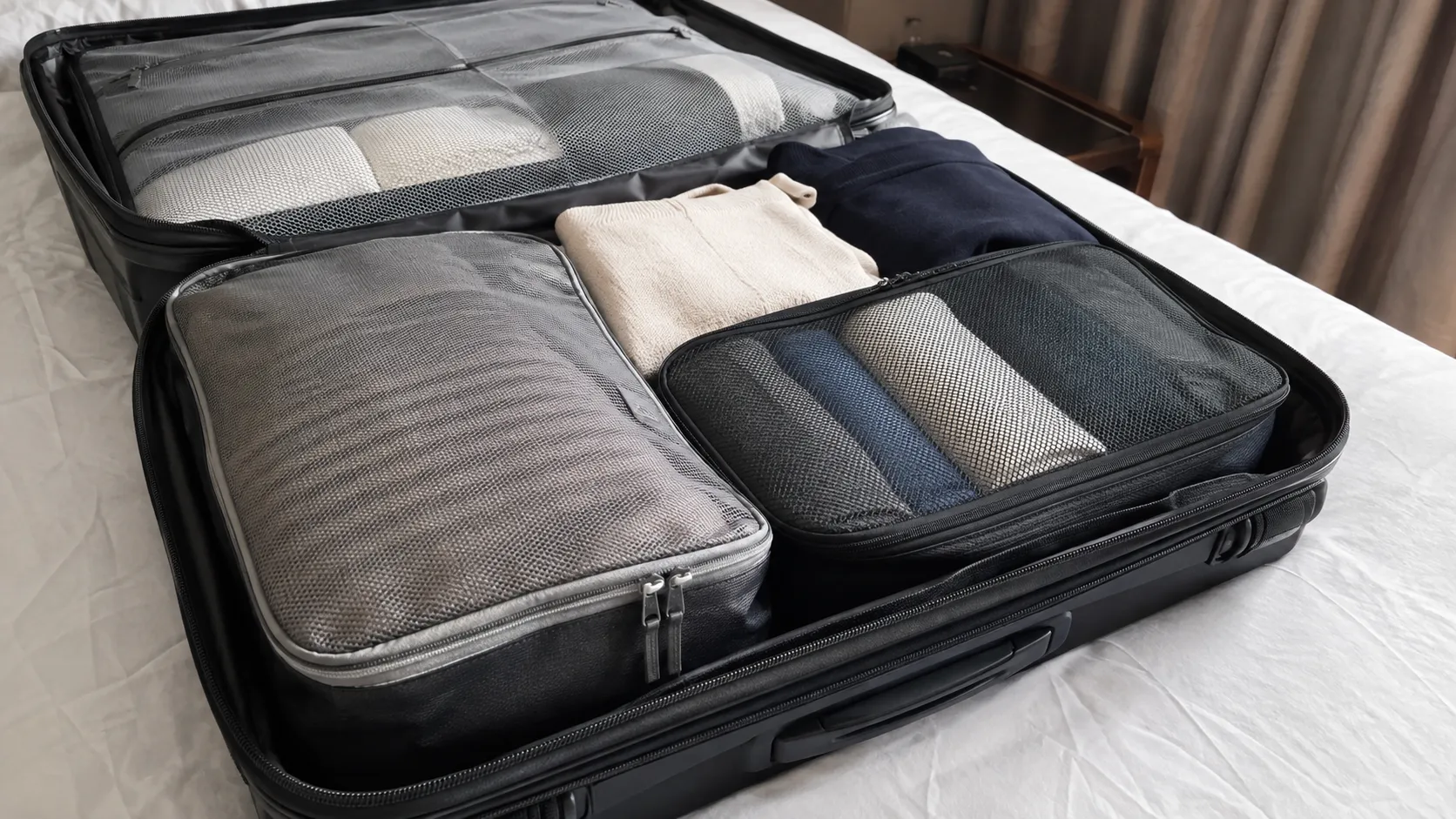
    Medium compression cube:
    T-shirts, trousers and sportswear
    
    Small compression cube:
    Underwear, socks and sleepwear
    
    Regular slim cube:
    Shirts or clothing that should not be tightly compressed

    Thule states that many carry-on bags can accommodate either two medium cubes or a combination of one medium and two small cubes, though the exact fit depends on the luggage model.

    The combination is more flexible than forcing everything into one container.

    The clean-and-dirty problem

    By day four, the original packing system begins to fail.

    Some clothes are clean. Some are worn. Some may be damp.

    Mixing everything in the same cube destroys the organizational benefit.

    Use one of these methods:

    Method A: Empty cube transfer

    Day 1:
    Clean clothing in compression cubes
    
    During trip:
    One empty cube gradually becomes the laundry cube

    Method B: Internal divider

    Some cubes include two compartments so clean and dirty clothing can remain separated while each side expands or contracts as the trip progresses. Peak Design, for example, describes its packing cubes as having an internal divider for clean and dirty clothes together with a compression zipper.

    Method C: Separate lightweight bag

    Carry one simple laundry bag.

    Do not compress wet or heavily soiled clothing together with clean garments.

    When compression cubes are worth buying

    They are worth considering when:

    You travel with carry-on only
    You pack mostly soft clothing
    Your bag is limited by depth
    You take trips longer than four days
    You change accommodation during the trip
    You value organization
    You are willing to weigh the finished bag

    They are less useful when:

    You already pack lightly
    Your checked bag has plenty of space
    Most of your items are shoes or equipment
    You travel mainly with formal clothing
    Your main restriction is weight, not space
    You dislike repacking compressed clothing

    A traveller taking three T-shirts and one pair of trousers does not need a compression system.

    A traveller trying to fit seven days into a small cabin bag may notice a meaningful difference.

    The Fintayo 80% rule

    Do not fill a compression cube completely before closing it.

    Aim for approximately:

    80% of maximum expanded capacity

    Then:

    1. Close the main zipper.
    2. Press the top evenly with one hand.
    3. Pull the compression zipper slowly.
    4. Stop if the zipper begins pulling the fabric.
    5. Redistribute the clothing instead of forcing it.

    A cube packed to 100% may technically close, but the compressed result can become too dense, rounded and difficult to position.

    The objective is not to defeat the zipper.

    The objective is to create a flatter, useful block.

    The most effective hybrid system

    The strongest packing method is not compression alone.

    It is a combination:

    Roll:
    T-shirts, underwear and sportswear
    
    Fold:
    Shirts and trousers that crease
    
    Compress:
    Soft casual clothing
    
    Leave outside cubes:
    Shoes, toiletries and rigid objects
    
    Fill gaps:
    Socks, chargers and small accessories

    This hybrid approach uses the benefit of each system without applying one technique to everything.

    Final scores

    CategoryRegular cubesCompression cubesRolling onlyVacuum bags
    Space efficiency69810
    Organization10956
    Fast access9853
    Easy repacking10863
    Wrinkle control8664
    Weight awareness8684
    Overall score8.58.86.35.0

    The Fintayo takeaway

    Compression packing cubes do work—but not in the way many advertisements imply.

    They do not make clothing weightless.

    They do not increase an airline’s baggage allowance.

    They do not guarantee that every garment will become dramatically thinner.

    What they do well is remove loose air, produce a flatter shape and preserve the organization of a normal packing cube.

    Our verdict:

    Use compression cubes for soft clothing when suitcase space is limited. Use regular cubes when organization and effortless repacking matter more. Use vacuum bags only for genuinely bulky garments.

    For most carry-on travellers, the best setup is not an expensive six-piece set.

    It is:

    One medium compression cube
    One small compression cube
    One lightweight regular cube
    One laundry bag

    That is enough to save useful space without turning packing into an engineering project.

  • eSIM vs Airport SIM: Which option is actually cheaper?

    eSIM vs Airport SIM: Which option is actually cheaper?

    The first mobile-data decision of a trip often happens at the worst possible moment.

    You have just landed, the airport Wi-Fi is unreliable, your accommodation is waiting for a message and you need directions. A kiosk offers a physical tourist SIM, while your phone displays several travel eSIM plans that can be activated immediately.

    The eSIM looks easier.

    The airport SIM may appear to offer more data.

    But neither option is automatically cheaper.

    The real comparison depends on how much data you need, whether you require a local telephone number, how many countries you will visit and whether the advertised package includes activation, taxes, calls and hotspot use.

    What we are actually comparing

    An eSIM is not a separate type of mobile network. It is a digital method of loading a mobile operator profile onto a compatible device instead of inserting a removable plastic card.

    GSMA describes eSIM as a standardized system that allows operator profiles to be downloaded remotely and lets compatible devices store multiple profiles.

    The term travel eSIM can refer to two different products:

    • an eSIM sold directly by a local mobile network
    • an international travel eSIM using partner networks in the destination.

    An airport SIM can also be sold by:

    • the official local operator
    • an authorized retailer
    • an independent airport reseller

    This creates an important distinction:

    The real comparison is not simply digital SIM versus plastic SIM. It is travel reseller versus local operator, data-only plan versus full mobile service, and convenience versus complete value.

    A local operator can sell both a physical SIM and an eSIM. Dubai operator du, for example, currently promotes a tourist eSIM that can be activated digitally after passport verification, including a free introductory 10GB allowance valid for 24 hours.

    The Fintayo comparison method

    To compare the two options fairly, do not look only at the largest data number.

    Use the same travel profile for both offers:

    Trip length: 7–14 days
    Required data: approximately 10GB
    Devices: one smartphone
    Countries visited: one or several
    Calls required: yes or no
    Hotspot required: yes or no

    Then compare:

    Cost factorTravel eSIMAirport or local SIM
    Package priceUsually shown before travelConfirmed at kiosk or operator store
    SIM or activation feeOften includedMay be separate
    Data allowanceFrequently data-onlyOften larger local package
    Local numberNot always includedCommonly included
    Calls and SMSFrequently excludedOften included
    Passport registrationUsually digital or not required by resellerOften completed at point of sale
    Installation timeBefore departure or on arrivalQueue, registration and SIM change
    Multi-country coverageCommonUsually one country
    Hotspot useDepends on providerDepends on tariff
    Top-upApp or websiteOperator app, store or voucher

    The cheapest product is the one that meets the actual requirement without making you buy missing services later.

    Current market examples

    Prices vary constantly, so these examples are a snapshot rather than a universal ranking.

    A multi-country European eSIM

    Orange Travel currently lists a Europe data-only eSIM with 10GB valid for 14 days at $22.99. It also lists a 20GB package with calls and SMS valid for 14 days at $29.99, covering more than 40 European destinations.

    For a traveler visiting several European countries, one regional eSIM can remove the need to purchase a new local package at each border.

    A local tourist SIM in Türkiye

    Turkcell’s official Tourist Welcome Pack currently provides 20GB of data and 200 local minutes, valid for 28 days, at a recommended price of 1,800 Turkish lira. The operator states that the package is available to new prepaid tourist customers through its stores.

    That package provides more than data: it also includes a local mobile line and domestic calling minutes.

    However, a traveler staying for four days and using only maps and messaging may not need a 28-day package. A lower-priced data-only eSIM could still be better value even if it contains fewer gigabytes.

    A local tourist eSIM in the UAE

    The du example shows why “eSIM versus local SIM” is sometimes the wrong question. The local operator itself offers a tourist eSIM, including a free 10GB introductory allowance valid for 24 hours, followed by optional tourist bundles.

    In that situation, the traveler can receive the convenience of an eSIM while still purchasing directly from a destination operator.

    When the travel eSIM is usually cheaper

    A travel eSIM tends to provide better overall value when:

    • the trip is short
    • you need only mobile data
    • you will visit several countries
    • you do not need a local telephone number
    • airport time is limited
    • the physical tourist package contains far more data than you will use
    • the local SIM has a separate registration or activation cost
    • you want to keep your home SIM installed

    Apple and Google both present prepaid travel eSIMs as an option for international travel. Apple notes that an unlocked compatible iPhone can use an eSIM from a local carrier or worldwide provider, while Google recommends prepaid travel eSIMs as a way to avoid conventional roaming charges on compatible Pixel devices.

    Consider a five-day city break.

    The traveler expects to use:

    • navigation
    • restaurant searches
    • messaging
    • occasional social-media uploads
    • airline and transport applications

    A smaller eSIM package may be more rational than paying for 20GB, local calls and 28 days of validity that will never be used.

    The price per gigabyte could be higher, but the total trip cost could still be lower.

    When an airport or local SIM may be the better deal

    A local SIM can offer better value when:

    • the stay is long
    • heavy data use is expected
    • the traveler needs a local telephone number
    • local calls are important
    • hotspot use is required for a laptop or family
    • the local operator offers a generous tourist bundle
    • the device does not support eSIM
    • the phone is carrier-locked
    • in-person technical assistance is valuable

    A telephone number can matter more than travelers expect.

    Accommodation hosts, restaurants, delivery services, hospitals and local transport operators may prefer an ordinary local call. Some online services also require a national number for registration or verification.

    A data-only travel eSIM usually keeps WhatsApp and similar services working with the existing account, but it does not necessarily provide a number that can receive normal local calls or SMS.

    For a month-long stay, the physical local SIM may therefore offer more complete value even when the initial purchase takes longer.

    Airport SIM does not always mean the best local price

    A SIM sold inside an airport may be convenient, but the airport counter is not automatically the cheapest place to buy the operator’s service.

    The product may be:

    • an official tourist package at the normal price
    • a package with an additional activation charge
    • a retailer bundle containing accessories or unnecessary services
    • a different offer from the one advertised on the operator’s website

    Before paying, ask for a complete breakdown:

    SIM price
    Activation or registration fee
    Data allowance
    Validity
    Calls and SMS
    Taxes
    Top-up conditions
    Hotspot restrictions

    Take a photograph of the package description and receipt.

    Do not assume that the largest sign above the kiosk represents the final amount.

    The hidden cost of an eSIM

    Travel eSIMs also have limitations that can make a cheap package poor value.

    The phone must be compatible

    Not every device supports eSIM. Compatibility can also vary by model, country of sale and carrier configuration.

    Apple currently states that international travel eSIM use generally requires an iPhone XS, XS Max, XR or later, a supporting provider and an unlocked device.

    Google states that eSIM availability on Pixel phones depends on the model and mobile carrier.

    Check this before purchasing a non-refundable package.

    The phone may be carrier-locked

    A compatible phone can still reject another operator’s eSIM when it is locked to the home carrier.

    On iPhone, the status can be checked under:

    Settings → General → About → Carrier Lock

    Apple states that an unlocked device should display “No SIM Restrictions.”

    Some plans are data-only

    A cheap eSIM may not include:

    • a telephone number
    • voice calls
    • incoming SMS
    • emergency calling through that line
    • hotspot access
    • unrestricted high-speed data

    “Unlimited” also needs careful reading. A plan can be subject to fair-use rules, speed management or daily hotspot restrictions.

    Installation requires preparation

    Most eSIMs should be installed while a reliable internet connection is available. Apple notes that Wi-Fi or a hotspot is generally required during activation, although limited exceptions exist for certain devices and regions.

    Do not wait until you are standing outside an airport without working internet.

    The hidden cost of a physical airport SIM

    A physical SIM creates costs that do not always appear in the advertised package price:

    • time spent finding the correct kiosk
    • queueing and passport registration
    • removing and storing the home SIM
    • losing access to the normal number on a single-SIM phone
    • sales pressure toward a larger package
    • language misunderstandings
    • difficulty recovering the SIM if it is lost
    • replacing it when traveling to another country

    The plastic card itself is rarely the important cost.

    The real cost is the package, registration process and loss of flexibility.

    Multi-country travel changes the answer

    For one destination, a local package can compete strongly on price and data volume.

    For a multi-country trip, the calculation changes.

    A regional eSIM can connect through partner networks across multiple destinations without requiring a new purchase at each border. Orange Travel’s current European packages, for example, cover more than 40 countries under a single plan.

    A traveler moving from Spain to France and then Italy can keep the same eSIM profile active.

    By contrast, a domestic physical SIM may or may not include affordable roaming outside its home country. Coverage, fair-use conditions and included destinations must be checked individually.

    The cheapest single-country SIM is not necessarily the cheapest solution for the entire itinerary.

    Keeping the home number active

    One of the strongest advantages of an eSIM setup is Dual SIM use.

    A compatible phone can keep:

    • the home line active for calls and verification messages;
    • the travel eSIM selected for mobile data.

    Apple supports using Dual SIM while traveling and lets users assign one line for cellular data and another for calls or messages. It also warns that using two different carriers requires an unlocked device unless both plans belong to the same carrier.

    The safe configuration is:

    SettingHome SIMTravel eSIM
    Line activeYesYes
    Mobile dataOffOn
    Data roamingOff unless coveredAs instructed by provider
    Default callsHome SIMOptional
    Automatic data switchingOffOff

    Keeping the home line active can still create charges for calls or SMS depending on the carrier. The roaming tariff must therefore be checked separately.

    The Fintayo three-part test

    Before buying either option, answer three questions.

    1. What will I actually use?

    Estimate:

    • trip duration
    • expected data
    • number of countries
    • voice-call requirements
    • hotspot usage

    Do not buy 50GB because it looks like better value when you normally use only a few gigabytes per week.

    2. What is the complete price?

    For an airport SIM:

    Package + SIM + activation + taxes

    For an eSIM:

    Package + required calls + possible top-up

    The offers must provide comparable services before their prices can be compared honestly.

    3. What happens when something goes wrong?

    Ask:

    • Is support available?
    • Can the plan be reinstalled?
    • Is the eSIM refundable before activation?
    • Can the airport kiosk replace a faulty SIM?
    • Can the account be topped up online?
    • Does the plan display real-time data usage?

    Saving five euros is not worthwhile if the connection fails when navigation or a boarding pass is needed.

    Our verdict

    For a short trip where the traveler needs only data, a travel eSIM is often the cheaper and more efficient option.

    It can be bought before departure, avoids airport queues, leaves the home SIM in place and can cover several countries under one package.

    For a longer stay, heavy data consumption or a genuine need for a local number and local calls, an official local tourist SIM can provide better total value.

    The winner is not determined by whether the SIM is physical or digital.

    It is determined by four factors:

    Total price, usable data, geographic coverage and the services actually needed.

    The airport SIM wins when the traveler needs a complete local mobile service.

    The travel eSIM wins when the traveler needs fast, flexible internet without paying for benefits that will never be used.

    Important: Prices, coverage, fair-use rules and package availability can change without notice. Verify the current offer, device compatibility and refund terms before purchasing or activating a SIM.