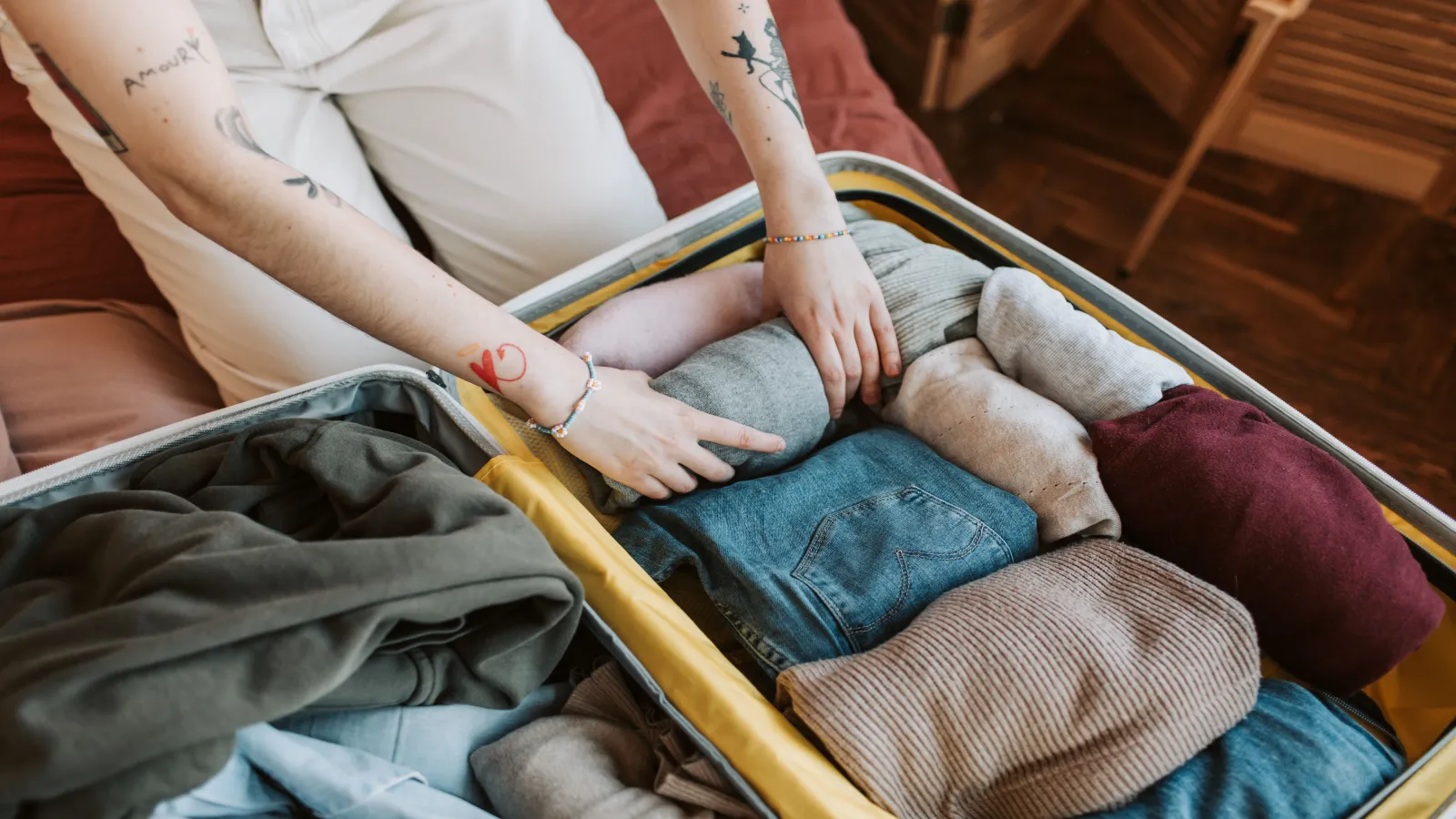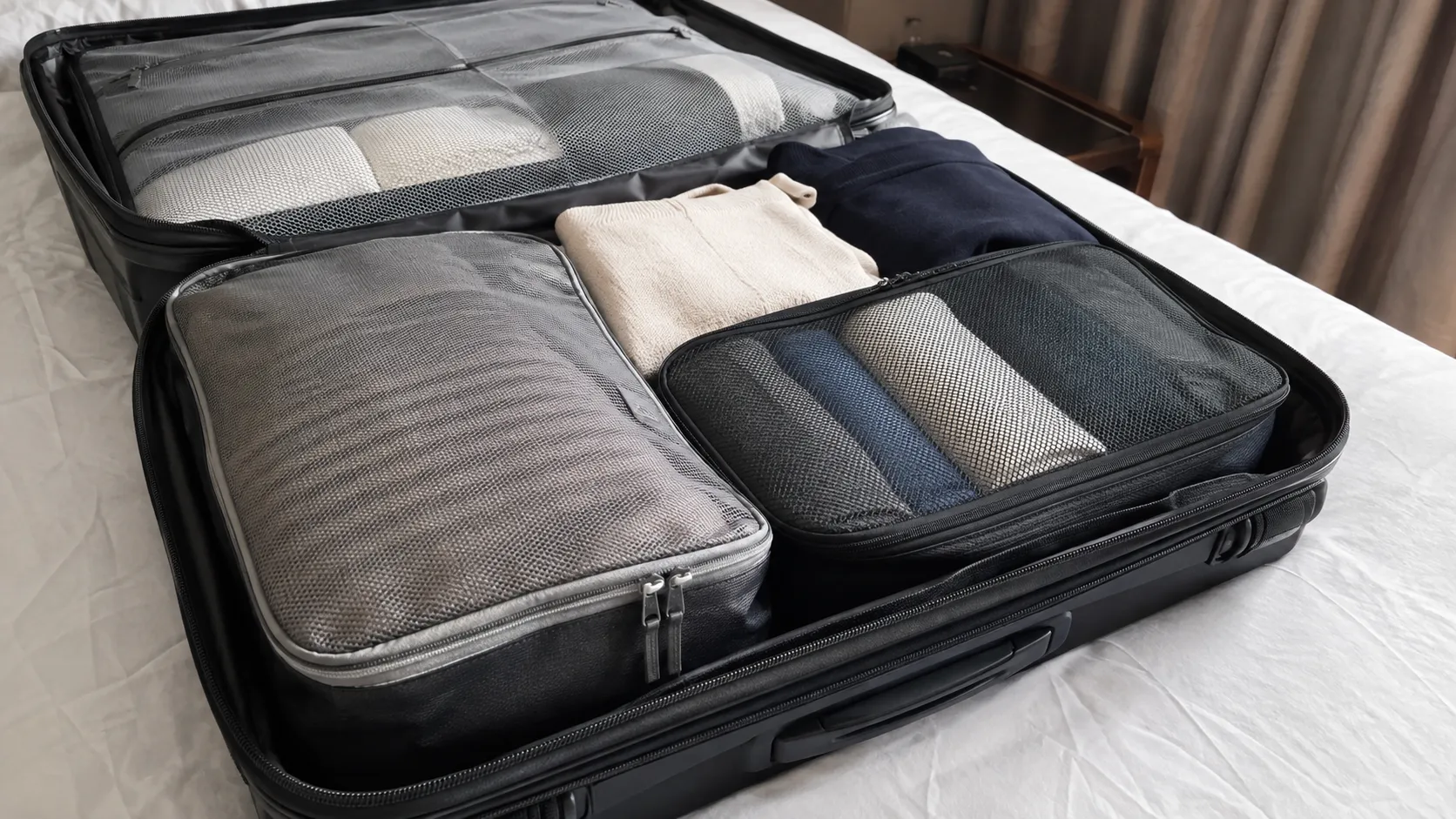
A compression packing cube looks impressive in a demonstration.
You place several shirts inside, close the main zipper, pull a second zipper around the edge and watch the cube become noticeably thinner.
It feels like you have created extra suitcase space.
But three questions remain:
- Does the cube genuinely help you pack more?
- Is it better than an ordinary packing cube?
- Does fitting more clothing into the bag create another problem—too much weight?
For this Fintayo comparison, we evaluated four common systems against the same type of seven-day travel wardrobe:
Compression packing cubes
Regular packing cubes
Rolled clothes without cubes
Vacuum compression bags
The comparison focuses on usable space, organization, weight, wrinkles, accessibility and how difficult the system is to repack during the return journey.
This is a scenario-based product comparison using published specifications and a repeatable packing framework. Exact results will vary according to fabric thickness, suitcase shape and how aggressively each traveller packs.
The quick verdict
| Packing method | Space saving | Organization | Easy to repack | Weight risk | Best use |
|---|---|---|---|---|---|
| Compression cubes | High | Excellent | Good | Medium | Carry-on travel |
| Regular cubes | Low | Excellent | Excellent | Low | Organized trips |
| Rolling without cubes | Medium | Fair | Fair | Low | Travellers spending nothing |
| Vacuum bags | Very high | Fair | Poor | High | Bulky seasonal clothing |
The overall winner is not the method that becomes the smallest.
For most carry-on travellers, compression packing cubes offer the best balance between saving space and keeping the bag organized.
Regular cubes remain better when speed, simple access and easy repacking matter more than maximum compression.
What a regular packing cube actually does
A regular packing cube is primarily an organizer.
It separates clothing into predictable groups:
Cube 1: shirts
Cube 2: underwear and socks
Cube 3: trousers and sportswear
It prevents the contents of the suitcase from collapsing into one pile every time you remove something.
Regular cubes can also improve packing efficiency because they encourage the traveller to use defined rectangular sections of the bag. However, the fabric and zipper do not actively force air out of the clothing.
Eagle Creek’s medium Reveal cube, for example, is listed at approximately 25 × 18 × 8 cm and weighs around 113 g. Its main purpose is visibility, separation and organization rather than mechanical compression.
A regular cube therefore saves space indirectly:
- clothing remains tightly arranged;
- empty corners become easier to identify;
- garments do not spread across the suitcase;
- the traveller is less likely to disturb everything while searching.
But it does not make a thick sweater fundamentally thinner.
What a compression cube changes
A compression cube includes a second zipper or compression mechanism.
The main compartment is filled while expanded. After the first zipper is closed, the secondary zipper pulls the top and bottom sections closer together.
The objective is to remove unused air between garments.
Thule describes its compression zipper as a system that eliminates excess air between clothes. Its small cube expands to approximately 26 × 18 × 11 cm and compresses to a nominal external profile of roughly 25 × 18 × 3 cm; the cube itself weighs around 80 g. Those specifications describe the product’s expanded and compressed structure, not a guaranteed reduction for every load.
The medium version is designed for items such as shirts, trousers and sweaters. Thule recommends rolling clothing before placing it inside.
Eagle Creek uses a similar concept. Its medium Isolate compression cube measures approximately 36 × 25 × 8 cm while expanded and 36 × 25 × 2.5 cm in its nominal compressed configuration, with a listed weight of about 82 g.
Again, that does not mean every 8 cm stack becomes 2.5 cm thick. Clothing resists compression, zippers have limits and overfilling can prevent the compression zipper from closing.
Our seven-day packing scenario
The comparison uses this warm-weather list:
5 T-shirts
2 button-down shirts
2 pairs of lightweight trousers
1 pair of shorts
7 sets of underwear
7 pairs of socks
1 lightweight sweatshirt
1 set of sleepwear
1 gym outfit
Shoes, toiletries, electronics and jackets are excluded because they distort the comparison.
We evaluate each method based on six questions:
How much visible bulk can it remove?
Does the suitcase remain organized?
Can one item be removed without disturbing everything?
How difficult is it to close?
How easy is it to repack?
Does it encourage overpacking?
The purpose is not to create an artificial laboratory percentage.
It is to determine which system works best during an actual trip.
Method 1: Regular packing cubes
The wardrobe is divided into two medium cubes and one smaller cube.
Garments are folded or lightly rolled, but no compression zipper is used.
What works
The bag is extremely easy to organize.
Each cube has one purpose, and the traveller can remove an entire category without unpacking the suitcase.
This is particularly useful when:
- changing hotels frequently;
- sharing luggage with another person;
- staying in small rooms;
- using a backpack that opens from the top;
- separating clean and worn clothing.
The cubes also act like removable drawers. They can be placed directly into a wardrobe or hotel shelf.
What does not work
The cubes can preserve air instead of removing it.
A cube filled with neatly folded shirts may look organized while still containing unused space between garments.
Regular cubes also add their own fabric, zippers and seams. Three cubes may weigh several hundred grams in total depending on the model.
Tested verdict
Space: 6/10
Organization: 10/10
Repacking: 10/10
Accessibility: 9/10
Value: 8/10
Regular cubes are the best choice for travellers who already fit comfortably within their luggage allowance.
They improve the trip more than they improve the raw capacity of the suitcase.
Method 2: Compression packing cubes
The same clothing is rolled or folded into compression cubes.
The primary zipper closes the compartment. The secondary zipper is then pulled slowly around the cube while the traveller presses down evenly.
What works
Soft clothing becomes more compact.
Compression is most effective with:
- T-shirts;
- underwear;
- socks;
- sportswear;
- lightweight knitwear;
- soft trousers;
- packable jackets.
The compression cube produces a flatter, more stable block than loose rolled clothing.
That shape matters.
A suitcase does not only have a total volume. It has a fixed depth. A cube that becomes several centimetres thinner may allow another layer to fit above it.
Compression cubes retain most of the organizational benefits of regular cubes while reducing bulk. REI’s travel guidance also distinguishes compression organizers as tools that can help reduce packed volume, particularly for soft items.
What does not work
The zipper becomes difficult to close when the cube is overfilled.
Pulling harder is not a packing strategy. It is a way to damage the zipper.
Compression can also push clothing toward the centre of the cube, creating a dense rounded shape instead of a perfectly flat rectangle.
Thicker garments may develop deeper creases. A carefully folded shirt can emerge more wrinkled after being compressed under several other items.
The biggest risk is behavioural:
Extra space encourages extra packing.
The cube reduces volume, not mass.
A sweatshirt weighing 600 g still weighs 600 g after compression.
REI specifically cautions that compression systems can make it easier to add more items and accidentally create an overweight bag.
Tested verdict
Space: 9/10
Organization: 9/10
Repacking: 8/10
Accessibility: 8/10
Value: 9/10
Compression cubes are the best overall solution for a traveller trying to fit a seven-day wardrobe into a carry-on.
They save usable depth without turning the suitcase into an unstructured compressed bundle.
Method 3: Rolling without cubes
Rolling is the zero-cost option.
Every garment is rolled individually and placed directly into the suitcase.
REI notes that rolling and packing cubes can be used together, but rolling alone remains a common way to fill gaps and reduce loose folds.
What works
Rolled clothing fits into narrow spaces.
Socks can be placed inside shoes. T-shirts can fill the channel between the suitcase frame and its central compartment.
The method adds no weight and requires no purchase.
Rolling works particularly well for:
- casual shirts;
- leggings;
- underwear;
- gym clothing;
- lightweight trousers.
What does not work
The suitcase loses structure.
Remove three items and the remaining rolls can move, unfold or sink into the empty space.
Finding one specific black T-shirt among several tightly rolled black garments is less convenient than opening a labeled cube.
Rolling also creates a false sense that every gap must be filled. The traveller may use the last available corner even when the bag is already near its weight limit.
Tested verdict
Space: 8/10
Organization: 5/10
Repacking: 6/10
Accessibility: 5/10
Value: 10/10
Rolling is the best budget method.
It can compete surprisingly well with regular packing cubes for raw space, but it cannot match their organization.
Method 4: Vacuum compression bags
Vacuum bags remove air through a valve or by rolling air out of the bag.
They can dramatically reduce the visible size of:
- winter jackets;
- thick sweaters;
- fleece garments;
- blankets;
- soft children’s clothing.
What works
No other method reduces bulky, air-filled clothing as aggressively.
For a winter trip, compressing two sweaters and a down jacket can create significant additional room.
The bag also separates clothing from moisture and dirty items.
What does not work
Vacuum bags can turn clothing into a rigid, uneven slab.
That slab does not always fit the contours of a suitcase as efficiently as expected.
They also create three operational problems:
- You need to recompress the bag for the return trip.
- The plastic can tear or lose its seal.
- The reduced volume makes it easy to exceed the weight allowance.
A vacuum bag is particularly inconvenient during a multi-city trip. Opening the bag for one sweater may require recompressing the entire load.
Tested verdict
Space: 10/10
Organization: 6/10
Repacking: 3/10
Accessibility: 3/10
Value: 7/10
Vacuum bags win the maximum-compression category.
They lose the practical travel category.
For ordinary summer clothing, they are usually more trouble than they are worth.
The biggest myth: “Compression creates more luggage allowance”
It does not.
Airlines measure luggage using dimensions, weight or both. The specific allowance can vary by airline, cabin, route and aircraft, so IATA advises passengers to verify the operating airline’s individual rules.
Consider this example:
Carry-on weight limit: 8 kg
Bag weight: 2.6 kg
Clothing and toiletries: 5.1 kg
Total: 7.7 kg
You have only:
300 g remainingCompression may create room for another pair of shoes weighing 700 g.
The suitcase will close.
It may still be overweight.
The correct order is:
1. Pack
2. Compress
3. Weigh
4. Remove items if necessary
Never assume that a bag is compliant simply because the zipper closes.
What should go inside a compression cube
Compression works best when the contents are soft and reasonably uniform.
Good candidates
T-shirts
Underwear
Socks
Sportswear
Soft trousers
Swimwear
Pyjamas
Lightweight sweaters
Poor candidates
Shoes
Belts with hard buckles
Electronics
Toiletries
Structured jackets
Bras with rigid cups
Formal shirts that crease easily
Fragile items
Hard objects can create pressure points and make the compression zipper harder to close.
They also prevent the cube from forming a flat shape.
Do compression cubes wrinkle clothes?
They can.
The level of wrinkling depends on three factors:
- fabric;
- folding method;
- compression pressure.
Technical and synthetic fabrics usually tolerate compression better than cotton dress shirts or linen.
For a shirt that needs to look presentable:
Button it
Fold the sleeves inward
Create one flat rectangle
Place it at the top of the cube
Do not compress the cube to its absolute limit
For formal clothing, a garment folder or conventional flat packing method is usually safer. REI recommends packing folders for clothing that should remain pressed.
One large cube or several smaller cubes?
Several smaller cubes generally work better.
A single large compressed block has three disadvantages:
- it is difficult to fit around shoes and toiletries;
- opening it exposes the entire wardrobe;
- uneven clothing creates an unstable shape.
A practical carry-on system is:
Medium compression cube:
T-shirts, trousers and sportswear

Small compression cube:
Underwear, socks and sleepwear

Regular slim cube:
Shirts or clothing that should not be tightly compressed
Thule states that many carry-on bags can accommodate either two medium cubes or a combination of one medium and two small cubes, though the exact fit depends on the luggage model.
The combination is more flexible than forcing everything into one container.
The clean-and-dirty problem
By day four, the original packing system begins to fail.
Some clothes are clean. Some are worn. Some may be damp.
Mixing everything in the same cube destroys the organizational benefit.
Use one of these methods:
Method A: Empty cube transfer
Day 1:
Clean clothing in compression cubes

During trip:
One empty cube gradually becomes the laundry cube
Method B: Internal divider
Some cubes include two compartments so clean and dirty clothing can remain separated while each side expands or contracts as the trip progresses. Peak Design, for example, describes its packing cubes as having an internal divider for clean and dirty clothes together with a compression zipper.
Method C: Separate lightweight bag
Carry one simple laundry bag.
Do not compress wet or heavily soiled clothing together with clean garments.
When compression cubes are worth buying
They are worth considering when:
You travel with carry-on only
You pack mostly soft clothing
Your bag is limited by depth
You take trips longer than four days
You change accommodation during the trip
You value organization
You are willing to weigh the finished bag
They are less useful when:
You already pack lightly
Your checked bag has plenty of space
Most of your items are shoes or equipment
You travel mainly with formal clothing
Your main restriction is weight, not space
You dislike repacking compressed clothing
A traveller taking three T-shirts and one pair of trousers does not need a compression system.
A traveller trying to fit seven days into a small cabin bag may notice a meaningful difference.
The Fintayo 80% rule
Do not fill a compression cube completely before closing it.
Aim for approximately:
80% of maximum expanded capacityThen:
- Close the main zipper.
- Press the top evenly with one hand.
- Pull the compression zipper slowly.
- Stop if the zipper begins pulling the fabric.
- Redistribute the clothing instead of forcing it.
A cube packed to 100% may technically close, but the compressed result can become too dense, rounded and difficult to position.
The objective is not to defeat the zipper.
The objective is to create a flatter, useful block.
The most effective hybrid system
The strongest packing method is not compression alone.
It is a combination:
Roll:
T-shirts, underwear and sportswear

Fold:
Shirts and trousers that crease

Compress:
Soft casual clothing

Leave outside cubes:
Shoes, toiletries and rigid objects

Fill gaps:
Socks, chargers and small accessories
This hybrid approach uses the benefit of each system without applying one technique to everything.
Final scores
| Category | Regular cubes | Compression cubes | Rolling only | Vacuum bags |
|---|---|---|---|---|
| Space efficiency | 6 | 9 | 8 | 10 |
| Organization | 10 | 9 | 5 | 6 |
| Fast access | 9 | 8 | 5 | 3 |
| Easy repacking | 10 | 8 | 6 | 3 |
| Wrinkle control | 8 | 6 | 6 | 4 |
| Weight awareness | 8 | 6 | 8 | 4 |
| Overall score | 8.5 | 8.8 | 6.3 | 5.0 |
The Fintayo takeaway
Compression packing cubes do work—but not in the way many advertisements imply.
They do not make clothing weightless.
They do not increase an airline’s baggage allowance.
They do not guarantee that every garment will become dramatically thinner.
What they do well is remove loose air, produce a flatter shape and preserve the organization of a normal packing cube.
Our verdict:
Use compression cubes for soft clothing when suitcase space is limited. Use regular cubes when organization and effortless repacking matter more. Use vacuum bags only for genuinely bulky garments.
For most carry-on travellers, the best setup is not an expensive six-piece set.
It is:
One medium compression cube
One small compression cube
One lightweight regular cube
One laundry bag
That is enough to save useful space without turning packing into an engineering project.