Tag: cheap flights

  • Points, miles and Lie-flat smiles: How to fly business class for less

    Points, miles and Lie-flat smiles: How to fly business class for less

    A business-class ticket may appear on the airline’s website for €2,800.

    The same seat may also be available for:

    85,000 miles
    + airport taxes
    + airline charges

    Or it may become available through an upgrade from a paid Economy ticket.

    Or through a monthly award promotion.

    Or as a last-minute upgrade offer after check-in opens.

    The passenger in seat 4A and the passenger in seat 4B may therefore receive almost the same bed, meal, lounge access and priority treatment while paying completely different amounts.

    That is the central idea behind points and miles:

    Business Class has more than one price.

    The objective is not simply to collect as many miles as possible. It is to understand which type of ticket you are buying, what your miles are replacing and whether the redemption is genuinely better than paying cash.

    This guide explains how that system works, with particular attention to Turkish Airlines Miles&Smiles and practical options available to travellers in Europe and the Balkans.

    First, understand the four currencies

    A frequent-flyer account may display several balances, but they do not all perform the same function.

    The four currencies that matter are:

    1. Redeemable miles
    2. Status miles or status points
    3. Cash
    4. Flexibility

    Redeemable miles can normally be used for award flights, upgrades or other rewards.

    Status miles or status points usually determine whether you receive benefits such as lounge access, priority check-in, additional baggage and elite status. They are generally not a spendable currency.

    In Turkish Airlines Miles&Smiles, ordinary Miles can be redeemed for tickets, upgrades, Cash&Miles and other services. Status Miles are used to reach or maintain Classic Plus, Elite and Elite Plus status and cannot be spent on an award ticket. Ordinary Miles are generally valid for three years.

    Flexibility is also a currency.

    A passenger who can:

    • travel one day earlier
    • return from another airport
    • accept one connection
    • book one passenger instead of four
    • travel outside school holidays

    has a much better chance of finding a low-mileage Business Class seat.

    Points cannot create award availability that does not exist.

    The business-class price equation

    Before using miles, record four numbers:

    Comparable cash ticket
    – cash charges on the award
    = value replaced by miles

    Then divide that amount by the miles required:

    Value per mile =
    (cash fare – award taxes and charges) ÷ miles used

    Consider an illustrative example:

    Comparable Business Class fare: €2,350
    Award price: 85,000 miles + €310
    Cash value replaced: €2,040

    Calculation:

    €2,040 ÷ 85,000 = €0.024

    The redemption produces approximately:

    2.4 euro cents per mile

    That can represent strong value.

    Now consider a different use:

    Cash Economy ticket: €260
    Cash&Miles discount: €45
    Miles required: 9,000

    Calculation:

    €45 ÷ 9,000 = €0.005

    That is only:

    0.5 euro cents per mile

    Both transactions reduce the amount paid today.

    But they do not produce equal value.

    The five routes into Business Class

    There are five common ways to reach the front cabin without paying the original Business Class fare.

    MethodWhat you buyMain advantageMain risk
    Award ticketBusiness seat with milesOften the highest valueLimited availability
    Partner awardAnother airline through an allianceMore routes and productsComplex search and fees
    Mileage upgradeEconomy or Premium ticket plus milesRetain a paid ticketFare may not be eligible
    Cash upgradeFixed offer or upgrade bidNo large mileage balance neededPrice and availability uncertain
    Cash and milesPart cash, part milesEasy use of a small balanceFrequently weaker redemption value

    The cheapest method varies by flight.

    The mistake is choosing the method before checking all available prices.

    Miles&Smiles: the important distinction between promotional and regular awards

    Turkish Airlines divides its own award tickets into two broad categories:

    Promotion Award Ticket
    Award Ticket

    Promotion awards use fewer miles, but only a defined allocation of seats is available.

    Regular awards require more miles, but Turkish Airlines states that they can be issued as long as a seat is available for sale on the flight, subject to the program’s rules and restrictions.

    That difference can be enormous.

    For a one-way Turkish Airlines journey between Türkiye and North America, the published table lists:

    Ticket typeEconomyBusiness
    Promotion award40,000 miles65,000 miles
    Regular award55,000 miles135,000 miles

    The regular Business Class award costs more than twice as many miles as the promotional seat.

    The correct question is therefore not:

    Does Turkish Airlines have Business Class seats?

    It is:

    Does Turkish Airlines have a Business Class seat available in the lower award category?

    The aircraft may show several empty Business Class seats for sale, while the lower promotional award category shows none.

    Cash availability and award availability are not the same inventory.

    A useful Miles&Smiles example for Balkan travellers

    Miles&Smiles classifies North Macedonia, Albania, Serbia, Croatia, Greece, Bulgaria, Bosnia and several neighbouring markets as Europe 1.

    On its Star Alliance award table, a one-way Business Class journey between Europe 1 and North America is listed at 85,000 miles. The same chart lists 50,000 miles in Economy.

    That creates a potential comparison such as:

    Business cash fare: €2,400
    Business award: 85,000 miles + €320
    Economy cash fare: €650

    A traveller with 85,000 miles should not automatically compare the award against the €650 Economy ticket.

    The correct comparison depends on what the traveller would realistically have bought.

    Comparison A: You would otherwise buy Business Class

    €2,400 – €320 = €2,080 value replaced
    
    €2,080 ÷ 85,000 = 2.45 cents per mile

    Comparison B: You would otherwise buy Economy

    The points may still create an excellent experience, but describing them as a €2,080 saving would be misleading if you were never prepared to spend €2,400.

    Your real personal cost comparison is:

    Economy alternative: €650
    Award cash charges: €320
    Additional cash saved: €330
    Miles used: 85,000

    The miles bought comfort, sleep, lounge access and a premium experience.

    They did not necessarily save €2,080 from your actual travel budget.

    That distinction prevents points collectors from exaggerating their savings.

    Why an award ticket is often better than an upgrade

    Many beginners assume the cheapest strategy is:

    Buy the cheapest Economy ticket
    + use miles to upgrade

    That often fails.

    Mileage upgrades may only be permitted from specific, usually more expensive, booking classes.

    For Star Alliance upgrades through Miles&Smiles, Turkish Airlines states that only certain fare classes qualify. On Turkish Airlines flights, its published table identifies Economy classes Y and B as eligible for an Economy-to-Business Star Alliance upgrade.

    A deeply discounted Economy ticket may be booked in a class such as:

    L
    V
    W
    P
    U

    depending on the airline and route.

    The ticket may be perfectly valid for travel but completely ineligible for a mileage upgrade.

    The traveller then discovers that:

    Cheap Economy ticket: €520
    Eligible flexible Economy ticket: €1,480
    Business award ticket: 85,000 miles + €320
    Business cash ticket: €2,300

    Buying the expensive Economy fare only to upgrade it may require:

    €1,480
    + upgrade miles
    + upgrade availability

    A direct Business Class award could be the more rational option.

    Always confirm the booking class before purchasing a ticket intended for an upgrade.

    Turkish Airlines mileage upgrades are not one universal price

    The published Miles&Smiles upgrade table lists different requirements by region.

    For Turkish Airlines-operated travel from Türkiye, examples include:

    Destination regionEconomy to Business
    Europe 120,000 miles
    Europe 225,000 miles
    Middle East28,000 miles
    Far East65,000 miles
    North America, 72+ hours before departure65,000 miles
    North America, within 72 hours90,000 miles

    The figures apply one way, and the upgrade is subject to eligibility and availability.

    This leads to an important calculation.

    Suppose you have two options:

    Option 1 — Business award

    65,000 miles + €300

    Option 2 — paid Economy plus mileage upgrade

    Eligible Economy fare: €1,250
    Upgrade: 65,000 miles

    The upgrade uses the same number of miles while requiring an additional €950 in cash.

    The paid ticket may provide greater flexibility or mileage earning, but it is not automatically the cheaper option.

    Search the direct Business award before buying an upgradeable Economy fare.

    Cash&Miles: useful, but measure the conversion

    Turkish Airlines Cash&Miles allows members to purchase a normal paid ticket using a mixture of miles and a bank card.

    Up to 50% of the ticket price excluding taxes can be covered with miles. Cash&Miles tickets remain subject to the normal fare rules, and the passenger can still earn miles according to the purchased ticket. The method is limited to eligible Turkish Airlines bookings made through its website or app and does not apply to codeshare or partner flights.

    This can be useful when:

    • you do not have enough miles for an award
    • no award seat is available
    • your miles are approaching expiry
    • the cash discount is valuable to your immediate budget
    • you still want the normal paid-ticket conditions

    But always calculate the value offered.

    Example:

    Ticket price excluding taxes: €800
    Miles requested: 40,000
    Cash discount: €200

    Value per mile:

    €200 ÷ 40,000 = €0.005

    That equals 0.5 cents per mile.

    Another redemption may offer:

    €1,700 of Business Class value
    ÷ 65,000 miles
    = 2.6 cents per mile

    Cash&Miles is convenient.

    Convenience and maximum value are not always the same objective.

    Tax&Smiles can reduce the cash bill

    Award tickets are not normally free.

    Taxes, airport charges and other statutory costs may still be payable. Turkish Airlines also states that additional charges can arise when Miles&Smiles award tickets are issued.

    Tax&Smiles allows members to use miles toward taxes on eligible Turkish Airlines award tickets. It is available to Miles&Smiles members but is limited to Turkish Airlines-operated flights.

    Before selecting it, calculate the conversion rate.

    Example:

    Taxes payable: €280
    Tax&Smiles price: 35,000 miles

    Value:

    €280 ÷ 35,000 = €0.008

    That is 0.8 cents per mile.

    Paying the €280 in cash and retaining the miles for a future Business Class award may produce greater value.

    Tax&Smiles is most attractive when preserving cash is more important than maximizing theoretical mileage value.

    The partner-airline advantage

    One frequent-flyer program can often book flights operated by many airlines.

    Miles&Smiles can be redeemed for Turkish Airlines, Star Alliance members and certain other partners. Turkish Airlines also permits one-way partner awards, subject to award space and program restrictions.

    This matters because the best Business Class product may be operated by an airline other than the program whose miles you hold.

    For example, Star Alliance includes airlines whose flights may be searchable through Miles&Smiles. The exact operating airline, eligible routing and award space determine whether a booking is possible.

    The smart sequence is:

    1. Search the route
    2. Identify the operating airline
    3. Find Business award space
    4. Confirm the mileage price
    5. Confirm taxes and surcharges
    6. Only then transfer or purchase points

    Do not transfer a large points balance based solely on the belief that an airline flies the route.

    The flight may exist while the award seat does not.

    Other programs worth monitoring

    Miles&Smiles is not automatically the best program for every route.

    Flying Blue

    Flying Blue, the program used by Air France and KLM, publishes new Promo Rewards on the first day of each month. These can reduce the usual mileage requirement by up to 25%, subject to availability and the listed destinations. Mileage prices otherwise vary according to destination and travel dates.

    Flying Blue can be attractive when:

    • you can connect through Amsterdam or Paris
    • your destination appears in Promo Rewards
    • your dates are flexible
    • you need a one-way ticket
    • you can compare several departure cities

    The risk is waiting too long for the perfect low price while the available seats disappear.

    Miles & More

    Miles & More offers monthly mileage bargains with savings of up to 50% on selected airlines and routes, including Business Class.

    However, these discounted awards generally have limited availability, taxes and surcharges are charged separately, and mileage-bargain tickets cannot be rebooked or cancelled. They usually require an outbound and return journey on the same airline.

    This can provide excellent mileage value for a traveller with fixed plans.

    It is much less attractive for someone whose travel dates may change.

    Avios

    British Airways permits Avios redemptions on British Airways, Iberia, American Airlines and other oneworld partners.

    For British Airways flights to or from Heathrow and Gatwick, the airline states that it releases at least four Business Class reward seats per flight. Avios part payment can also reduce the cash price using as little as 1,000 Avios.

    The principal caution is the cash component.

    A low Avios requirement can still be paired with substantial taxes, fees and carrier charges. Always compare the total cash-and-points cost rather than the points number alone.

    Quick comparison

    ProgramUseful featureMajor caution
    Miles&SmilesRegional award tables and Star Alliance accessPromo seats are limited; miles generally expire after three years
    Flying BlueMonthly Promo Rewards up to 25% offDynamic mileage pricing
    Miles & MoreMileage bargains up to 50% offTaxes extra and discounted awards may be non-refundable
    AviosGuaranteed minimum BA reward inventory on key London routesCash charges can materially affect value

    The best program is the one that offers an available seat on the route you actually need.

    A theoretically valuable program with no usable award space has zero practical value for that trip.

    Cash upgrade offers can beat miles

    Some airlines sell upgrades after the original ticket has been purchased.

    Lufthansa, for example, allows eligible passengers to submit an upgrade bid. A passenger chooses the amount they are willing to pay, and Lufthansa later confirms whether the offer has been accepted. Eligibility is shown inside the booking, and acceptance is not guaranteed.

    KLM also sells eligible last-minute upgrades to Premium Comfort or Business Class, including during online check-in. Availability depends on the flight and remaining seats.

    A rational upgrade comparison might look like this:

    Original Economy ticket: €540
    Cash upgrade offer: €620
    Total: €1,160

    Compared with:

    Business Class cash fare: €2,400

    The €620 upgrade may be attractive.

    But compare it with an award:

    Business award: 65,000 miles + €300

    Your choice depends on the value you place on the miles and the cash you have available.

    Do not confuse European Business Class with long-haul Business Class

    Before spending miles, examine the actual product.

    A Business Class ticket can describe very different experiences:

    Short-haul aircraft:
    Standard seat
    Blocked middle seat
    Priority services
    Meal
    Lounge access
    
    Long-haul aircraft:
    Wide seat or suite
    Fully flat or angled bed
    Direct aisle access on some aircraft
    Larger entertainment screen
    Multi-course meal

    Check:

    • operating airline
    • aircraft type
    • seat map
    • whether the long segment is actually in Business
    • whether any connection is in Economy
    • lounge access rules
    • baggage allowance

    Do not redeem 85,000 miles based only on the word “Business.”

    The flight duration and seat product determine much of the real value.

    Mixed-cabin awards require special attention

    A search result may display:

    Business Class

    But the itinerary may contain:

    Skopje → Istanbul: Economy
    Istanbul → New York: Business

    That can still be a good redemption because the long sector is in Business.

    A less attractive result might be:

    Skopje → Istanbul: Business
    Istanbul → New York: Economy

    The itinerary carries a Business label, but the most important eight- or ten-hour flight remains in Economy.

    Open every segment before paying.

    Also verify whether the program charges the full Business mileage price when only part of the itinerary is in the premium cabin. Miles&Smiles states that certain mixed-cabin one-way awards can be priced according to the higher cabin.

    Miles have an expiry date and rules can change

    Miles are not a savings account.

    Miles&Smiles states that its ordinary Miles are valid for three years. The program also announced that its feature for reactivating miles that had already expired was discontinued from January 1, 2026, while an extension option for miles approaching expiry remained available.

    Award charts, partner relationships and mileage requirements can also change.

    The strategy should therefore be:

    Earn with a realistic trip in mind
    Search regularly
    Redeem when a strong opportunity appears
    Do not hoard indefinitely

    A balance of 200,000 miles feels impressive.

    Two confirmed Business Class tickets are more useful.

    The seven most expensive mileage mistakes

    1. Transferring before finding a seat

    Search first. Transfer second.

    2. Buying miles because they are “on sale”

    A discount does not guarantee a profitable redemption.

    Calculate:

    Cost of purchased miles
    + award taxes
    + booking fees

    Then compare the total with the cash fare.

    3. Comparing an award with a fare you would never buy

    A €5,000 retail price does not mean you personally saved €5,000.

    4. Ignoring surcharges

    An award requiring 60,000 miles plus €700 may be less attractive than another requiring 80,000 miles plus €120.

    5. Buying the cheapest Economy ticket before checking upgrade eligibility

    The lowest fare class may not be upgradeable.

    6. Spending miles on low-value products

    Merchandise, small cash discounts and part payments may produce lower value than premium-cabin awards.

    7. Booking the cabin instead of the seat

    Check the actual aircraft and the longest segment.

    The Fintayo Business Class search system

    Use this process before spending any points.

    Step 1: Record the cash prices

    Economy:
    Premium Economy:
    Business:

    Step 2: Search one-way journeys separately

    Sometimes the cheapest strategy is:

    Outbound: Miles&Smiles
    Return: Flying Blue

    or:

    Outbound: Business award
    Return: paid Economy

    Step 3: Test nearby airports

    Search:

    Departure airport
    Nearby regional airports
    Destination airport
    Alternative destination airports

    Add ground transport before declaring an option cheaper.

    Step 4: Search several programs

    Check programs connected to the airlines operating the route.

    Step 5: Record the full award cost

    Miles:
    Taxes:
    Carrier charges:
    Booking fee:
    Change fee:
    Cancellation fee:

    Step 6: Verify every segment

    Aircraft:
    Cabin:
    Seat type:
    Operating airline:
    Connection duration:

    Step 7: Calculate value per mile

    Comparable cash fare
    – award cash payment
    ÷ miles required

    Step 8: Consider your real alternative

    Would you otherwise buy:

    Business
    Premium Economy
    Economy
    Or not travel?

    Step 9: Confirm cancellation conditions

    Miles&Smiles currently publishes an international award change or refund transaction charge of USD 70, with higher charges applying after a no-show. Rules can change, so check them again before ticketing.

    Step 10: Transfer only when ready to book

    Confirm:

    Seat available
    Passenger name correct
    Miles price confirmed
    Cash charges accepted
    Travel documents valid

    Then complete the transfer or redemption.

    Copy-and-paste comparison sheet

    ROUTE:
    [Origin] → [Destination]
    
    TRAVEL DATES:
    [Dates]
    
    PASSENGERS:
    [Number]
    
    ================================
    CASH OPTIONS
    ================================
    
    Economy:
    Premium Economy:
    Business:
    
    ================================
    AWARD OPTION 1
    ================================
    
    Program:
    Operating airline:
    Cabin:
    Miles:
    Taxes and fees:
    Total cash payment:
    Change fee:
    Cancellation fee:
    Seat type:
    Award availability confirmed:
    Value per mile:
    
    ================================
    AWARD OPTION 2
    ================================
    
    Program:
    Operating airline:
    Cabin:
    Miles:
    Taxes and fees:
    Total cash payment:
    Change fee:
    Cancellation fee:
    Seat type:
    Award availability confirmed:
    Value per mile:
    
    ================================
    UPGRADE OPTION
    ================================
    
    Original ticket price:
    Fare class:
    Upgrade eligibility confirmed:
    Miles required:
    Cash upgrade price:
    Upgrade availability:
    Total final cost:
    
    ================================
    FINAL DECISION
    ================================
    
    Best cash option:
    Best award option:
    Best upgrade option:
    Miles balance after booking:
    Reason for selection:

    The Fintayo takeaway

    Flying Business Class for less is not based on one secret website or one magical credit card.

    It is a sequence:

    Find the seat
    Identify the program
    Check the real cash charges
    Calculate the value
    Confirm the cabin
    Only then spend the miles

    Miles&Smiles can provide valuable Business Class awards, particularly when the lower promotional category is available. Flying Blue can reduce mileage prices through monthly promotions. Miles & More can offer deep mileage discounts, while Avios can provide predictable access to British Airways reward inventory.

    But no program wins every search.

    The smartest traveller does not remain loyal to a logo.

    The smartest traveller remains loyal to the calculation.

    Because a Business Class seat does not have one price.

    It has the price paid by the passenger who stopped searching-and the price paid by the passenger who understood the system.

  • Why tuesday is not always the cheapest day to book flights

    Why tuesday is not always the cheapest day to book flights

    You find a flight for €219 on Sunday evening.

    It fits your schedule, the departure time is reasonable and the price is within your budget. But instead of booking, you remember a piece of travel advice repeated across social media:

    Never buy a flight on Sunday. Wait until Tuesday.

    So you wait.

    Tuesday arrives. The same flight now costs €267.

    The problem was not that you searched incorrectly. The problem was that you followed a rule that sounds precise but is far less reliable than it appears.

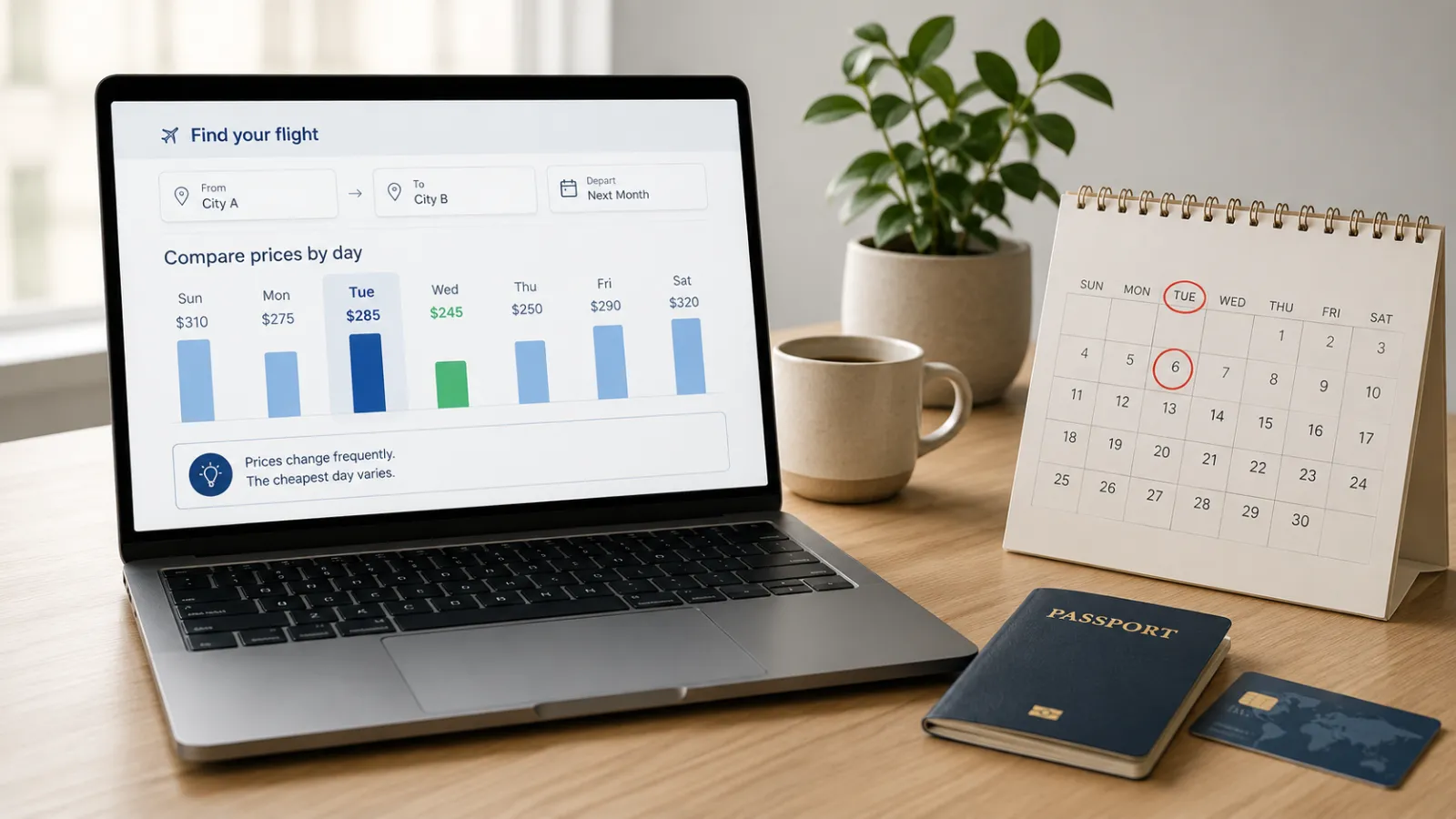
    Tuesday can sometimes be a cheaper booking day. But it is not a universal airfare shortcut, and waiting for a particular weekday can cost more than it saves.

    The Tuesday rule is based on an average, not your flight

    When travel companies analyse millions of bookings, they may find that tickets purchased on one weekday were slightly cheaper on average.

    That does not mean every flight becomes cheaper on that day.

    Google’s 2025 analysis of four years of aggregated Google Flights data found that Tuesday had historically been the cheapest day to book for trips departing from US airports. However, the difference between Tuesday and Sunday—the most expensive booking day in that dataset—was only 1.3%.

    On a €250 ticket, 1.3% is:

    €250 × 1.3% = €3.25

    That possible saving is smaller than a routine fare increase of €20, €40 or €80 while you wait.

    More importantly, another large dataset produced a different answer. Expedia’s 2026 US Air Hacks Report identified Friday as the cheapest overall day to book, although the average difference from Sunday was only 3%. For domestic US tickets in that report, Saturday was the cheapest booking day.

    Different markets produced different results again. Expedia’s 2026 Australian report identified Thursday as the cheapest booking day in its local dataset.

    The correct conclusion is not that Tuesday, Friday, Thursday or Saturday always wins.

    The correct conclusion is:

    There is no single cheapest booking day that applies to every route, country, airline and travel period.

    Why major reports give different answers

    The reports are not necessarily contradicting each other. They are measuring different things.

    Google’s 2025 findings were based on round-trip fares observed through Google Flights for trips departing from thousands of US markets between January 2021 and August 2025. Expedia’s 2026 US figures were based on bookings made through Expedia during a different 12-month period.

    The results can change because of:

    • the country of departure
    • domestic versus international travel
    • the routes included
    • the period being analysed
    • airline capacity and demand
    • the platform through which the booking was made
    • economy, premium or business-class fares
    • how far in advance passengers booked

    A general statistic may describe millions of historical bookings accurately while still being useless for the exact flight you need next month.

    Your route does not know that the calendar says Tuesday.

    It responds to available seats, demand, competition, departure dates and airline pricing decisions.

    Booking day and travel day are not the same thing

    This distinction causes much of the confusion.

    The booking day is the weekday on which you buy the ticket.

    The travel day is the weekday on which the aircraft departs.

    Changing the day you fly can create much larger savings than changing the day you click “Buy.”

    Google’s 2025 US-market analysis found that flights departing on Monday, Tuesday or Wednesday were approximately 13% cheaper on average than weekend departures. Flights with a layover were around 22% cheaper than nonstop options in the same dataset.

    That does not mean Wednesday will always be cheaper for a European route or that every connection is worth taking. It shows that adjusting the itinerary can have more impact than waiting for a supposedly magical booking weekday.

    Compare the possible effect:

    ChangeIllustrative effect
    Waiting for TuesdayPerhaps a few euros
    Flying one day earlierPotentially tens of euros
    Using another airportPotentially tens or hundreds
    Accepting one stopLower fare, but longer journey
    Removing checked luggageLower total trip cost
    Booking before seats sellAvoiding a major fare increase

    The greatest saving often comes from changing what you book, not when during the week you book it.

    A cheap headline price may not be the cheapest trip

    Suppose you find these two options:

    Flight A — €145

    Small personal item only
    No seat selection
    Distant airport
    Airport transfer: €35
    Carry-on bag: €42

    Flight B — €194

    Cabin bag included
    Main airport
    No additional airport transfer

    The first result appears €49 cheaper.

    After adding the bag and transport:

    €145 + €42 + €35 = €222

    Flight B is actually €28 cheaper.

    Google Flights provides a baggage filter that can include estimated carry-on or checked-bag fees when comparing results. Google notes that displayed baggage information comes from travel partners and may still be subject to additional charges or taxes.

    The weekday myth distracts travellers from costs that are much easier to identify and control.

    Always compare the total journey cost:

    Ticket
    + baggage
    + seat selection
    + payment fees
    + airport transport
    + overnight accommodation
    + food during long connections

    A €20 saving is not a saving if it creates €45 in additional costs.

    Use route-specific information instead of a universal rule

    The most useful airfare data is not “Tuesday is cheap.”

    It is:

    Skopje → Rome
    October 8–12
    Cabin bag included
    Maximum one stop

    Google Flights can display a date grid and price graph showing how fares change when departure or return dates are adjusted. Where sufficient historical data exists, it can also show a route-specific “cheapest time to book” insight.

    This is more relevant than a worldwide average because it considers the destination and travel dates you are actually researching.

    The date grid may show that:

    Thursday departure: €238
    Wednesday departure: €181
    Tuesday departure: €176

    In that case, moving the trip by one or two days matters.

    The day on which you complete the purchase may not.

    The 15-minute Fintayo flight-search method

    Instead of waiting blindly for Tuesday, use a structured search.

    Step 1: Search your fixed itinerary

    Enter the exact airports and dates you prefer.

    Record the best acceptable fare, not only the lowest fare shown.

    Best acceptable option: €228
    Departure: 09:10
    One stop
    Cabin bag included

    The lowest result may have a 14-hour connection or arrive at an airport far from the destination.

    Step 2: Check dates around your trip

    Move the departure and return dates by one to three days.

    Do not only test the day before. Sometimes returning one day later creates the largest reduction.

    Google’s date grid and price graph are specifically designed to show how small date changes affect the displayed fare.

    Step 3: Add nearby airports

    Check whether the origin or destination has practical alternatives.

    For example:

    Main airport fare: €210
    Alternative airport fare: €155
    Extra transport: €31
    Real saving: €24

    Do not calculate the saving before adding transport time and cost.

    Step 4: Compare the complete fare

    Confirm:

    Cabin baggage
    Checked baggage
    Seat selection
    Change conditions
    Cancellation conditions
    Connection protection
    Airport location

    A basic fare and a standard fare are not directly comparable when one includes services you will later purchase.

    Step 5: Turn on price tracking

    Google Flights allows price tracking for specific routes and dates, selected flights or flexible dates. Notifications can be sent when tracked prices change.

    This is more rational than manually opening the same search every Tuesday morning.

    Step 6: Establish your buying threshold

    Decide before searching endlessly.

    Example:

    Excellent price: below €180
    Acceptable price: €180–€220
    Too expensive: above €220

    When an acceptable itinerary enters the excellent range, book it.

    Do not change the threshold simply because you hope the price might fall another €8.

    When you should probably book now

    Waiting for a specific weekday becomes riskier when:

    • the trip is approaching
    • your dates cannot change
    • you need a specific departure time
    • only one airline operates the route
    • school holidays or a major event affect demand
    • several passengers must travel together
    • the current fare is already within your budget
    • the fare includes reasonable change or cancellation conditions

    Google’s guidance says booking earlier is generally safer when the itinerary is not flexible. Its route-specific insights may indicate whether the usual low-price period is still ahead or has already passed.

    A family requiring four seats has a different risk profile from a solo traveller who can fly on any date.

    The solo traveller can wait and switch flights.

    The family may discover that only two seats remain in the lower fare category.

    When waiting can make sense

    Waiting is more reasonable when:

    The trip is months away
    Your dates are flexible
    Several airlines serve the route
    You can use multiple airports
    The current price is unusually high
    Price tracking is active
    You are prepared not to travel

    The final condition matters.

    Waiting for a lower price is only a sensible strategy when you are willing to accept that the fare may rise instead.

    Otherwise, it is not a strategy.

    It is a gamble with a required purchase.

    Do not confuse historical patterns with a guarantee

    A platform may accurately report that Friday was the cheapest booking day in one recent dataset.

    That still does not guarantee that your flight will fall in price next Friday.

    Historical airfare data can help identify tendencies. It cannot control:

    • sudden demand
    • airline schedule changes
    • fare-class availability
    • route cancellations
    • fuel and operating costs
    • special events
    • competitive pricing
    • individual airline promotions

    Even the best airfare tool cannot promise that tomorrow’s price will be lower.

    The objective is not to buy at the absolute lowest price ever offered.

    The objective is to buy a suitable flight at a reasonable total cost without taking unnecessary risk.

    The copy-and-paste booking checklist

    Before purchasing, complete this block:

    ROUTE:
    [Origin] → [Destination]
    
    DATES:
    [Departure] — [Return]
    
    CURRENT PRICE:
    [Amount and currency]
    
    PRICE INCLUDES:
    [ ] Personal item
    [ ] Cabin bag
    [ ] Checked bag
    [ ] Seat
    [ ] Changes
    [ ] Refund
    
    ADDITIONAL COSTS:
    Airport transport:
    Baggage:
    Seat:
    Accommodation during connection:
    Other:
    
    TOTAL REAL COST:
    
    ALTERNATIVE DATES CHECKED:
    [Dates and prices]
    
    ALTERNATIVE AIRPORTS CHECKED:
    [Airports and transport cost]
    
    PRICE TRACKING:
    [On / Off]
    
    MY BUYING THRESHOLD:
    
    CURRENT FARE:
    [Excellent / Acceptable / Too expensive]
    
    DECISION DEADLINE:
    [Date]

    The decision deadline prevents weeks of repetitive searching.

    For example:

    Book immediately below €190.
    Book by August 10 if below €220.
    Reconsider the trip above €260.

    This is a real booking strategy.

    “Wait until Tuesday” is not.

    The Fintayo takeaway

    Tuesday is not completely meaningless. In some historical datasets, it has been marginally cheaper.

    But recent reports do not even agree on one universal winner. Google’s data placed Tuesday slightly ahead, while Expedia’s more recent US report identified Friday. Other national datasets produced different answers.

    That disagreement is the lesson.

    Do not plan a purchase around a weekday myth.

    Compare flexible dates, nearby airports, baggage costs, connection times and the complete trip price. Activate a fare alert, establish the amount you are willing to pay and book when a suitable itinerary reaches that level.

    The cheapest day to book a flight is not necessarily Tuesday.

    It is the day you find the right flight at a price you are prepared to accept.

  • The 24-hour flight price rule that can save you money after booking

    The 24-hour flight price rule that can save you money after booking

    The most frustrating airfare drop is not the one you miss before booking. It is the one that appears immediately afterward.

    You buy a ticket for $520, receive the confirmation and stop searching. That evening, the same flight appears for $455.

    At first, the $65 difference looks lost. But when a booking is covered by the U.S. Department of Transportation’s 24-hour reservation requirement, there may still be enough time to cancel the original ticket and purchase the lower fare.

    This is not a price-match guarantee. It is a limited cancellation or reservation-hold protection, and several details determine whether it can actually help.

    What the 24-hour flight rule really provides

    For airline tickets purchased at least seven days before scheduled departure, an airline subject to the rule must provide one of two options:

    • allow the reservation to be cancelled within 24 hours for a full refund without a penalty; or
    • allow the reservation and quoted price to be held for 24 hours without requiring payment.

    The airline does not have to provide both options. Travelers therefore need to check the policy shown during the airline’s booking process rather than assume that every carrier follows an identical system.

    The rule also does not force an airline to modify an existing ticket for free. If the fare falls, the practical route may be to cancel the original reservation and create a new booking at the lower price. The DOT itself notes that refunding and rebooking can sometimes cost less than changing a ticket, while warning that airfares can change quickly.

    That distinction matters. You are not asking the airline to refund the price difference. You are using an eligible cancellation window and taking the risk of making a second purchase.

    The Fintayo calculation: when the saving is real

    Consider this hypothetical booking:

    Cost itemOriginal fareNew fare
    Base ticket and mandatory charges$520$455
    Checked baggageIncluded$40
    Seat selectionIncluded$18
    Real total$520$513

    The search result suggests a $65 saving.

    The real saving is only $7.

    That is why the headline fare is not enough. Airlines sell different fare classes with different restrictions, and cheaper products may exclude baggage, advance seat selection or other services. DOT guidance specifically advises travelers to compare ticket restrictions and optional-service costs before purchasing.

    A proper comparison should include:

    • the same airports and travel dates
    • the same flight numbers and connections
    • cabin and checked-baggage allowance
    • seat-selection costs
    • cancellation and change conditions
    • loyalty benefits
    • any payment or booking charges
    • the value of extras already purchased

    If the replacement ticket saves only a few dollars, the risk and administrative work may not be worthwhile.

    The safest order of operations

    The biggest mistake is cancelling the original ticket before fully examining the replacement.

    A safer process is:

    1. Open the original reservation and confirm the exact cancellation deadline.
    2. Search for the same itinerary in a separate browser tab.
    3. Compare the complete fare conditions, not only the displayed price.
    4. Confirm that enough seats remain for every traveler in the booking.
    5. Check whether baggage, seats and other purchased extras are refundable.
    6. Take a screenshot of the lower fare and the cancellation policy.
    7. Cancel through the airline’s official website or app.
    8. Immediately complete the replacement booking.
    9. Save the original confirmation, cancellation receipt and new confirmation.

    This process still carries risk. The lower fare can change or disappear between cancellation and payment, particularly when inventory is limited.

    For a family booking, a complicated itinerary or a small potential saving, contacting the airline first may be the more sensible decision.

    Direct airline booking and third-party booking are not the same

    The DOT’s 24-hour airline requirement does not apply to tickets booked through online travel agencies, traditional travel agents or other third-party sellers.

    Those companies may voluntarily offer a similar cancellation period, but they are not required to provide the airline protection described above. When a third party issued the ticket, the traveler should normally contact that seller before contacting the airline.

    This is one reason the cheapest listing is not always the best booking channel.

    A third-party platform might show a fare that is $8 lower, but direct airline booking may provide a clearer cancellation process, easier schedule-change support and fewer parties involved when something goes wrong.

    Before using an agency, check:

    • who will process a cancellation
    • whether its own 24-hour policy applies
    • whether it charges an administration fee
    • whether refunds return as cash or platform credit
    • whether the airline can manage the reservation directly

    The seller that charged the payment is often the first company you will need to deal with.

    A U.S. rule is not a worldwide right

    The 24-hour protection should not be treated as a universal rule for every flight purchased anywhere in the world.

    In the European Union, consumers generally have a 14-day cooling-off period for many online purchases. However, plane and train tickets for specific dates are expressly excluded from that general right of withdrawal. For these bookings, cancellation depends on the fare conditions, the airline’s voluntary policy and any other applicable rules.

    An airline may still independently offer a risk-free cancellation period. But the existence, duration and refund method must be confirmed for the specific ticket.

    This is particularly important when:

    • the booking is made outside the United States
    • the flight does not fall under the relevant U.S. protection
    • the seller is based in another jurisdiction
    • the ticket is part of a package
    • the fare is purchased through an intermediary

    The correct question is not simply, “Was this booked online?”

    It is, “Which rule and which seller’s conditions apply to this exact reservation?”

    Use the first 24 hours as a booking audit

    The strongest use of the rule may not be chasing a lower fare. It may be catching an expensive mistake.

    Immediately after receiving the confirmation, check:

    • passenger names
    • departure and arrival dates
    • origin and destination airports
    • connection lengths
    • operating airline
    • baggage allowance
    • passport details, where entered
    • seat assignments
    • total amount charged

    Airlines are not required to correct ticket details or move a passenger to a different date for free merely because the request is made within 24 hours. Cancelling and rebooking may therefore be the cleaner option when an eligible booking contains a serious error.

    Set a reminder well before the deadline. Do not plan to act in the final few minutes, when website errors, payment verification or customer-service queues can become decisive.

    When the trick is not worth using

    Do not cancel only because a search engine displays a smaller number.

    Keeping the original reservation may be safer when:

    • the lower fare has worse baggage conditions
    • paid seats or extras may be lost
    • the replacement price is not available for all passengers
    • the ticket was issued by an online travel agency
    • the original purchase used vouchers, credits or points
    • the itinerary contains partner airlines or multiple tickets
    • the saving is too small to justify the risk
    • the airline’s cancellation wording is unclear

    Also distinguish between a refund and a travel credit.

    A voucher that can only be used with the same airline is not equivalent to money returned to the original payment method. When a refund is legally owed under current DOT refund standards, airlines generally may not substitute a voucher unless the passenger affirmatively chooses that alternative.

    A realistic example

    You purchase a direct airline ticket for $430 on Monday afternoon. The flight departs in six weeks.

    On Monday evening, the same itinerary appears for $365.

    Before acting, you confirm that:

    • the booking was made directly with the airline
    • it was purchased more than seven days before departure
    • the airline provides penalty-free cancellation for the first 24 hours
    • the new fare includes the same cabin bag
    • the seat-selection difference is only $9
    • the lower price remains available

    The replacement total is $374, producing a real saving of $56.

    That may be worth the effort.

    Now change one detail: the new fare excludes a $45 checked bag and charges $18 for the seat you already selected.

    The replacement total becomes $428.

    The apparent $65 discount has become a $2 saving. Cancelling would make little sense.

    The Fintayo takeaway

    The 24-hour flight price rule is useful, but not because it guarantees the cheapest airfare.

    Its real value is that it may provide a short decision window after a qualifying booking. During that window, a traveler can verify the itinerary, correct a costly mistake through cancellation and rebooking, or take advantage of a genuinely lower total price.

    The rule is most useful when you:

    • book directly with the airline
    • purchase at least seven days before departure
    • understand whether the airline offers a hold or a cancellation option
    • compare the full replacement cost
    • act well before the deadline
    • keep written records of every step

    A lower price after booking is not automatically a loss.

    But before cancelling a confirmed seat, make sure the saving exists beyond the search-result headline.

    Important: Airline policies, fare conditions and consumer-protection rules may change. Confirm the conditions displayed for your exact booking before cancelling or purchasing another ticket.