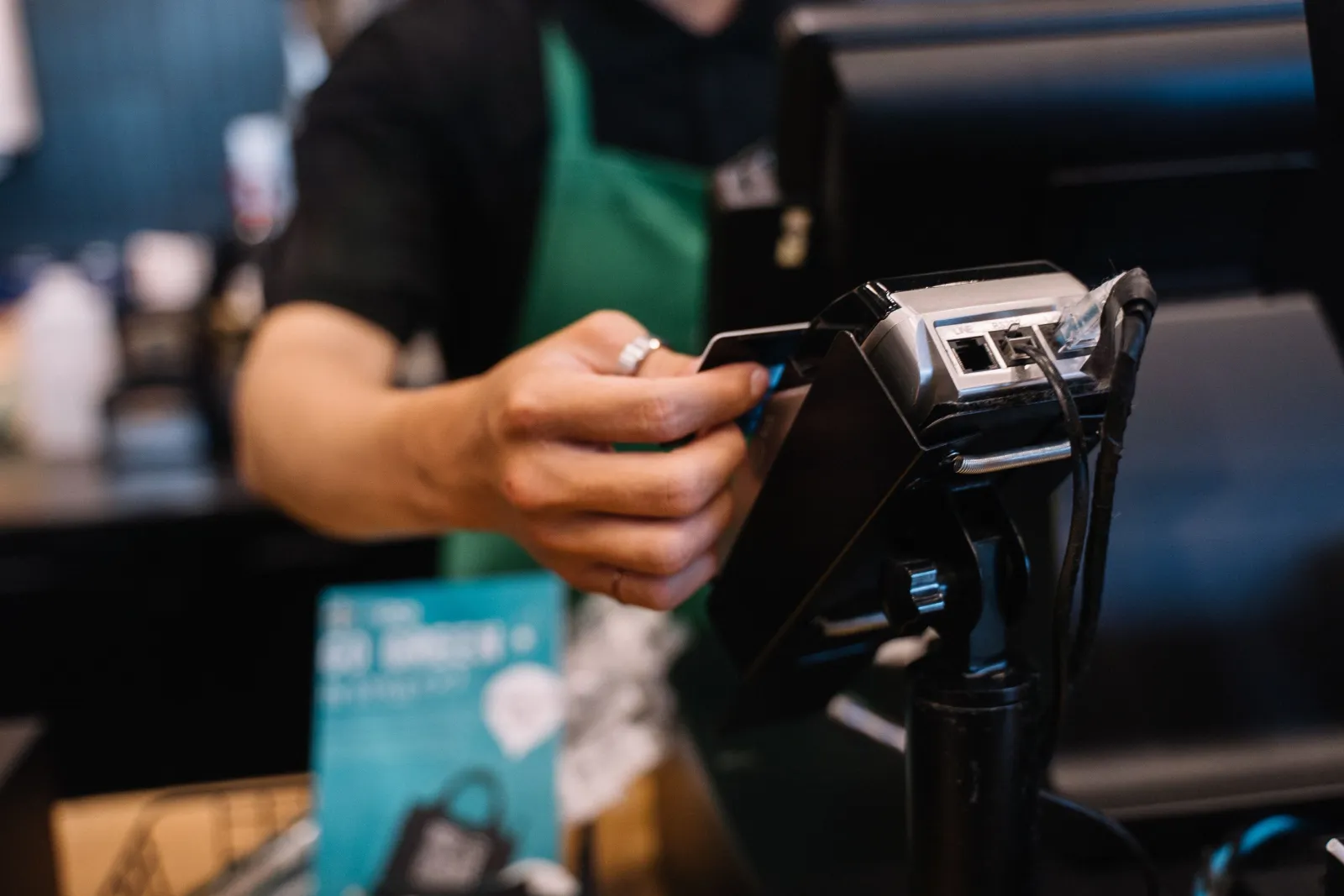
You are in Prague.
Dinner costs:
1,250 CZKYou tap your card.
The terminal suddenly asks:
PAY IN:

1,250 CZK

or

€55.80
The euro option feels safer.
You immediately understand the amount.
No mental conversion.
No uncertainty about what your bank will charge later.
So you press:
EUR
And that small decision may make the dinner more expensive.
What the terminal is offering is usually Dynamic Currency Conversion, or DCC.
Instead of letting your bank or card network convert the purchase later, the merchant’s payment provider converts it immediately into your card’s home currency.
Convenient?
Yes.
Usually cheaper?
Not necessarily.
Visa currently warns that DCC may include an exchange-rate markup and additional fees, and separately notes that using DCC while travelling can often mean roughly a 3–5% markup through the exchange rate.
That means one button on a payment terminal can turn a €1,000 holiday spend into an additional €30–€50.
Without buying anything extra.
What actually happens when you choose local currency?
Suppose you are in Hungary and the restaurant bill is:
40,000 HUFYou choose:
40,000 HUFThe merchant sends the transaction in Hungarian forints.
Your card issuer then converts it into the currency of your account according to the applicable card-network or bank terms.
Mastercard, for example, provides its own currency-conversion calculator and notes that the relevant conversion can depend on when the transaction is authorized or processed, together with any fee charged by your issuing bank.
Your statement might eventually show something like:
40,000 HUF
→ €102.40
The important point is:
The merchant did not perform the currency conversion.
Your own payment chain did.
What happens when you choose your home currency?
Now choose:
€107.50instead.
The merchant or its payment provider performs the conversion before sending the transaction.
You have accepted DCC.
Mastercard explicitly notes that when a transaction is converted by the merchant or ATM operator — commonly when you choose your card’s currency instead of the merchant’s — Mastercard’s own currency-conversion rate does not apply.
So the choice is not merely:
HUF vs EURIt is more accurately:
Bank/card-network conversion

vs

Merchant/payment-provider conversion
And those rates may be very different.
The 5-second Fintayo rule
When travelling abroad and a terminal asks:
HOME CURRENCY

or

LOCAL CURRENCY
our default rule is:
Choose the local currency.
Examples:
In Croatia:
EURIn Albania:
ALLIn Serbia:
RSDIn Turkey:
TRYIn the UK:
GBPIn Switzerland:
CHFThe principle is simple:
Pay the merchant in the currency in which the merchant normally prices the purchase.
Then allow your own card issuer/payment network to handle the conversion.
There are exceptions, which we will get to.
But this is the safer default.
Why the euro button is so tempting
DCC is psychologically clever.
Imagine the terminal displays:
4,250 TRYYou may have no immediate intuition whether that is:
€80
€95
€110
Then the terminal offers:
€92.64Suddenly everything feels clear.
The home-currency number removes uncertainty.
But clarity is not the same as value.
You are effectively being offered:
“Would you like us to calculate the exchange rate for you?”
The correct response is:
“At what rate?”
Visa requires DCC merchants and ATMs to disclose the exchange rate, the local and home-currency amounts and applicable markup or fees, and says the cardholder must be allowed to accept or decline the conversion.
The EU also requires providers offering point-of-sale currency conversion to disclose the conversion markup and show both the merchant-currency and payer-currency amounts before the transaction begins.
So the information may be there.
The problem is that most travellers do not stop to calculate it.
The €1,000 holiday example
Suppose DCC costs 4% more than the alternative conversion.
Your trip spending:
Hotels:       €400 equivalent
Restaurants:  €250
Shopping:     €200
Transport:    €100
Other:         €50

Total:      €1,000
Extra cost:
€1,000 × 4%
=
€40
Nothing dramatic happened.
No scam notification.
No giant fee appeared.
You simply paid:
€40more for the same trip.
At 5%:
€1,000 × 5%
=
€50
For a family spending €3,000 abroad:
€3,000 × 5%
=
€150
That is why small exchange-rate differences deserve attention.
The terminal may use reassuring language
You may see wording such as:
Guaranteed exchange rateor:
Pay conveniently in EURor:
Know exactly what you payThose statements can be technically true.
DCC can tell you exactly how many euros will hit your card for that transaction.
But you are paying for that certainty through the offered conversion rate if it is worse than your alternative.
The question is not:
Is the rate guaranteed?
The question is:
Is the guaranteed rate good?
Sometimes the choice looks backwards
Terminals are not always intuitive.
You may see:
WITH CONVERSION

WITHOUT CONVERSION
instead of:
EUR

CZK
The option labelled:
WITHOUT CONVERSIONcan actually be the one you want because it leaves the transaction in local currency.
Always identify the currency itself.
Do not rely only on button wording.
Good
PAY 1,250 CZKUsually avoid
PAY €55.80
Exchange rate guaranteed
when your home account is denominated in euros.
What if your bank charges a foreign transaction fee?
This is the major caveat.
Suppose your card issuer charges:
3%for foreign-currency purchases.
And the DCC markup is:
2%In that particular transaction, DCC could theoretically be competitive or even cheaper.
That is why the rule is not mathematically:
Local currency always wins.
It is:
Local currency is usually the best starting choice unless you know your own card’s FX costs and can prove the offered conversion is better.
You need to know:
Card network conversion
+
issuer FX markup
+
foreign transaction fee
versus:
DCC exchange rate
+
DCC markup/fees
Most travellers cannot calculate that accurately while a waiter is holding the terminal.
Hence the practical default:
Local currencyThe two-card strategy
Frequent travellers can make this easier.
Use:
Card A — Travel card
Low or zero FX markup
No foreign transaction fee
Use this abroad in:
local currencyCard B — Backup card
Keep it separately for:
- declined transactions
- lost cards
- offline terminals
- emergencies
Now you no longer need to perform a currency calculation every time you pay for coffee.
The operating rule becomes:
Travel card + local currencyDo not confuse card currency with nationality
Suppose you are Macedonian but your card account is in euros.
You are shopping in Serbia.
Terminal asks:
RSD

or

EUR
The relevant comparison is based on your card/account currency and its conversion terms, not your passport.
Likewise, someone living in Germany might use:
- a euro account
- a dollar card
- a multicurrency wallet
The correct answer depends on the funding currency and card terms.
Multicurrency cards make the terminal question even more important
Suppose your fintech account holds:
EUR
GBP
USD
CHF
and you pay in Switzerland.
If you already hold Swiss francs or your provider offers a competitive CHF conversion, selecting:
CHFat the terminal gives your own provider the chance to settle according to your account setup.
If you instead choose:
EURthrough DCC, the merchant’s conversion occurs first.
Your sophisticated multicurrency setup may never get a chance to do the thing you opened it for.
The receipt can reveal what happened
After payment, inspect the receipt.
A DCC receipt may display:
Transaction currency: CZK

Cardholder currency: EUR

Exchange rate:
...

Markup:
...
EU rules require currency-conversion providers in scope to disclose the markup over the relevant reference rate, while Visa rules require disclosure of the conversion details and active cardholder choice.
If you intended to pay in local currency but your receipt shows the purchase was converted into your home currency, act quickly.
Visa says merchants must give cardholders the opportunity to pay in local currency, and customers should contact their issuer if a transaction was converted without permission.
Never let the merchant choose for you
You say:
Card, please.
The waiter takes your card.
The terminal returns already processed in euros.
That should not happen without your choice.
Visa explicitly states that merchants or ATMs offering DCC should not select the conversion on behalf of the cardholder.
A simple sentence solves most situations:
Please charge me in local currency.
Use it before the card is tapped.
In Turkey:
Turkish lira, please.
In Poland:
Polish zloty, please.
In Hungary:
Forints, please.
You do not need to explain DCC theory at the restaurant.
The hotel checkout is where this gets expensive
A bad conversion on coffee costs cents.
A bad conversion on a hotel can cost serious money.
Hotel bill:
€1,500 equivalentDCC disadvantage:
4%Cost:
€60At 5%:
€75The same applies to:
- rental cars
- medical bills
- jewellery
- electronics
- luxury shopping
- large deposits
The larger the purchase, the more important the currency button becomes.
Watch pre-authorizations too
Hotels and rental-car companies often place deposits or holds.
Ask which currency will be used for:
Final purchase

and

pre-authorization
because the temporary hold may also interact with currency conversion and your available balance.
Do not focus exclusively on the final invoice while ignoring a large deposit.
Online shops can use the same psychology
DCC is not limited to physical terminals.
An international website may offer:
View prices in EURinstead of the merchant’s original currency.
This may be convenient.
But once again, ask:
Who is performing the conversion?
Visa’s merchant guidance recommends transparent currency disclosure and an easy way for customers to switch back to the merchant’s local currency when currency-conversion services are offered.
So when buying internationally online, compare:
Original currency checkoutwith:
Converted EUR checkoutbefore paying.
The phone-calculator trick
You do not need to memorize exchange rates.
Suppose the terminal offers:
Local price:
12,000 HUF

DCC price:
€32.80
Your phone indicates roughly:
12,000 HUF ≈ €30.80Difference:
€2Percentage difference:
€2 ÷ €30.80
≈ 6.5%
Now the convenience has a visible price.
You can make the decision in seconds.
The Fintayo €10 rule
For a tiny transaction:
Coffee: €4 equivalenteven a 5% disadvantage is:
€0.20Do not ruin your holiday performing forensic accounting over every espresso.
But once a transaction exceeds:
€100pay attention.
At €100:
5% = €5At €500:
5% = €25At €2,000:
5% = €100The larger the transaction, the less excusable an unnecessary conversion becomes.
Fintayo’s card-abroad checklist
Before the trip:
CARD:

Account currency:

Foreign transaction fee:

Issuer FX markup:

ATM fee:

Travel notifications required:
[Yes / No]

================================

WHEN TERMINAL ASKS:

LOCAL CURRENCY
or
HOME CURRENCY

Default:
LOCAL CURRENCY

================================

BEFORE CONFIRMING:

[ ] Check currency symbol
[ ] Decline DCC unless proven cheaper
[ ] Verify amount
[ ] Keep receipt for large purchase

================================

FOR LARGE TRANSACTIONS:

Local amount:

DCC amount:

Approximate market conversion:

Difference:

Percentage difference:

================================

DECISION:

[ ] Local currency
[ ] DCC — demonstrably cheaper
Three phrases worth remembering
Restaurant
Please charge the card in local currency.
Hotel
Please process the payment in local currency, without currency conversion.
If the terminal has already converted it
Please cancel that transaction and charge it again in local currency.
Short.
Clear.
No banking lecture necessary.
The Fintayo takeaway
When a card terminal abroad asks whether you want to pay in your own currency, it is not simply translating the number for you.
It may be offering a separate currency-conversion service.
Visa says DCC can include additional fees and markup, and its current consumer guidance notes that the convenience can often carry a roughly 3–5% markup.
So the default Fintayo rule is simple:
When abroad, pay in the merchant’s local currency and let your own card issuer handle the conversion.
Not because local currency is mathematically guaranteed to win every single transaction.
But because accepting DCC means giving the merchant’s payment provider control of the exchange rate.
And unless you have compared both conversion costs, that is usually a bet you do not need to make.
The expensive button is often the one designed to look most convenient.