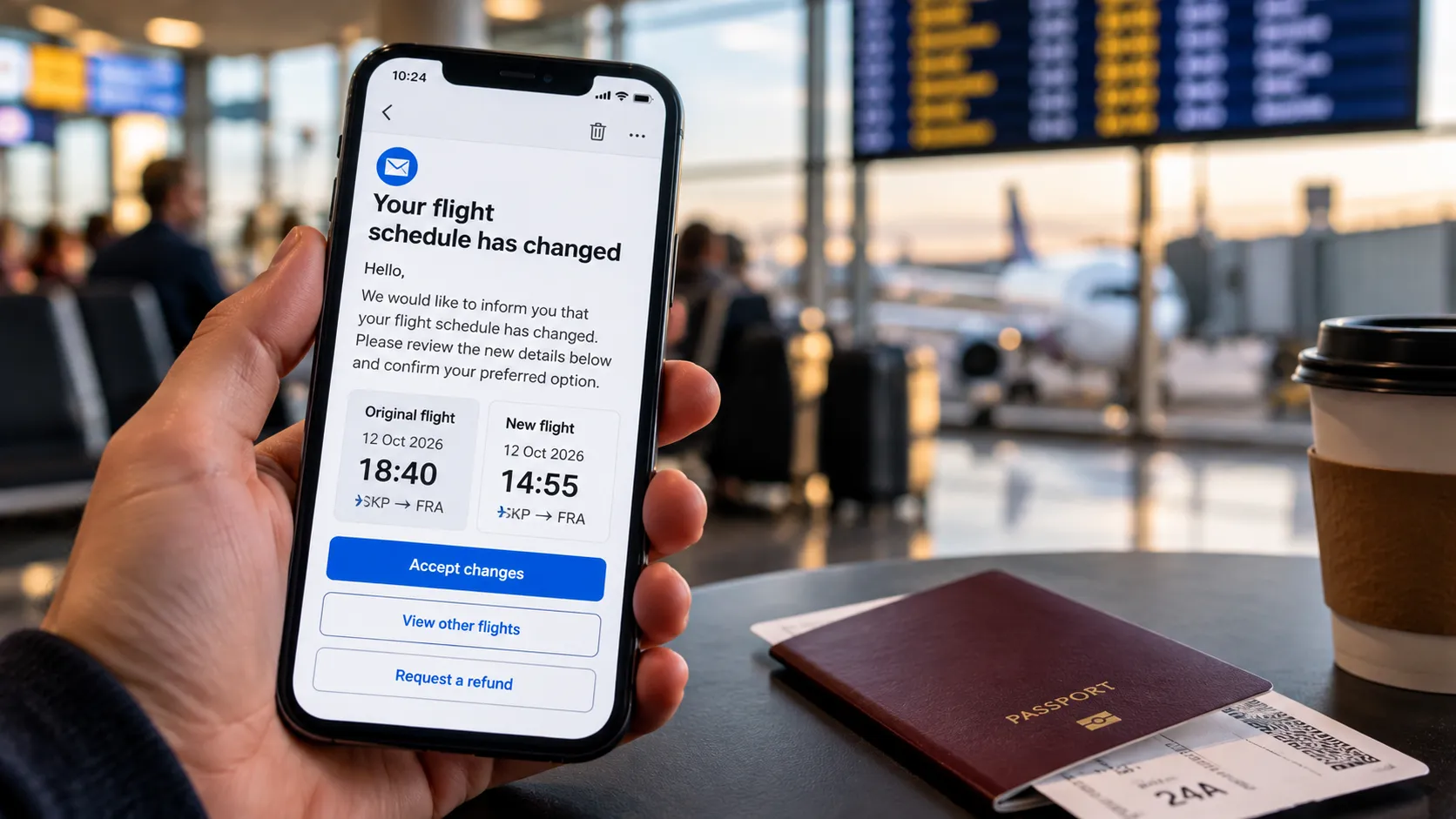
The email looks harmless.
Your flight schedule has changed.
Old departure:
18:40New departure:
14:55Underneath is a large button:
ACCEPT CHANGESMost people click it.
The flight still exists. The destination is the same. It seems like there is nothing else to do.
But before you press that button, stop.
Because when an airline changes the flight you originally bought, you may have options that are much better than simply accepting the replacement.
Depending on the route, the size of the change and the rules that apply, those options can include another flight or even a refund.
And once you voluntarily accept an alternative itinerary, some refund choices may disappear.
That makes the most valuable part of a schedule-change email the few minutes before you click anything.
First: take a screenshot
Before opening the airline app and changing anything, save the original message.
You want evidence of:
Original flight number
Original departure time
Original arrival time
New flight number
New departure time
New arrival time
Original airports
New airports
Connections
Cabin
Why?
Because six weeks later, your booking may show only the new itinerary.
The original flight you actually purchased can become surprisingly difficult to reconstruct.
That matters if you need to prove how significant the change was.
Not every schedule change is the same
An airline changing:
18:40 → 18:55is inconvenient but usually very different from:
18:40 → 13:10Likewise, this:
Direct flight
Skopje → Paris
is not equivalent to:
Skopje → Vienna → Pariseven if both eventually reach Paris.
The important question is not simply:
Did my flight change?
It is:
How much did the itinerary I bought change?
That can determine what options you have.
In the U.S., “significant change” has an actual definition
For flights covered by U.S. Department of Transportation refund rules, passengers can be entitled to a refund when an airline significantly changes or significantly delays a flight and the passenger chooses not to travel or accept the alternative offered.
Current DOT rules treat several situations as significant changes.
For domestic itineraries, a departure moved three hours or more earlier, or an arrival moved three hours or more later, qualifies.
For international itineraries, that threshold is six hours.
Changing the origin or destination airport can qualify too.
So can adding more connections or involuntarily moving the passenger to a lower class of service.
Imagine you booked:
New York → London

Departure: 19:00
Arrival:   07:00
The airline changes it to:
Departure: 12:30
Arrival:   00:30
That is not just a minor timetable adjustment.
The departure has moved more than six hours earlier.
Under the U.S. rule, if the itinerary is covered and you do not accept the replacement, that can trigger a refund right.
The important part: accepting matters
DOT says that where a refund right exists because of a cancellation or significant change, passengers who bought directly from the airline are entitled to an automatic refund if they do not accept the significantly changed flight, rebooked flight, travel credit or other alternative compensation.
That is why clicking:
ACCEPTwithout checking first can matter.
It may mean you have chosen the airline’s alternative instead of rejecting it and pursuing the refund option available under the applicable rules.
This does not mean every “Accept” button instantly destroys every possible right under every airline policy.
It means you should understand your choices before telling the airline that the new itinerary works for you.
Europe works differently — but the same habit is useful
EU passenger rights have their own framework.
One particularly useful rule is surprisingly generous.
If an airline moves your departure more than one hour earlier, EU guidance says the flight is treated as cancelled.
Read that again.
Not:
3 hoursNot:
6 hoursFor this specific EU cancellation rule:
More than 1 hour earliercan be enough.
Imagine:
Original departure: 10:00

New departure:       08:40
That is:
1 hour 20 minutes earlierUnder current EU guidance, that is regarded as a cancellation.
And cancellation brings choices.
Refund, rerouting or travel later
Under current EU passenger-rights rules, when a flight is cancelled the airline must offer a choice between reimbursement, rerouting to the final destination at the earliest opportunity, or rerouting later under comparable conditions subject to availability.
But there is an important detail.
Once you choose one of those options, EU guidance says you generally no longer have rights to the other two choices, although separate compensation rights can still exist depending on the circumstances.
So when the airline says:
“We moved you to another flight. Click here to confirm.”
do not think only:
“Can I still make this flight?”
Ask:
“Is this actually the best option available to me?”
The hidden opportunity: the replacement flight may be worse than another flight you can see
Suppose you booked:
Original:
08:00 → 10:20
Direct
Airline changes it to:
Replacement:
15:50 → 18:10
Direct
But when you search the airline website, you discover:
Alternative:
09:15 → 11:35
Direct
with seats available.
Do not automatically assume the flight assigned by the computer is the only flight the airline can put you on.
Before accepting, check the airline’s own schedule.
Then contact them and ask whether you can be moved to the better alternative because they changed your original itinerary.
Airline policy will determine what changes they are willing to make, especially when the disruption does not meet a statutory refund threshold.
But asking before accepting costs nothing.
This can be especially valuable when the new ticket is more expensive
Suppose you bought your flight months ago for:
€160Today the alternative flight you actually prefer costs:
€320If the airline’s schedule change qualifies you for free rerouting under applicable rules or its own policy, you may be able to move to that flight without buying a completely new €320 ticket.
That is why the first reaction to a schedule change should not be:
How annoying.It should be:
What options did this change just create?Check the arrival time, not only departure
Passengers often focus only on:
Departure moved by 2 hoursand miss what happened later.
Example:
Original
Skopje → Frankfurt → New York

Departure: 06:30
Arrival:   14:20
New itinerary
Skopje → Frankfurt → Chicago → New York

Departure: 06:30
Arrival:   21:45
The departure did not move at all.
But you gained:
One additional connection
+
7 hours 25 minutes
of travel time.
Under current U.S. DOT rules, an increase in the number of connections is itself one of the situations defined as a significant change for covered itineraries.
So never compare only the first line of the itinerary.
Compare:
Departure
Arrival
Airports
Stops
Connection times
Cabin
Airport changes deserve special attention
Imagine you booked arrival at:
London Heathrowand the new itinerary ends at:
London Gatwickor you booked:
New York JFKand are moved to:
NewarkA destination-airport change can affect:
Hotel transfer
Rental car
Train booking
Meeting time
Parking
Family pickup
Under U.S. DOT’s refund definition, a change in origin or destination airport is one of the listed significant changes.
EU rules are more nuanced: arriving at a different airport can be treated as cancellation unless the new airport serves the same town, city or region and the relevant rerouting conditions are met.
Either way, do not evaluate the new flight only by departure time.
The airport itself can be the biggest change.
A downgrade is not a small detail
Imagine you paid for:
Premium Economyand the new itinerary shows:
EconomyDo not click Accept just because the date and time look fine.
Under current U.S. DOT rules, involuntary downgrade to a lower class of service is included in the definition of significant change. If you still travel after the downgrade, DOT says the airline must refund the difference between the original and lower fare class rather than the whole airfare.
EU rules also provide reimbursement percentages for downgrading depending on flight distance.
So compare:
Cabin
Seat
Baggage allowance
Purchased extras
not only the flight number.
What about a change of only 30 minutes?
Now we reach the grey area.
Suppose:
Original: 16:20
New:      16:55
That may not trigger a statutory refund right.
But that does not mean you should automatically click Accept.
Why?
Because individual airline policies can be more generous than the legal minimum.
An airline may allow a free move to another flight even when the change is not large enough to create a government-mandated refund right.
The right question is:
“Because you changed my original schedule, what alternative flights can I move to without a fare difference?”
Not:
“Can I cancel my non-refundable ticket?”
Those are two very different conversations.
The Fintayo 5-minute schedule-change routine
When an airline changes your flight, do this before touching the Accept button:
1. Screenshot the old and new itinerary.

2. Calculate:
   - departure difference
   - arrival difference

3. Check:
   - airport changed?
   - extra connection?
   - cabin changed?
   - seat lost?
   - baggage changed?

4. Search the airline's website
   for better flights on the same date
   and nearby dates.

5. Check the passenger-rights rules
   that apply to your itinerary.

6. Only then choose:
   ACCEPT
   REBOOK
   REFUND
Five minutes can completely change the outcome.
The €240 example
Imagine this situation.
You bought:
Rome → New York
€480 return
The airline moves your outbound flight from:
17:30to:
10:45Difference:
6 hours 45 minutes earlierYou were planning to work in Rome that day.
The new flight ruins the trip.
You search and find another airline departing at 18:00, but it costs:
€720Your first instinct might be:
“I have a non-refundable €480 ticket, so I’m stuck.”
But the airline—not you—made the significant change.
For a covered U.S. international itinerary, a move of six hours or more earlier meets DOT’s definition of significant change. If you decline the changed itinerary, refund rights can apply.
That changes the financial calculation.
Instead of thinking:
Lose €480
+
buy €720 ticket
=
€1,200
you may be looking at:
Refund original ticket
+
buy €720 alternative
The new flight is still expensive.
But the decision is radically different.
Do not confuse refund with compensation
This distinction matters.
A refund means getting back money for transportation you will not use because of a qualifying cancellation or change.
Compensation is an additional payment that may be owed under certain passenger-rights regimes because of disruption.
They are not the same thing.
In the EU, whether compensation is owed after a cancellation depends on factors including when you were informed, the rerouting offered and whether extraordinary circumstances caused the disruption.
So:
Eligible for refunddoes not automatically mean:
Eligible for €250 / €400 / €600And the reverse situation can also require separate analysis.
Do not accept a voucher automatically
Another screen may say:
Get €500 travel credit nowwhen your original ticket cost:
€500Travel credit may be useful if you know you will fly that airline again.
But cash is cash.
Under current U.S. DOT rules, passengers entitled to a refund because of a covered cancellation or significant change do not have to accept a travel credit instead.
Before accepting a voucher, check:
Expiry date
Transferability
Route restrictions
Currency
Blackout conditions
Whether accepting it replaces a cash refund
A €500 voucher expiring in twelve months is not economically identical to €500 returned to your card.
Bought through an online travel agency?
This can add another layer.
The flight may be operated by Airline A but booked through Agency B.
The legal rights do not necessarily disappear, but the practical refund or rebooking process may involve the intermediary.
Do not immediately cancel through the agency interface.
First identify:
Who issued the ticket?
Who changed the flight?
Who controls the booking?
Then keep screenshots of every communication.
A schedule-change case becomes much harder when the airline says:
“Speak to the agency.”
and the agency says:
“Speak to the airline.”
Documentation becomes your leverage.
One important 2026 U.S. detail
The U.S. DOT is currently exercising temporary enforcement discretion in a narrow situation involving flights that are merely renumbered.
Through July 7, 2027, DOT says it will not enforce automatic-refund requirements solely because a flight number changed when the passenger was successfully rebooked and the flight otherwise operates without a significant change or delay.
In plain English:
Flight 123 → Flight 456by itself should not be treated as a jackpot for a refund if everything meaningful about the trip remains essentially unchanged.
Focus on the real itinerary.
Not just the flight number.
The Fintayo rule
When you receive:
Your flight has changed
do not ask:
“Where is the Accept button?”
Ask:
“What did I originally buy, what am I being offered now, and what are my alternatives?”
Then compare them.
Sometimes the airline changed the flight by 15 minutes and the sensible choice is simply to accept it.
Sometimes it moved your international departure seven hours earlier, added a connection, changed the airport or downgraded your cabin.
Those are not the same situation.
And your non-refundable ticket may suddenly be far more flexible than it was yesterday.
The Fintayo takeaway
A schedule-change email is not only bad news.
Sometimes it is an opportunity.
The airline has changed the contract first.
That can create options you did not have when you voluntarily wanted to change the ticket yourself.
So before clicking:
ACCEPT CHANGEStake five minutes.
Screenshot the original itinerary.
Measure the change.
Search the alternatives.
Check the rules.
Then decide.
Because the most expensive button in an airline email may be the one that looks easiest to press.