Blog

  • Don’t click “Accept” when an airline changes your flight – Check this first

    Don’t click “Accept” when an airline changes your flight – Check this first

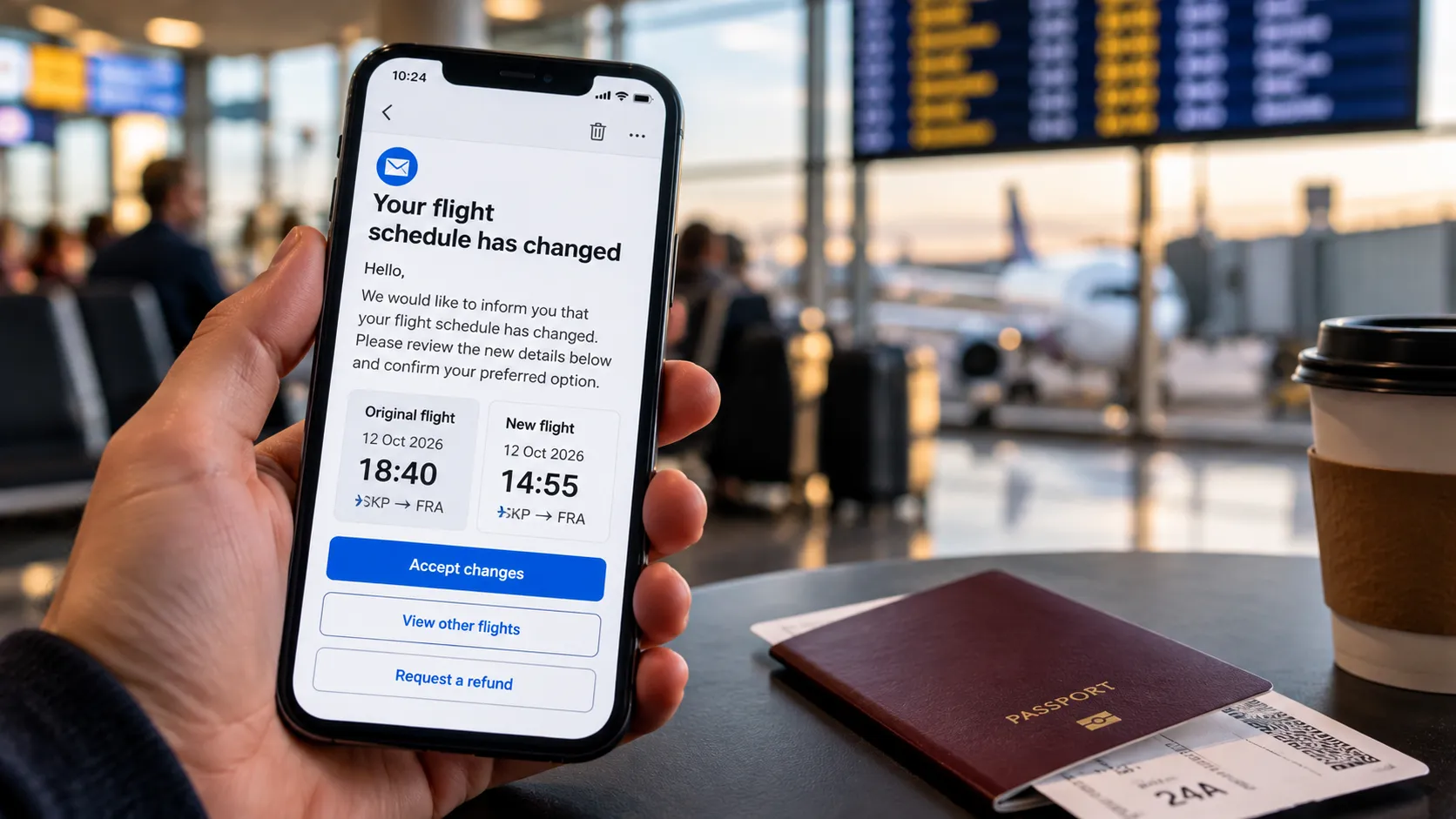
    The email looks harmless.

    Your flight schedule has changed.

    Old departure:

    18:40

    New departure:

    14:55

    Underneath is a large button:

    ACCEPT CHANGES

    Most people click it.

    The flight still exists. The destination is the same. It seems like there is nothing else to do.

    But before you press that button, stop.

    Because when an airline changes the flight you originally bought, you may have options that are much better than simply accepting the replacement.

    Depending on the route, the size of the change and the rules that apply, those options can include another flight or even a refund.

    And once you voluntarily accept an alternative itinerary, some refund choices may disappear.

    That makes the most valuable part of a schedule-change email the few minutes before you click anything.

    First: take a screenshot

    Before opening the airline app and changing anything, save the original message.

    You want evidence of:

    Original flight number
    Original departure time
    Original arrival time
    New flight number
    New departure time
    New arrival time
    Original airports
    New airports
    Connections
    Cabin

    Why?

    Because six weeks later, your booking may show only the new itinerary.

    The original flight you actually purchased can become surprisingly difficult to reconstruct.

    That matters if you need to prove how significant the change was.

    Not every schedule change is the same

    An airline changing:

    18:40 → 18:55

    is inconvenient but usually very different from:

    18:40 → 13:10

    Likewise, this:

    Direct flight
    Skopje → Paris

    is not equivalent to:

    Skopje → Vienna → Paris

    even if both eventually reach Paris.

    The important question is not simply:

    Did my flight change?

    It is:

    How much did the itinerary I bought change?

    That can determine what options you have.

    In the U.S., “significant change” has an actual definition

    For flights covered by U.S. Department of Transportation refund rules, passengers can be entitled to a refund when an airline significantly changes or significantly delays a flight and the passenger chooses not to travel or accept the alternative offered.

    Current DOT rules treat several situations as significant changes.

    For domestic itineraries, a departure moved three hours or more earlier, or an arrival moved three hours or more later, qualifies.

    For international itineraries, that threshold is six hours.

    Changing the origin or destination airport can qualify too.

    So can adding more connections or involuntarily moving the passenger to a lower class of service.

    Imagine you booked:

    New York → London
    
    Departure: 19:00
    Arrival:   07:00

    The airline changes it to:

    Departure: 12:30
    Arrival:   00:30

    That is not just a minor timetable adjustment.

    The departure has moved more than six hours earlier.

    Under the U.S. rule, if the itinerary is covered and you do not accept the replacement, that can trigger a refund right.

    The important part: accepting matters

    DOT says that where a refund right exists because of a cancellation or significant change, passengers who bought directly from the airline are entitled to an automatic refund if they do not accept the significantly changed flight, rebooked flight, travel credit or other alternative compensation.

    That is why clicking:

    ACCEPT

    without checking first can matter.

    It may mean you have chosen the airline’s alternative instead of rejecting it and pursuing the refund option available under the applicable rules.

    This does not mean every “Accept” button instantly destroys every possible right under every airline policy.

    It means you should understand your choices before telling the airline that the new itinerary works for you.

    Europe works differently — but the same habit is useful

    EU passenger rights have their own framework.

    One particularly useful rule is surprisingly generous.

    If an airline moves your departure more than one hour earlier, EU guidance says the flight is treated as cancelled.

    Read that again.

    Not:

    3 hours

    Not:

    6 hours

    For this specific EU cancellation rule:

    More than 1 hour earlier

    can be enough.

    Imagine:

    Original departure: 10:00
    
    New departure:       08:40

    That is:

    1 hour 20 minutes earlier

    Under current EU guidance, that is regarded as a cancellation.

    And cancellation brings choices.

    Refund, rerouting or travel later

    Under current EU passenger-rights rules, when a flight is cancelled the airline must offer a choice between reimbursement, rerouting to the final destination at the earliest opportunity, or rerouting later under comparable conditions subject to availability.

    But there is an important detail.

    Once you choose one of those options, EU guidance says you generally no longer have rights to the other two choices, although separate compensation rights can still exist depending on the circumstances.

    So when the airline says:

    “We moved you to another flight. Click here to confirm.”

    do not think only:

    “Can I still make this flight?”

    Ask:

    “Is this actually the best option available to me?”

    The hidden opportunity: the replacement flight may be worse than another flight you can see

    Suppose you booked:

    Original:
    08:00 → 10:20
    Direct

    Airline changes it to:

    Replacement:
    15:50 → 18:10
    Direct

    But when you search the airline website, you discover:

    Alternative:
    09:15 → 11:35
    Direct

    with seats available.

    Do not automatically assume the flight assigned by the computer is the only flight the airline can put you on.

    Before accepting, check the airline’s own schedule.

    Then contact them and ask whether you can be moved to the better alternative because they changed your original itinerary.

    Airline policy will determine what changes they are willing to make, especially when the disruption does not meet a statutory refund threshold.

    But asking before accepting costs nothing.

    This can be especially valuable when the new ticket is more expensive

    Suppose you bought your flight months ago for:

    €160

    Today the alternative flight you actually prefer costs:

    €320

    If the airline’s schedule change qualifies you for free rerouting under applicable rules or its own policy, you may be able to move to that flight without buying a completely new €320 ticket.

    That is why the first reaction to a schedule change should not be:

    How annoying.

    It should be:

    What options did this change just create?

    Check the arrival time, not only departure

    Passengers often focus only on:

    Departure moved by 2 hours

    and miss what happened later.

    Example:

    Original

    Skopje → Frankfurt → New York
    
    Departure: 06:30
    Arrival:   14:20

    New itinerary

    Skopje → Frankfurt → Chicago → New York
    
    Departure: 06:30
    Arrival:   21:45

    The departure did not move at all.

    But you gained:

    One additional connection
    +
    7 hours 25 minutes

    of travel time.

    Under current U.S. DOT rules, an increase in the number of connections is itself one of the situations defined as a significant change for covered itineraries.

    So never compare only the first line of the itinerary.

    Compare:

    Departure
    Arrival
    Airports
    Stops
    Connection times
    Cabin

    Airport changes deserve special attention

    Imagine you booked arrival at:

    London Heathrow

    and the new itinerary ends at:

    London Gatwick

    or you booked:

    New York JFK

    and are moved to:

    Newark

    A destination-airport change can affect:

    Hotel transfer
    Rental car
    Train booking
    Meeting time
    Parking
    Family pickup

    Under U.S. DOT’s refund definition, a change in origin or destination airport is one of the listed significant changes.

    EU rules are more nuanced: arriving at a different airport can be treated as cancellation unless the new airport serves the same town, city or region and the relevant rerouting conditions are met.

    Either way, do not evaluate the new flight only by departure time.

    The airport itself can be the biggest change.

    A downgrade is not a small detail

    Imagine you paid for:

    Premium Economy

    and the new itinerary shows:

    Economy

    Do not click Accept just because the date and time look fine.

    Under current U.S. DOT rules, involuntary downgrade to a lower class of service is included in the definition of significant change. If you still travel after the downgrade, DOT says the airline must refund the difference between the original and lower fare class rather than the whole airfare.

    EU rules also provide reimbursement percentages for downgrading depending on flight distance.

    So compare:

    Cabin
    Seat
    Baggage allowance
    Purchased extras

    not only the flight number.

    What about a change of only 30 minutes?

    Now we reach the grey area.

    Suppose:

    Original: 16:20
    New:      16:55

    That may not trigger a statutory refund right.

    But that does not mean you should automatically click Accept.

    Why?

    Because individual airline policies can be more generous than the legal minimum.

    An airline may allow a free move to another flight even when the change is not large enough to create a government-mandated refund right.

    The right question is:

    “Because you changed my original schedule, what alternative flights can I move to without a fare difference?”

    Not:

    “Can I cancel my non-refundable ticket?”

    Those are two very different conversations.

    The Fintayo 5-minute schedule-change routine

    When an airline changes your flight, do this before touching the Accept button:

    1. Screenshot the old and new itinerary.
    
    2. Calculate:
       - departure difference
       - arrival difference
    
    3. Check:
       - airport changed?
       - extra connection?
       - cabin changed?
       - seat lost?
       - baggage changed?
    
    4. Search the airline's website
       for better flights on the same date
       and nearby dates.
    
    5. Check the passenger-rights rules
       that apply to your itinerary.
    
    6. Only then choose:
       ACCEPT
       REBOOK
       REFUND

    Five minutes can completely change the outcome.

    The €240 example

    Imagine this situation.

    You bought:

    Rome → New York
    €480 return

    The airline moves your outbound flight from:

    17:30

    to:

    10:45

    Difference:

    6 hours 45 minutes earlier

    You were planning to work in Rome that day.

    The new flight ruins the trip.

    You search and find another airline departing at 18:00, but it costs:

    €720

    Your first instinct might be:

    “I have a non-refundable €480 ticket, so I’m stuck.”

    But the airline—not you—made the significant change.

    For a covered U.S. international itinerary, a move of six hours or more earlier meets DOT’s definition of significant change. If you decline the changed itinerary, refund rights can apply.

    That changes the financial calculation.

    Instead of thinking:

    Lose €480
    +
    buy €720 ticket
    =
    €1,200

    you may be looking at:

    Refund original ticket
    +
    buy €720 alternative

    The new flight is still expensive.

    But the decision is radically different.

    Do not confuse refund with compensation

    This distinction matters.

    A refund means getting back money for transportation you will not use because of a qualifying cancellation or change.

    Compensation is an additional payment that may be owed under certain passenger-rights regimes because of disruption.

    They are not the same thing.

    In the EU, whether compensation is owed after a cancellation depends on factors including when you were informed, the rerouting offered and whether extraordinary circumstances caused the disruption.

    So:

    Eligible for refund

    does not automatically mean:

    Eligible for €250 / €400 / €600

    And the reverse situation can also require separate analysis.

    Do not accept a voucher automatically

    Another screen may say:

    Get €500 travel credit now

    when your original ticket cost:

    €500

    Travel credit may be useful if you know you will fly that airline again.

    But cash is cash.

    Under current U.S. DOT rules, passengers entitled to a refund because of a covered cancellation or significant change do not have to accept a travel credit instead.

    Before accepting a voucher, check:

    Expiry date
    Transferability
    Route restrictions
    Currency
    Blackout conditions
    Whether accepting it replaces a cash refund

    A €500 voucher expiring in twelve months is not economically identical to €500 returned to your card.

    Bought through an online travel agency?

    This can add another layer.

    The flight may be operated by Airline A but booked through Agency B.

    The legal rights do not necessarily disappear, but the practical refund or rebooking process may involve the intermediary.

    Do not immediately cancel through the agency interface.

    First identify:

    Who issued the ticket?
    Who changed the flight?
    Who controls the booking?

    Then keep screenshots of every communication.

    A schedule-change case becomes much harder when the airline says:

    “Speak to the agency.”

    and the agency says:

    “Speak to the airline.”

    Documentation becomes your leverage.

    One important 2026 U.S. detail

    The U.S. DOT is currently exercising temporary enforcement discretion in a narrow situation involving flights that are merely renumbered.

    Through July 7, 2027, DOT says it will not enforce automatic-refund requirements solely because a flight number changed when the passenger was successfully rebooked and the flight otherwise operates without a significant change or delay.

    In plain English:

    Flight 123 → Flight 456

    by itself should not be treated as a jackpot for a refund if everything meaningful about the trip remains essentially unchanged.

    Focus on the real itinerary.

    Not just the flight number.

    The Fintayo rule

    When you receive:

    Your flight has changed

    do not ask:

    “Where is the Accept button?”

    Ask:

    “What did I originally buy, what am I being offered now, and what are my alternatives?”

    Then compare them.

    Sometimes the airline changed the flight by 15 minutes and the sensible choice is simply to accept it.

    Sometimes it moved your international departure seven hours earlier, added a connection, changed the airport or downgraded your cabin.

    Those are not the same situation.

    And your non-refundable ticket may suddenly be far more flexible than it was yesterday.

    The Fintayo takeaway

    A schedule-change email is not only bad news.

    Sometimes it is an opportunity.

    The airline has changed the contract first.

    That can create options you did not have when you voluntarily wanted to change the ticket yourself.

    So before clicking:

    ACCEPT CHANGES

    take five minutes.

    Screenshot the original itinerary.

    Measure the change.

    Search the alternatives.

    Check the rules.

    Then decide.

    Because the most expensive button in an airline email may be the one that looks easiest to press.
  • Europe just changed the rules for flying – But your cabin bag is not free yet

    Europe just changed the rules for flying – But your cabin bag is not free yet

    You book a €29 flight.

    Then the airline asks for another €25 for a cabin bag.

    Another €14 to sit next to your child.

    And if you missed the outbound flight?

    You might discover that the return ticket you already paid for has become a problem too.

    For years, these have been some of the most frustrating parts of flying in Europe.

    Now the rules are changing.

    On October 2, 2026, the European Union published Regulation (EU) 2026/2202, a major overhaul of European air-passenger rights. It introduces new rules covering hand baggage, family seating, missed outbound flights, rerouting, assistance during disruption and more.

    But before you celebrate by arriving at the airport tomorrow with a free trolley bag, there is one crucial detail.

    Most of these new rights do not apply yet.

    According to the official EUR-Lex record, the regulation enters into force on October 22, 2026, but its rules are scheduled to apply from October 23, 2027.

    That distinction changes almost everything.

    So here is what the new EU airline rules actually mean — without the headline confusion.

    First: No, the EU has not simply made every cabin suitcase free

    This is likely to become the biggest misconception.

    The new rules distinguish between:

    PERSONAL ITEM
    
    and
    
    HAND BAGGAGE

    They are not necessarily the same thing.

    Under the new framework, passengers will be entitled to bring one personal item into the cabin at no extra cost.

    The Council of the EU describes a personal item as something such as:

    Handbag
    Small backpack
    Laptop-style bag

    with a benchmark size of:

    40 × 30 × 15 cm

    or an item that fits under the seat in front of you.

    That is the genuinely free part.

    What about the larger cabin bag?

    This is where the headline:

    “EU makes cabin baggage free”

    becomes misleading.

    The regulation requires airlines to make fares including an allowance for a piece of hand baggage visible by default before the booking process begins.

    That should make airline prices easier to compare.

    But airlines can still offer a cheaper fare to passengers who voluntarily travel without that hand baggage.

    So think of it like this.

    Personal item

    Free

    under the new rules.

    Larger hand/cabin baggage

    A fare including it must be clearly displayed

    but airlines can still sell a cheaper product without it.

    That is very different from:

    Every passenger gets a free trolley suitcase.

    They do not.

    Why this could still be a big improvement

    Imagine two airlines.

    Airline A

    Headline fare: €39
    
    Cabin bag: €27
    
    Real fare you need:
    €66

    Airline B

    Headline fare: €55
    
    Cabin bag included
    
    Real fare:
    €55

    Today, Airline A looks cheaper during the first stage of the search.

    Under the new rules, the EU wants passengers to see fares including hand baggage before the booking process starts, making comparisons less misleading.

    The benefit is not necessarily:

    “Your bag becomes free.”

    The benefit is:

    The true price should become easier to see.

    That is potentially much more useful.

    The Fintayo rule: compare the trip, not the headline fare

    This becomes especially important with low-cost airlines.

    Suppose you see:

    AIRLINE A
    Ticket: €34

    and:

    AIRLINE B
    Ticket: €59

    You immediately assume:

    Airline A saves €25.

    But then:

    AIRLINE A
    
    Ticket:       €34
    Cabin bag:    €28
    Seat:         €13
    
    REAL TOTAL:   €75

    while:

    AIRLINE B
    
    Ticket:       €59
    Cabin bag:     €0
    Seat:          €0
    
    REAL TOTAL:   €59

    The “€34 flight” was actually:

    €16 more expensive.

    That is exactly why baggage-price transparency matters.

    Families get another important protection

    The new rules also strengthen family seating.

    The Council says families travelling with children will have the right to be seated together without an additional charge.

    The European Commission’s explanation specifies children under 14.

    This matters because seat selection becomes expensive very quickly.

    Imagine:

    2 adults
    2 children
    return flight

    Seat selection:

    €14 per person

    Calculation:

    €14
    × 4 passengers
    × 2 flights
    =
    €112

    A family may currently pay more than €100 simply to guarantee an acceptable seating arrangement.

    Under the new framework, families travelling with children under 14 gain stronger protection against having to pay just to sit together.

    But “together” does not mean any seat you want

    There is an important distinction.

    Free family seating does not mean:

    Free exit row
    Free extra legroom
    Free front row
    Free window preference

    It means the airline cannot turn the basic need for an accompanying adult and child to sit together into an extra-fee opportunity.

    Premium seat products can remain premium products.

    Missed your outbound flight? Your return is better protected

    This is another major change.

    Imagine you book:

    Rome → Paris
    Paris → Rome

    on one itinerary.

    At the last minute, you decide to travel to Paris by train.

    You still want to use your return flight.

    Historically, so-called no-show clauses could create problems because missing one part of an itinerary could affect later segments.

    The new EU rules ban airlines from denying a passenger boarding on the return flight simply because they did not take the outbound flight.

    That is a meaningful consumer protection.

    Under the new framework:

    Missed outbound flight
    ≠
    automatic loss of return flight

    This does not mean you can ignore every flight segment

    Be careful.

    The rule concerns protection against being denied the return flight merely because you skipped the outbound sector.

    That does not mean travellers should assume every multi-segment ticket can be freely rearranged.

    Connecting itineraries, fare conditions and operational rules can still matter.

    The practical Fintayo advice remains:

    If you intentionally will not take a flight segment, contact the airline.

    The difference is that the new EU framework gives passengers stronger protection against losing a return journey simply because the outward trip was not used.

    Another big change: airlines get three hours to reroute you properly

    Disruption is where the regulation becomes particularly interesting.

    The Council’s summary says airlines must offer rerouting at the earliest opportunity, potentially including:

    • another airline;
    • another airport;
    • alternative transport;

    when appropriate.

    More importantly, if the airline fails to provide an appropriate rerouting option within three hours after the disruption, passengers may arrange alternative transport themselves and request reimbursement.

    There is a limit:

    Up to four times
    the original ticket price

    according to the Council’s explanation of the revised rules.

    That could fundamentally change the decision during a cancellation.

    Example

    Your original ticket:

    €120

    Flight cancelled.

    Airline gives you no reasonable rerouting within three hours.

    Potential reimbursement ceiling for self-rerouting:

    €120 × 4
    =
    €480

    You find another suitable flight for:

    €310

    Under the new framework, that kind of self-rerouting can become significantly easier to justify.

    But document everything.

    Keep:

    Cancellation notice
    Screenshots of airline alternatives
    Times
    Receipts
    Alternative-ticket confirmation
    Communication with airline

    Never rely on memory during a reimbursement claim.

    Food and drinks become clearer too

    Waiting during a disruption produces another familiar airport scene.

    The flight is delayed.

    Everyone asks:

    “Are we entitled to food yet?”

    Under the revised framework, the Council says the right to assistance becomes more explicit.

    It includes:

    Refreshments:
    every 2 hours of waiting
    
    Meal:
    after 3 hours
    
    Additional meal:
    every 5 hours thereafter
    
    Maximum:
    3 meals per day

    plus internet access and two telephone calls.

    If the airline fails to provide required assistance, passengers can make their own reasonable arrangements and request reimbursement.

    The Council says necessary, reasonable and proportionate expenses should then be reimbursed within 14 calendar days after the request is received.

    “Reasonable” remains the important word

    A delayed flight does not turn this:

    Meal entitlement

    into:

    €220 champagne dinner

    If you need to buy food because the airline has not provided it, keep the expense reasonable.

    Think:

    Sandwich
    Meal
    Water
    Coffee

    rather than:

    Luxury restaurant
    Premium alcohol
    Celebration dinner

    And always keep the receipt.

    No receipt:

    Harder claim

    Receipt:

    Much stronger claim

    Current compensation rights do not disappear today

    The Council currently explains EU passenger protection as providing potential compensation where qualifying flights arrive more than three hours late or are cancelled less than 14 days before departure, depending on circumstances.

    The familiar amounts are:

    €250
    Flights up to 1,500 km
    
    €400
    Certain intra-EU flights and flights
    between 1,500 and 3,500 km
    
    €600
    Other qualifying flights

    Whether compensation is actually owed depends on the circumstances, including the cause of the disruption.

    So never use:

    My flight was late
    =
    I automatically get €600

    as your calculation.

    Eligibility comes first.

    Who is actually covered by EU passenger rules?

    This is another common misunderstanding.

    You do not need to be an EU citizen.

    The Council states that EU passenger-rights rules generally cover passengers:

    Flying within the EU
    
    Departing the EU
    to a non-EU country
    
    Arriving in the EU
    from outside the EU
    when flying with an EU airline

    That is particularly useful for travellers from non-EU countries.

    Your passport is not necessarily what determines whether EU261-style protection applies.

    The itinerary and operating carrier matter.

    The most important date is not October 2, 2026

    This is where today’s headlines can cause expensive mistakes.

    The regulation was published:

    October 2, 2026

    It enters into force:

    October 22, 2026

    But EUR-Lex lists its application date as:

    October 23, 2027

    So if you fly:

    next week
    next month
    Christmas 2026
    summer 2027

    do not assume every new rule described in this article already applies.

    The existing rules and the airline’s current baggage and seating policies still matter until the new provisions become applicable.

    That one fact may be the most valuable part of this entire article.

    So what should you do today?

    If you are booking a flight now, continue checking the airline’s actual fare conditions.

    Do not arrive with:

    40 × 30 × 15 cm personal item
    +
    large trolley

    and tell the gate agent:

    “The EU says this is free.”

    The regulation being published does not make all its substantive provisions immediately applicable.

    For current travel, check:

    Personal-item dimensions
    Cabin-bag dimensions
    Cabin-bag weight
    Fare type
    Seat-selection rules
    Family-seating rules

    directly with the airline.

    The Fintayo booking test

    Before buying a low-cost ticket, create this comparison:

    AIRLINE A
    
    Base fare:             €
    Personal item:         €
    Cabin bag:             €
    Checked bag:           €
    Seat required:         €
    Payment fee:           €
    Transfer to airport:   €
    
    REAL TOTAL:            €

    Then do exactly the same for Airline B.

    Do not compare:

    €29 vs €46

    Compare:

    €87 vs €72

    if those are the amounts required for the trip you actually intend to take.

    What changes from October 2027?

    Based on the legislation published now, the major practical changes include:

    • one personal item in the cabin at no extra cost;
    • clearer display of fares that include hand baggage;
    • airlines retaining the ability to offer cheaper fares without that larger hand baggage;
    • stronger free family-seating protection;
    • protection against losing a return flight merely because the outbound sector was missed;
    • clearer rerouting obligations;
    • more explicit assistance during long disruption;
    • strengthened protection for passengers with disabilities or reduced mobility.

    That is a substantial reform.

    It is just not a universal:

    “Free cabin suitcase for everyone.”

    The Fintayo screenshot rule

    One practical habit becomes even more useful as airline pricing gets regulated more tightly.

    When booking, screenshot:

    Fare displayed
    Baggage included
    Seat conditions
    Final price

    Why?

    Because if your booking later says something different, you have evidence of what was presented during purchase.

    Do the same for:

    Cancellation
    Delay
    Alternative flight offered
    Airline chat
    Reimbursement promise

    Digital travel creates digital evidence.

    Use it.

    The 2027 reminder worth setting now

    If you travel frequently in Europe, put this date somewhere:

    23 October 2027

    That is when EUR-Lex says Regulation (EU) 2026/2202 becomes applicable.

    Around that point, re-check:

    Ryanair
    Wizz Air
    easyJet
    Lufthansa
    Air France
    KLM
    ITA
    other carriers you use

    because their fare structures and booking interfaces may change to comply with the new framework.

    Some may adjust well before the legal deadline.

    Others may wait.

    The Fintayo takeaway

    The EU has genuinely changed airline passenger rights.

    But the viral version of the story will probably become:

    “Cabin bags are now free in Europe.”

    That is too simple.

    The more accurate version is:

    Passengers will get a free personal item, fares including larger hand baggage must become much easier to see and compare, and several other passenger protections become stronger.

    And there is an even more important detail:

    The new framework is published now, but its main rules are not scheduled to apply until October 23, 2027.

    So do not fight a gate agent in 2026 over a trolley bag based on a headline.

    Know:

    what changed,
    what did not,
    and when the change actually starts.

    That is the difference between travel news and a travel hack.

    Sources

    The primary source is Regulation (EU) 2026/2202, published in the Official Journal of the European Union on October 2, 2026. EUR-Lex lists October 22, 2026 as its entry-into-force date and October 23, 2027 as the application date.

    The Council of the EU’s passenger-rights guidance explains the new personal-item rule, hand-baggage fare transparency, family seating, no-show protection, rerouting and passenger-assistance provisions.

  • The hotel check-in card trap: Why a debit card can lock up hundreds for days

    The hotel check-in card trap: Why a debit card can lock up hundreds for days

    Your hotel is already paid.

    You arrive at reception, hand over your passport and hear:

    “We just need a card for incidentals.”

    No problem.

    You tap your debit card.

    A few minutes later, €300, €500 or even more appears to be missing from your available balance.

    You did not spend it.

    The hotel did not necessarily charge it.

    The money is simply unavailable.

    Welcome to the hotel authorization hold.

    And if you are travelling with a debit card and a limited amount of cash in your bank account, this seemingly harmless check-in procedure can create a surprisingly serious problem.

    A hotel deposit is not always a charge

    Hotels commonly place an authorization hold on a payment card at check-in.

    It can cover things such as:

    • room and taxes
    • minibar
    • food and drinks
    • parking
    • room service
    • damage
    • other incidental expenses

    Marriott’s current digital-entry terms say that at check-in the issuing bank may place a hold covering room and tax, applicable resort fees and an additional amount for incidentals.

    Hilton similarly explains that even guests who have already prepaid their stay may still have a card hold placed for incidentals at check-in.

    That distinction is important.

    You can have:

    HOTEL ROOM
    Already paid: €700
    
    AND
    
    CHECK-IN HOLD
    Temporarily reserved: €300

    Your hotel did not suddenly become €1,000.

    But for a period of time, you may need access to €1,000 of financial capacity.

    Why debit cards create the bigger problem

    An authorization can happen on both credit and debit cards.

    The practical difference is where the hold lands.

    Credit card

    A €400 authorization generally reduces your available credit.

    Example:

    Credit limit:       €4,000
    Hotel hold:           €400
    
    Available credit:   €3,600

    Your current-account cash has not disappeared.

    Debit card

    The same hold can affect money directly associated with your bank account.

    Example:

    Account balance:    €1,200
    Hotel hold:           €400
    
    Available funds:      €800

    You still technically have the money.

    But you may not be able to spend it.

    Some Hyatt properties state this extremely clearly in their policies: debit-card authorization funds are shown as pending and therefore become unavailable to the guest. Some also recommend using a credit card at check-in and a debit card to settle the final balance at checkout.

    That is the travel trick.

    The problem is often not the cost of the hotel. It is temporary access to your own money.

    The €500 example

    Imagine a five-night holiday.

    You prepaid:

    Hotel: €750

    So you arrive with:

    Bank account: €1,500

    You expect the €1,500 to cover:

    Restaurants
    Transport
    Shopping
    Activities
    Emergency money

    At check-in, the hotel authorizes:

    €100 per night
    ×
    5 nights
    =
    €500

    Your available cash can suddenly become:

    €1,500
    -
    €500
    =
    €1,000

    Nothing has actually been purchased with that €500.

    But for practical purposes during the holiday:

    You cannot use it.

    That is a very different problem from a €500 expense.

    The hold may survive your checkout

    Here is where many travellers become confused.

    You check out.

    The receptionist tells you:

    “We have released the deposit.”

    You check your banking app.

    The money is still unavailable.

    Both statements can be true.

    The hotel can release the authorization from its side, but your issuing bank may need additional time before the funds become available again.

    Marriott currently says its check-in hold may remain until the issuing bank releases it, with its digital-entry terms referring to up to five business days after departure.

    IHG says that for a card linked to a bank or checking account, held funds may remain unavailable for at least 72 hours after checkout or longer depending on the financial institution.

    Hilton says its hold is generally released after checkout within 72 hours, while noting that the card provider may take longer.

    And some Hyatt properties warn debit-card customers that released authorizations may take 7–10 business days, potentially longer depending on the bank.

    So:

    Hotel releases hold
    ≠
    Money immediately available

    The road-trip problem is even worse

    Imagine a ten-day trip:

    Hotel A: 3 nights
    Hotel B: 3 nights
    Hotel C: 4 nights

    Each places approximately:

    €250 hold

    You leave Hotel A.

    Its €250 has not yet returned.

    You check into Hotel B.

    Another:

    €250

    gets blocked.

    Then you reach Hotel C before the first authorization has completely disappeared.

    In the wrong timing scenario, you might temporarily have:

    Hotel A: €250
    Hotel B: €250
    Hotel C: €250
    
    TOTAL:
    €750

    tied up.

    Again:

    You have not spent €750.

    But you may temporarily be unable to use it.

    For someone travelling with €1,500–€2,000 in their main account, that matters.

    Prepaid hotel does not automatically solve it

    This is probably the biggest misconception.

    You show reception:

    “But I already paid for the hotel.”

    That does not necessarily eliminate the incidental hold.

    Hilton’s current FAQ specifically addresses this situation: even when accommodation has been prepaid, a hotel may still require a card at check-in and place a hold for incidentals such as food, drink, parking and other charges.

    Think of them as two separate things:

    ROOM PAYMENT
    =
    What you owe for accommodation
    
    INCIDENTAL AUTHORIZATION
    =
    Security against additional spending

    Paying one does not automatically eliminate the other.

    The question to ask BEFORE handing over your card

    Instead of simply asking:

    “Do you need my card?”

    ask:

    “How much will you authorize on the card?”

    That one sentence can save a lot of confusion.

    Even better:

    “Is the authorization per night or per stay?”

    Because these two policies are very different.

    Example A:

    €50 per stay
    =
    €50

    Example B:

    €50 per night
    ×
    7 nights
    =
    €350

    You want to know that before tapping the card.

    Ask how long the release normally takes

    Second question:

    “When you release the authorization at checkout, how long can it remain pending?”

    The hotel cannot guarantee your bank’s processing time.

    But it can explain its own procedure.

    Now you know whether you are potentially dealing with:

    hours

    or:

    several business days

    That becomes especially important if another hotel, rental-car company or cruise line will require a deposit immediately afterwards.

    Rental cars can create the same problem

    Hotels are not the only travel businesses using deposits.

    Rental-car companies can require much larger authorization amounts.

    For example, Enterprise’s current Skopje Airport terms list security deposits ranging from €290 to €1,000 depending on vehicle category, and state that the deposit there must be provided using a valid credit card.

    So imagine the combination:

    Hotel hold:       €400
    Rental car hold:  €390
    
    TOTAL CAPACITY:
    €790

    before you have bought lunch.

    This is why payment-card planning should be part of trip planning.

    Not something you think about while standing at reception.

    The Fintayo two-card travel setup

    A practical setup is:

    Card 1 — check-in / deposits

    Preferably a suitable credit card with enough available limit, where accepted.

    Use it for:

    Hotel authorization
    Rental-car deposit
    Other security holds

    Card 2 — daily spending

    Use another card for:

    Food
    Transport
    Shopping
    Tickets
    Cash withdrawals

    Why?

    Because if one card accumulates large pending authorizations, you still have a separate source of everyday spending capacity.

    It also gives you redundancy if:

    A card is declined
    A card is lost
    A bank fraud system blocks it
    A terminal does not accept that card

    But do not blindly use a credit card

    There is an important qualification.

    A credit card is useful only if:

    The hotel accepts it
    You have sufficient available limit
    You understand its fees
    You can pay the balance responsibly

    A €500 hold on a card with only:

    €700 available limit

    still creates a problem.

    After authorization:

    €200 available

    The issue has simply moved from your bank balance to your credit limit.

    The Fintayo rule is therefore not:

    Credit cards are always better.

    It is:

    Do not use the account containing your day-to-day travel cash for a large authorization unless you understand the consequences.

    Do not use your only card

    This is one of the simplest travel mistakes to avoid.

    You travel with:

    One debit card

    It contains:

    All holiday money

    Then:

    Hotel freezes part of it

    and later:

    Bank blocks a suspicious transaction

    Now you have one problem and no backup.

    For international trips, two independent payment methods are far safer than one.

    Ideally, do not keep both in the same wallet.

    The checkout trick

    Some hotel policies explicitly recommend a useful strategy:

    Credit card
    → authorization at check-in
    
    Debit card
    → final payment at checkout

    Some Hyatt properties currently make exactly this recommendation to debit-card users.

    Why can this work?

    The credit card absorbs the temporary hold.

    At checkout, you tell reception:

    “I’d like to settle the final bill with this debit card.”

    The hotel processes the actual bill.

    The authorization on the credit card is released according to the hotel’s and issuer’s process.

    Your checking-account funds were not tied up for the entire stay.

    But always confirm the property allows changing the payment method at checkout.

    Photograph or keep the final hotel bill

    Do not walk away with nothing.

    Ask for the final folio or invoice showing:

    Room
    Taxes
    Extras
    Final payment
    Balance due: 0

    If the authorization remains pending for an unusually long period, you now have documentation showing the stay was settled.

    Marriott advises guests with billing discrepancies to contact the property and retain updated hotel-bill documentation when corrections are made.

    That is far more useful than telling your bank:

    “The receptionist said everything was fine.”

    The Fintayo check-in script

    At reception, ask:

    Before I provide the card,
    how much will you authorize?

    Then:

    Is that amount per night
    or for the entire stay?

    Then:

    When you release it,
    how long can it remain pending?

    And if you have both debit and credit cards:

    Can I use this card for the authorization
    and another card for the final bill?

    Four questions.

    Thirty seconds.

    Potentially hundreds of euros of liquidity protected.

    The €1,000 holiday cash-flow test

    Before travelling, calculate:

    Available trip money:
    €________
    
    Hotel authorization:
    €________
    
    Rental-car deposit:
    €________
    
    Other deposits:
    €________
    
    TOTAL TEMPORARILY UNAVAILABLE:
    €________

    Then:

    Available trip money
    -
    temporary holds
    =
    money actually available to spend

    Example:

    Bank balance:          €2,000
    
    Hotel hold:              €400
    Rental car:              €390
    
    Actually accessible:
    €1,210

    That is the number you should build the trip around.

    Not €2,000.

    Do this before a long trip

    If the hotel website does not clearly publish its authorization policy, send a message before travelling:

    “Could you confirm the card authorization/deposit required at check-in, whether it is per night or per stay, and the usual release process after checkout?”

    This matters particularly for:

    • expensive resorts
    • long stays
    • multiple hotels
    • car rentals
    • cruises
    • travellers relying primarily on debit cards
    • trips where your bank balance is close to your planned budget

    The Fintayo takeaway

    A hotel authorization hold is not necessarily a hidden fee.

    It is a cash-flow problem.

    And on a debit card, cash flow matters because the hold can make real money in your account temporarily unavailable.

    So before hotel check-in, remember:

    Ask the hold amount.
    Ask whether it is per night.
    Ask how release works.
    Keep daily spending money separate.
    Carry a backup payment method.

    The hotel room may already be paid.

    Your account can still lose access to hundreds for several days.

    And discovering that while standing in another country with dinner, transport and the rest of the trip still ahead is a travel trick worth avoiding.

  • Always choose local currency? The card terminal trick that can cost you 5% more

    Always choose local currency? The card terminal trick that can cost you 5% more

    You are in Prague.

    Dinner costs:

    1,250 CZK

    You tap your card.

    The terminal suddenly asks:

    PAY IN:
    
    1,250 CZK
    
    or
    
    €55.80

    The euro option feels safer.

    You immediately understand the amount.

    No mental conversion.

    No uncertainty about what your bank will charge later.

    So you press:

    EUR

    And that small decision may make the dinner more expensive.

    What the terminal is offering is usually Dynamic Currency Conversion, or DCC.

    Instead of letting your bank or card network convert the purchase later, the merchant’s payment provider converts it immediately into your card’s home currency.

    Convenient?

    Yes.

    Usually cheaper?

    Not necessarily.

    Visa currently warns that DCC may include an exchange-rate markup and additional fees, and separately notes that using DCC while travelling can often mean roughly a 3–5% markup through the exchange rate.

    That means one button on a payment terminal can turn a €1,000 holiday spend into an additional €30–€50.

    Without buying anything extra.

    What actually happens when you choose local currency?

    Suppose you are in Hungary and the restaurant bill is:

    40,000 HUF

    You choose:

    40,000 HUF

    The merchant sends the transaction in Hungarian forints.

    Your card issuer then converts it into the currency of your account according to the applicable card-network or bank terms.

    Mastercard, for example, provides its own currency-conversion calculator and notes that the relevant conversion can depend on when the transaction is authorized or processed, together with any fee charged by your issuing bank.

    Your statement might eventually show something like:

    40,000 HUF
    → €102.40

    The important point is:

    The merchant did not perform the currency conversion.

    Your own payment chain did.

    What happens when you choose your home currency?

    Now choose:

    €107.50

    instead.

    The merchant or its payment provider performs the conversion before sending the transaction.

    You have accepted DCC.

    Mastercard explicitly notes that when a transaction is converted by the merchant or ATM operator — commonly when you choose your card’s currency instead of the merchant’s — Mastercard’s own currency-conversion rate does not apply.

    So the choice is not merely:

    HUF vs EUR

    It is more accurately:

    Bank/card-network conversion
    
    vs
    
    Merchant/payment-provider conversion

    And those rates may be very different.

    The 5-second Fintayo rule

    When travelling abroad and a terminal asks:

    HOME CURRENCY
    
    or
    
    LOCAL CURRENCY

    our default rule is:

    Choose the local currency.

    Examples:

    In Croatia:

    EUR

    In Albania:

    ALL

    In Serbia:

    RSD

    In Turkey:

    TRY

    In the UK:

    GBP

    In Switzerland:

    CHF

    The principle is simple:

    Pay the merchant in the currency in which the merchant normally prices the purchase.

    Then allow your own card issuer/payment network to handle the conversion.

    There are exceptions, which we will get to.

    But this is the safer default.

    Why the euro button is so tempting

    DCC is psychologically clever.

    Imagine the terminal displays:

    4,250 TRY

    You may have no immediate intuition whether that is:

    €80
    €95
    €110

    Then the terminal offers:

    €92.64

    Suddenly everything feels clear.

    The home-currency number removes uncertainty.

    But clarity is not the same as value.

    You are effectively being offered:

    “Would you like us to calculate the exchange rate for you?”

    The correct response is:

    “At what rate?”

    Visa requires DCC merchants and ATMs to disclose the exchange rate, the local and home-currency amounts and applicable markup or fees, and says the cardholder must be allowed to accept or decline the conversion.

    The EU also requires providers offering point-of-sale currency conversion to disclose the conversion markup and show both the merchant-currency and payer-currency amounts before the transaction begins.

    So the information may be there.

    The problem is that most travellers do not stop to calculate it.

    The €1,000 holiday example

    Suppose DCC costs 4% more than the alternative conversion.

    Your trip spending:

    Hotels:       €400 equivalent
    Restaurants:  €250
    Shopping:     €200
    Transport:    €100
    Other:         €50
    
    Total:      €1,000

    Extra cost:

    €1,000 × 4%
    =
    €40

    Nothing dramatic happened.

    No scam notification.

    No giant fee appeared.

    You simply paid:

    €40

    more for the same trip.

    At 5%:

    €1,000 × 5%
    =
    €50

    For a family spending €3,000 abroad:

    €3,000 × 5%
    =
    €150

    That is why small exchange-rate differences deserve attention.

    The terminal may use reassuring language

    You may see wording such as:

    Guaranteed exchange rate

    or:

    Pay conveniently in EUR

    or:

    Know exactly what you pay

    Those statements can be technically true.

    DCC can tell you exactly how many euros will hit your card for that transaction.

    But you are paying for that certainty through the offered conversion rate if it is worse than your alternative.

    The question is not:

    Is the rate guaranteed?

    The question is:

    Is the guaranteed rate good?

    Sometimes the choice looks backwards

    Terminals are not always intuitive.

    You may see:

    WITH CONVERSION
    
    WITHOUT CONVERSION

    instead of:

    EUR
    
    CZK

    The option labelled:

    WITHOUT CONVERSION

    can actually be the one you want because it leaves the transaction in local currency.

    Always identify the currency itself.

    Do not rely only on button wording.

    Good

    PAY 1,250 CZK

    Usually avoid

    PAY €55.80
    Exchange rate guaranteed

    when your home account is denominated in euros.

    What if your bank charges a foreign transaction fee?

    This is the major caveat.

    Suppose your card issuer charges:

    3%

    for foreign-currency purchases.

    And the DCC markup is:

    2%

    In that particular transaction, DCC could theoretically be competitive or even cheaper.

    That is why the rule is not mathematically:

    Local currency always wins.

    It is:

    Local currency is usually the best starting choice unless you know your own card’s FX costs and can prove the offered conversion is better.

    You need to know:

    Card network conversion
    +
    issuer FX markup
    +
    foreign transaction fee

    versus:

    DCC exchange rate
    +
    DCC markup/fees

    Most travellers cannot calculate that accurately while a waiter is holding the terminal.

    Hence the practical default:

    Local currency

    The two-card strategy

    Frequent travellers can make this easier.

    Use:

    Card A — Travel card

    Low or zero FX markup
    No foreign transaction fee

    Use this abroad in:

    local currency

    Card B — Backup card

    Keep it separately for:

    • declined transactions
    • lost cards
    • offline terminals
    • emergencies

    Now you no longer need to perform a currency calculation every time you pay for coffee.

    The operating rule becomes:

    Travel card + local currency

    Do not confuse card currency with nationality

    Suppose you are Macedonian but your card account is in euros.

    You are shopping in Serbia.

    Terminal asks:

    RSD
    
    or
    
    EUR

    The relevant comparison is based on your card/account currency and its conversion terms, not your passport.

    Likewise, someone living in Germany might use:

    • a euro account
    • a dollar card
    • a multicurrency wallet

    The correct answer depends on the funding currency and card terms.

    Multicurrency cards make the terminal question even more important

    Suppose your fintech account holds:

    EUR
    GBP
    USD
    CHF

    and you pay in Switzerland.

    If you already hold Swiss francs or your provider offers a competitive CHF conversion, selecting:

    CHF

    at the terminal gives your own provider the chance to settle according to your account setup.

    If you instead choose:

    EUR

    through DCC, the merchant’s conversion occurs first.

    Your sophisticated multicurrency setup may never get a chance to do the thing you opened it for.

    The receipt can reveal what happened

    After payment, inspect the receipt.

    A DCC receipt may display:

    Transaction currency: CZK
    
    Cardholder currency: EUR
    
    Exchange rate:
    ...
    
    Markup:
    ...

    EU rules require currency-conversion providers in scope to disclose the markup over the relevant reference rate, while Visa rules require disclosure of the conversion details and active cardholder choice.

    If you intended to pay in local currency but your receipt shows the purchase was converted into your home currency, act quickly.

    Visa says merchants must give cardholders the opportunity to pay in local currency, and customers should contact their issuer if a transaction was converted without permission.

    Never let the merchant choose for you

    You say:

    Card, please.

    The waiter takes your card.

    The terminal returns already processed in euros.

    That should not happen without your choice.

    Visa explicitly states that merchants or ATMs offering DCC should not select the conversion on behalf of the cardholder.

    A simple sentence solves most situations:

    Please charge me in local currency.

    Use it before the card is tapped.

    In Turkey:

    Turkish lira, please.

    In Poland:

    Polish zloty, please.

    In Hungary:

    Forints, please.

    You do not need to explain DCC theory at the restaurant.

    The hotel checkout is where this gets expensive

    A bad conversion on coffee costs cents.

    A bad conversion on a hotel can cost serious money.

    Hotel bill:

    €1,500 equivalent

    DCC disadvantage:

    4%

    Cost:

    €60

    At 5%:

    €75

    The same applies to:

    • rental cars
    • medical bills
    • jewellery
    • electronics
    • luxury shopping
    • large deposits

    The larger the purchase, the more important the currency button becomes.

    Watch pre-authorizations too

    Hotels and rental-car companies often place deposits or holds.

    Ask which currency will be used for:

    Final purchase
    
    and
    
    pre-authorization

    because the temporary hold may also interact with currency conversion and your available balance.

    Do not focus exclusively on the final invoice while ignoring a large deposit.

    Online shops can use the same psychology

    DCC is not limited to physical terminals.

    An international website may offer:

    View prices in EUR

    instead of the merchant’s original currency.

    This may be convenient.

    But once again, ask:

    Who is performing the conversion?

    Visa’s merchant guidance recommends transparent currency disclosure and an easy way for customers to switch back to the merchant’s local currency when currency-conversion services are offered.

    So when buying internationally online, compare:

    Original currency checkout

    with:

    Converted EUR checkout

    before paying.

    The phone-calculator trick

    You do not need to memorize exchange rates.

    Suppose the terminal offers:

    Local price:
    12,000 HUF
    
    DCC price:
    €32.80

    Your phone indicates roughly:

    12,000 HUF ≈ €30.80

    Difference:

    €2

    Percentage difference:

    €2 ÷ €30.80
    ≈ 6.5%

    Now the convenience has a visible price.

    You can make the decision in seconds.

    The Fintayo €10 rule

    For a tiny transaction:

    Coffee: €4 equivalent

    even a 5% disadvantage is:

    €0.20

    Do not ruin your holiday performing forensic accounting over every espresso.

    But once a transaction exceeds:

    €100

    pay attention.

    At €100:

    5% = €5

    At €500:

    5% = €25

    At €2,000:

    5% = €100

    The larger the transaction, the less excusable an unnecessary conversion becomes.

    Fintayo’s card-abroad checklist

    Before the trip:

    CARD:
    
    Account currency:
    
    Foreign transaction fee:
    
    Issuer FX markup:
    
    ATM fee:
    
    Travel notifications required:
    [Yes / No]
    
    ================================
    
    WHEN TERMINAL ASKS:
    
    LOCAL CURRENCY
    or
    HOME CURRENCY
    
    Default:
    LOCAL CURRENCY
    
    ================================
    
    BEFORE CONFIRMING:
    
    [ ] Check currency symbol
    [ ] Decline DCC unless proven cheaper
    [ ] Verify amount
    [ ] Keep receipt for large purchase
    
    ================================
    
    FOR LARGE TRANSACTIONS:
    
    Local amount:
    
    DCC amount:
    
    Approximate market conversion:
    
    Difference:
    
    Percentage difference:
    
    ================================
    
    DECISION:
    
    [ ] Local currency
    [ ] DCC — demonstrably cheaper

    Three phrases worth remembering

    Restaurant

    Please charge the card in local currency.

    Hotel

    Please process the payment in local currency, without currency conversion.

    If the terminal has already converted it

    Please cancel that transaction and charge it again in local currency.

    Short.

    Clear.

    No banking lecture necessary.

    The Fintayo takeaway

    When a card terminal abroad asks whether you want to pay in your own currency, it is not simply translating the number for you.

    It may be offering a separate currency-conversion service.

    Visa says DCC can include additional fees and markup, and its current consumer guidance notes that the convenience can often carry a roughly 3–5% markup.

    So the default Fintayo rule is simple:

    When abroad, pay in the merchant’s local currency and let your own card issuer handle the conversion.

    Not because local currency is mathematically guaranteed to win every single transaction.

    But because accepting DCC means giving the merchant’s payment provider control of the exchange rate.

    And unless you have compared both conversion costs, that is usually a bet you do not need to make.

    The expensive button is often the one designed to look most convenient.

  • The rental car fuel trap: When “Prepaid full tank” actually costs you more

    The rental car fuel trap: When “Prepaid full tank” actually costs you more

    You arrive at the rental-car desk after a flight.

    The agent gives you two options.

    Option A:

    Return the car full.

    Option B:

    Pay for the full tank now and return it empty.

    Option B sounds attractive.

    No searching for a petrol station near the airport.

    No risk of being late.

    No need to refill the car before an early-morning flight.

    Sometimes the prepaid option can genuinely make sense.

    But there is one sentence travellers often miss:

    Unused fuel may not be refunded.

    That changes the calculation completely.

    Because prepaid fuel is only cheap when you actually use most of the fuel you have paid for.

    If you return the car with a quarter of a tank left, you may effectively be giving the rental company that fuel for free.

    First, understand the three common fuel models

    Rental companies use different terminology, but most fuel policies fall into three broad groups.

    1. Full-to-full

    You collect the car with a full tank.

    You return it with a full tank.

    If you do that correctly:

    Fuel charge from rental company: €0

    You simply pay petrol stations for the fuel you actually consume.

    SIXT currently describes full-to-full as its standard policy: collect full, return full. If the car is returned below full, the company can charge for missing fuel plus a service fee.

    Europcar describes the same basic structure and says that if the vehicle is returned at the same fuel level as collected, there is no refuelling charge.

    2. Prepaid full tank

    You pay for a complete tank at pickup.

    Then you can return the car with:

    Full
    Half-full
    Quarter-full
    Almost empty

    without needing to refuel.

    Hertz’s European Fuel Purchase Option works this way and explicitly states that unused fuel is not refunded.

    Europcar’s Full Tank Option follows the same principle: pay for the full tank upfront, return with whatever fuel remains, but receive no reimbursement for unused fuel.

    3. Return below full and let the rental company refill it

    This is usually the option you want to avoid accidentally.

    You return the vehicle without enough fuel and without having purchased the prepaid option.

    The rental company then charges:

    Missing fuel
    +
    refuelling/service fee

    Europcar and SIXT both explicitly describe additional refuelling/service charges when the car is returned below the required level.

    This is often the most expensive scenario.

    Why prepaid fuel feels cheaper than it is

    Imagine the rental car has a:

    50-litre tank

    At the desk, prepaid fuel costs:

    €1.55 × 50 litres
    =
    €77.50

    You think:

    “I will need fuel anyway.”

    Correct.

    But the important question is:

    Will you use 50 litres?

    Suppose your trip uses only:

    32 litres

    You return the car with approximately:

    18 litres remaining

    Value of unused fuel:

    18 × €1.55
    =
    €27.90

    Because unused fuel is not refunded under many prepaid policies, your effective fuel cost becomes:

    €77.50

    instead of approximately:

    €49.60

    You paid almost €28 for convenience.

    That may still be worth it.

    But now you know what the convenience actually cost.

    The Fintayo break-even formula

    Before accepting prepaid fuel, calculate:

    Expected kilometres
    ÷
    100
    ×
    vehicle consumption
    =
    expected litres used

    Then:

    Expected litres used
    ÷
    tank capacity
    =
    percentage of tank you expect to consume

    Example:

    Trip distance: 600 km
    Consumption: 6.5 L/100 km

    Fuel required:

    600 ÷ 100 × 6.5
    =
    39 litres

    If the tank holds:

    50 litres

    you expect to consume:

    39 ÷ 50
    =
    78%

    So approximately 22% of the prepaid tank could remain unused.

    At €1.60/litre:

    11 litres × €1.60
    =
    €17.60

    That €17.60 is effectively part of the price you are paying for convenience.

    When prepaid fuel can actually be a good deal

    There are situations where I would seriously consider it.

    1. You know you will use almost the entire tank

    Suppose:

    Tank: 55 litres
    Expected use: 52 litres

    Unused fuel:

    3 litres

    At €1.60:

    €4.80

    Now paying €4.80 extra to avoid looking for a petrol station before an airport return can be completely reasonable.

    The closer you get to empty, the better prepaid fuel becomes.

    2. You have an extremely early flight

    Imagine:

    Rental return: 04:30
    Flight: 06:00

    You do not know which petrol stations near the airport will be open.

    You are travelling with children.

    You need to unload luggage.

    The prepaid option might effectively cost:

    €10–€15

    more than self-refuelling.

    For some travellers, eliminating one stressful task at 04:00 is worth €15.

    That is not a bad financial decision.

    It is purchasing convenience knowingly.

    3. The prepaid per-litre price is genuinely competitive

    Do not assume the rental company is always more expensive.

    Ask:

    What is today's prepaid fuel price per litre?

    Then compare it with nearby fuel stations.

    Example:

    Rental prepaid price: €1.52/L
    Local station:         €1.66/L

    Prepaid fuel is:

    €0.14/L cheaper

    Across a 50-litre tank:

    €7 saving

    Now the prepaid option has a built-in buffer.

    Even returning with a few litres unused may still produce a reasonable result.

    But you must know the price.

    Do not accept:

    “It is cheaper than the petrol station.”

    Ask for the number.

    When full-to-full normally wins

    For most ordinary rentals, I prefer full-to-full.

    Why?

    Because you pay for:

    exactly the fuel you use

    rather than:

    the maximum fuel you could use

    This is especially important for:

    • city breaks
    • short rentals
    • hybrid cars
    • low-mileage trips
    • airport-to-hotel driving
    • travellers who do not know their route yet

    Example: three-day city break

    You rent a compact car.

    Tank: 45 litres
    Prepaid tank: €72

    Your entire trip is:

    Airport → hotel
    Hotel → beach
    Two dinners
    One day trip
    Hotel → airport

    Distance:

    280 km

    Vehicle consumption:

    6 L/100 km

    Expected fuel:

    280 ÷ 100 × 6
    =
    16.8 litres

    At €1.60/litre:

    16.8 × €1.60
    =
    €26.88

    Compare:

    Prepaid

    €72

    Full-to-full

    ≈ €27

    Difference:

    ≈ €45

    You effectively paid €45 to avoid stopping at a petrol station.

    That is difficult to justify.

    Example: 1,000 km road trip

    Now change the journey.

    Distance: 1,000 km
    Consumption: 6.5 L/100 km

    Fuel needed:

    65 litres

    The car has a:

    50-litre tank

    You will need more than one tank during the trip anyway.

    By the final day you can deliberately plan to return nearly empty.

    Now prepaid fuel may become much more sensible.

    The important variable is not:

    Rental duration

    It is:

    Expected fuel consumption

    A seven-day rental can use 10 litres.

    A two-day rental can use 100 litres.

    The biggest prepaid-fuel trap: trying to return completely empty

    Once people pay for a full tank, something psychological happens.

    They want to use every drop.

    So near the airport they start thinking:

    Range remaining: 32 km
    Airport: 24 km away
    Perfect.

    Do not do this.

    Fuel gauges and range estimates are not precise enough to justify risking:

    • running out of fuel
    • missing the flight
    • roadside assistance
    • towing
    • additional rental charges

    If you paid for prepaid fuel and return with €5 of petrol left, accept it.

    Do not risk a €500 travel problem to recover €5.

    The rental company refill option can be much worse

    Suppose you selected full-to-full.

    You forget to refill.

    Tank is short by:

    12 litres

    Local fuel price:

    €1.60/L

    Normal fuel cost:

    €19.20

    But rental-company charging can include:

    12 litres
    +
    higher contractual fuel price
    +
    refuelling/service fee

    Both Europcar and SIXT warn that returning the vehicle below the contracted fuel level can trigger an additional refuelling/service charge.

    So the worst strategy is often:

    Choose full-to-full and then forget to fill it.

    The airport petrol-station problem

    Full-to-full creates its own trap.

    Travellers search:

    Nearest petrol station to airport

    and choose the first one.

    That station may be:

    • expensive
    • crowded
    • difficult to access
    • on the wrong side of a motorway
    • several kilometres from the rental return

    The better method is to identify the station before the trip home.

    The night before return, save:

    Petrol station
    Rental return
    Airport terminal

    in your navigation app.

    Then create the route:

    Hotel
    → fuel
    → rental return
    → terminal

    Do not improvise with 40 minutes until check-in closes.

    Keep the fuel receipt

    This small habit can save an argument.

    SIXT advises customers to keep the fuel receipt in case questions arise, and Europcar notes that proof of fuel purchase may be requested in some circumstances.

    Before returning the car:

    Fill tank
    ↓
    Keep receipt
    ↓
    Photograph dashboard
    ↓
    Photograph fuel gauge
    ↓
    Photograph odometer

    That takes 30 seconds.

    If you later receive a fuel charge, you have evidence of:

    time
    location
    fuel purchase
    tank level
    mileage

    The 5-minute return photo rule

    Fuel should be part of a larger rental-return routine.

    Before handing over the keys, photograph:

    Front
    Rear
    Left side
    Right side
    Wheels
    Windscreen
    Interior
    Fuel gauge
    Mileage

    If possible, include the rental-return location in the sequence.

    Do it even if an employee says:

    “Everything is fine.”

    The photos cost nothing.

    The dispute may not.

    What happens with hybrids?

    Hybrids make prepaid fuel even more difficult to estimate.

    A car rated at:

    5.0 L/100 km

    may use significantly less fuel in urban driving depending on:

    • traffic
    • hybrid system
    • temperature
    • driving style

    You can easily return a hybrid with much more fuel than expected.

    Therefore, unless you are doing substantial motorway mileage, prepaid fuel can be particularly difficult to maximize with an efficient hybrid.

    Electric rental cars have the same idea in a different form

    Fuel becomes:

    battery percentage

    SIXT states that its standard approach also covers returning electric cars at the required charge level, with recharge charges and a service fee potentially applying if the vehicle is returned below the required level; prepaid charging can be offered as an alternative.

    Europcar’s 2026 terms similarly specify charge-level requirements for electric vehicles in relevant rental products.

    The same Fintayo principle applies:

    Calculate the convenience premium.

    If returning the EV at 80% requires:

    40-minute charging stop

    before a flight, a prepaid charging option may have greater practical value than prepaid petrol.

    The “same fuel level” trap

    Not every rental begins with a completely full tank.

    Some agreements may say:

    Fuel at pickup: 6/8

    Then you may be required to return it at:

    6/8

    This is less convenient than full-to-full because gauges are approximate.

    How much petrol produces exactly:

    6/8

    ?

    Nobody knows precisely.

    If possible, I prefer rental terms with:

    Full → Full

    because both sides can verify it much more easily.

    Fintayo’s 80% rule for prepaid fuel

    Use this as a practical shortcut.

    Expected to use less than 60% of the tank

    Choose full-to-full.

    Almost always.

    Expected to use 60–80%

    Compare prices carefully.

    Convenience may justify prepaid depending on the price difference.

    Expected to use more than 80%

    Prepaid becomes interesting.

    Particularly if the prepaid per-litre price is competitive and the return schedule is inconvenient.

    Expected to use almost 100%

    Strong candidate for prepaid.

    But do not intentionally run the car dangerously low.

    This is not an industry rule.

    It is a practical Fintayo decision framework.

    The better question to ask at the rental desk

    Do not ask:

    “Is prepaid fuel cheaper?”

    Ask:

    1. How many litres is the tank?
    
    2. What is the prepaid total price?
    
    3. What is the prepaid price per litre?
    
    4. Is unused fuel refunded?
    
    5. What is the refuelling/service fee if I return below full?
    
    6. Where is the nearest petrol station to the return location?

    With those six answers, the salesperson has very little room to make the option sound better than the arithmetic.

    A real Skopje example of the policy structure

    Europcar’s current information for its Skopje locations describes all three familiar scenarios:

    1. return at the same fuel level and pay no rental-company refuelling charge
    2. return below the required level and pay for missing fuel plus a refuelling charge
    3. buy the Full Tank Option, return with any remaining level, but receive no refund for unused fuel

    So this is not only a theoretical issue from American travel blogs.

    The same decision structure exists for rentals available in North Macedonia.

    The Fintayo rental fuel calculator

    Use this before accepting the prepaid option.

    CAR:
    
    TANK SIZE:
    _____ litres
    
    PREPAID FULL-TANK PRICE:
    €_____
    
    PREPAID PRICE PER LITRE:
    €_____
    
    ================================
    
    EXPECTED DISTANCE:
    _____ km
    
    EXPECTED CONSUMPTION:
    _____ L/100 km
    
    EXPECTED FUEL USED:
    
    distance ÷ 100 × consumption
    =
    _____ litres
    
    ================================
    
    EXPECTED FUEL LEFT:
    
    tank size – expected fuel used
    =
    _____ litres
    
    VALUE OF UNUSED FUEL:
    
    _____ litres × €_____
    =
    €_____
    
    ================================
    
    NEARBY PETROL PRICE:
    €_____ / litre
    
    EXPECTED FULL-TO-FULL COST:
    €_____
    
    PREPAID COST:
    €_____
    
    CONVENIENCE PREMIUM:
    €_____
    
    ================================
    
    RETURN CONDITIONS:
    
    [ ] Daytime
    [ ] Late night
    [ ] Early morning
    [ ] Tight flight connection
    [ ] Petrol station nearby
    [ ] Travelling with children
    
    ================================
    
    DECISION:
    
    [ ] Full-to-full
    [ ] Prepaid tank

    One final example

    You rent a car for five days.

    Tank: 50 litres
    Prepaid option: €78

    Expected trip:

    650 km

    Consumption:

    6.2 L/100 km

    Fuel used:

    650 ÷ 100 × 6.2
    =
    40.3 litres

    Fuel remaining:

    50 – 40.3
    =
    9.7 litres

    At €1.60 per litre:

    9.7 × €1.60
    =
    €15.52

    So the prepaid option includes approximately:

    €15.52

    of fuel you expect not to use.

    Now suppose the local fuel station would cost:

    40.3 × €1.60
    =
    €64.48

    Comparison:

    Prepaid:
    €78
    
    Self-refuel:
    €64.48
    
    Convenience premium:
    €13.52

    Now make the real decision:

    Is skipping the final petrol-station stop worth €13.52?

    If your flight is at 06:00:

    Maybe yes.

    If you return the car at 14:00 and the petrol station is 800 metres away:

    Probably not.

    That is the correct way to evaluate prepaid fuel.

    The Fintayo takeaway

    The prepaid full-tank option is not automatically a rip-off.

    It is also not automatically a bargain.

    It is a convenience product.

    The mistake is looking only at:

    price per litre

    instead of:

    price per litre
    ×
    litres you will actually use

    Under prepaid policies from companies such as Hertz and Europcar, unused fuel may not be refunded.

    So remember one rule:

    The cheapest prepaid tank is expensive if you return half of it to the rental company for free.

    Estimate your kilometres.

    Estimate your consumption.

    Check the tank size.

    Calculate the unused fuel.

    Then decide how much the convenience of skipping the petrol station is actually worth.

    That is the Fintayo way to buy fuel.

  • The €80 seat selection trap: When paying to choose your airline seat is actually worth it

    The €80 seat selection trap: When paying to choose your airline seat is actually worth it

    You find a flight for €49.

    Excellent.

    Then comes the seat map.

    Window seat:

    €18

    Aisle:

    €16

    Front rows:

    €22

    Two passengers flying return can suddenly add:

    €18 × 2 people × 2 flights
    =
    €72

    A family of four can easily turn a small seat fee into a three-digit extra.

    And that is exactly why seat selection should not be treated as an automatic part of buying a flight.

    Sometimes it is worth every euro.

    Sometimes you are paying simply because the booking screen made skipping it feel uncomfortable.

    First question: what happens if you pay nothing?

    This varies by airline.

    Ryanair currently offers free random seat allocation during check-in for passengers who do not buy a reserved seat. The free-seat check-in window opens 24 hours before departure.

    Wizz Air similarly offers a complimentary random seat if you decline paid selection, with check-in generally opening 24 hours before departure. It warns that multiple passengers on the same booking are not guaranteed adjacent random seats.

    easyJet also automatically allocates seats at check-in when passengers do not pay. Its system says it tries to place people on the same booking near each other, subject to availability, but does not guarantee this.

    So the starting point is important:

    On these airlines, paying for seat selection is normally paying for certainty or preference—not for the basic right to have a seat.

    The €15 illusion

    A booking screen shows:

    Seat: €15

    It feels minor.

    But calculate the trip, not one seat on one sector.

    Solo return trip:

    €15 × 2
    =
    €30

    Couple:

    €15 × 2 passengers × 2 flights
    =
    €60

    Family of four:

    €15 × 4 × 2
    =
    €120

    Now ask:

    Would I pay €120 for our preferred seating arrangement on a four-hour weekend trip?

    That is the real purchase.

    The Fintayo seat equation

    Calculate:

    TOTAL SEAT COST
    =
    seat fee
    × passengers
    × flight sectors

    Then divide by the total flight fare.

    Example:

    4 tickets:
    €420
    
    Seat selection:
    €120

    Seat selection adds:

    €120 ÷ €420
    =
    28.6%

    Your €420 airfare has effectively become:

    €540

    before bags, transfers or food.

    The seat was not a €15 decision.

    It increased the airfare by almost 29%.

    When paying for a seat makes sense

    1. You genuinely need a specific seat

    Some passengers strongly prefer:

    Aisle
    Window
    Front section
    Extra legroom

    For a six-hour flight, paying €15–€25 for the seat you actually want can be reasonable.

    For a 55-minute flight, the value is lower.

    The question is not whether €15 is expensive.

    It is:

    €15 ÷ flight hours

    For a one-hour flight:

    €15 per hour

    For a five-hour flight:

    €3 per hour

    The same seat fee becomes easier to justify as flight time increases.

    2. You need extra legroom

    This is a different product from ordinary seat selection.

    easyJet, for example, distinguishes Standard, Up Front and Extra Legroom seats, with the latter carrying additional benefits depending on the fare and product.

    If you are tall, have mobility considerations or simply know that standard legroom creates a miserable four-hour flight, paying for extra space is not comparable with paying €15 just to convert seat 21B into 21A.

    Evaluate:

    Standard preferred seat
    vs
    actual comfort upgrade

    separately.

    3. You have a tight connection

    A seat near the front can sometimes save useful minutes after landing.

    Suppose your connection is:

    55 minutes

    and your first flight is already 15 minutes late.

    Now sitting in:

    Row 4

    instead of:

    Row 31

    may have practical value.

    But do not overestimate it.

    The aircraft may use:

    • buses;
    • front and rear stairs;
    • remote stands;
    • delayed doors.

    A €25 front seat does not guarantee a fast connection.

    It only improves your odds in certain airport setups.

    4. You are travelling with children

    This requires much more care than the standard “pay or be separated” sales message suggests.

    Current policies differ.

    Wizz Air says children aged 2–14 are automatically assigned next to an accompanying adult during check-in, although the entire family may not sit together.

    Ryanair’s June 2026 family policy says up to four children can receive reserved seats beside the accompanying adult without an additional child seat-selection charge under its family seating system; the adult seat rules depend on the chosen arrangement.

    EASA’s operational guidance says that where a child under 12 travels with an adult in the same cabin, the child should be seated in the same seat-row segment where possible, or otherwise no more than one seat row or aisle away.

    That does not mean every family will automatically receive four seats in one perfect row.

    Read the specific airline policy before paying for the whole family.

    Example: the family overpayment

    Imagine:

    2 adults
    2 children
    Return flight

    Seat map:

    €17 each

    Selecting all four each way:

    €17 × 4 × 2
    =
    €136

    But the airline’s child policy may already guarantee or facilitate a child sitting next to an adult.

    The family may actually care only about:

    Child 1 beside Adult 1
    Child 2 beside Adult 2

    not:

    All four together in one row.

    Those are different objectives.

    Do not pay €136 for a result that the airline policy may partly provide anyway.

    When we would skip seat selection

    Solo traveller, short flight

    Example:

    Flight: 1h 20m
    Seat selection: €19

    You are travelling alone.

    You have no strong window/aisle preference.

    Skip it.

    Your free assigned seat may be a middle seat.

    For 80 minutes, the saving can easily be worth it.

    Couple who can survive two hours apart

    This sounds almost ridiculous, but the booking process can create strong psychological pressure:

    “Seats together are running out.”

    Imagine:

    Return seat selection:
    €64 total

    Flight duration:

    1h 45m each way

    Worst case:

    You sit separately for:

    3.5 total hours

    You keep:

    €64

    Effective saving:

    €18.29 per hour spent apart

    Some couples would happily take that trade.

    The €10-per-hour rule

    Here is a useful Fintayo shortcut.

    Calculate:

    Seat fee
    ÷
    flight duration

    Under €3 per flight hour

    Usually reasonable when the preferred seat matters to you.

    €3–€10 per hour

    Personal choice.

    More than €10 per hour

    We would want a meaningful reason:

    • extra legroom;
    • family need;
    • mobility;
    • connection;
    • specific work/sleep requirement.

    Paying €22 to choose a standard window seat on a 70-minute flight is a very different value proposition from paying €22 on a seven-hour flight.

    Seat selection can be bundled

    Never buy a seat in isolation before checking the next fare tier.

    Example:

    Basic

    Flight: €75
    Seat: €17
    Cabin bag: €30
    
    Total: €122

    Bundle

    Flight bundle: €112
    Includes:
    Seat
    Cabin bag
    Priority

    Suddenly the bundle is cheaper.

    The reverse also happens.

    A bundle may contain five benefits you do not need.

    Compare:

    Basic + only extras you will actually buy

    with:

    bundle total

    Wizz Air itself distinguishes between free random seats, individually purchased seats and seat benefits included through certain bundles or memberships.

    Do not buy seats twice

    This sounds obvious.

    Yet travellers sometimes:

    1. purchase a higher fare including seat selection;
    2. reach the seat map;
    3. choose a premium seat carrying an additional charge;
    4. assume the upgrade is included.

    Always read the final basket.

    Ask:

    Is this seat included in my fare?
    
    or
    
    Is this seat an upgrade from the included seat?

    The middle-seat fear is worth a number

    Suppose you dislike middle seats enough that you would pay:

    €8

    to avoid one.

    Fine.

    Then €8 is your personal middle-seat value.

    If the airline asks:

    €24

    you know the answer.

    Your booking decision becomes:

    My value: €8
    
    Airline price: €24
    
    Skip

    This is much more rational than becoming afraid of the seat map because only a few windows appear available.

    Never judge aircraft fullness from the seat map alone

    A seat map does not necessarily represent all unsold seats.

    It can show:

    • seats not yet selected;
    • blocked seats;
    • seats available for paid selection;
    • passengers holding tickets but without chosen seats.

    So:

    Only 6 selectable seats left

    does not necessarily mean:

    Only 6 unsold tickets remain.

    easyJet, for example, describes seat availability displays in terms of seats still available for selection, not total unsold aircraft inventory.

    Do not let a seat map manufacture urgency that is unrelated to the ticket itself.

    Emergency exit seats are not for everyone

    Extra legroom often means an exit-row seat.

    But safety restrictions apply.

    EASA rules and guidance restrict certain passengers from exit seating and set specific conditions for child-restraint locations.

    Do not purchase an exit-row seat solely for legroom without checking eligibility.

    The airline can move a passenger who does not meet safety requirements.

    The family strategy that saves money

    Instead of immediately buying four premium seats:

    Step 1

    Read the airline’s child seating policy.

    Step 2

    Define the minimum acceptable outcome.

    Example:

    Adult + child
    Adult + child

    rather than:

    Four seats together

    Step 3

    Check whether that minimum is provided by policy.

    Step 4

    Only pay extra if you want:

    specific row
    specific side
    front cabin
    extra legroom
    everyone together

    This separates need from preference.

    The couple strategy

    Ask one question:

    If we are assigned separately,
    will it materially affect the trip?

    For:

    50-minute flight

    probably not.

    For:

    overnight long-haul flight

    possibly yes.

    The booking screen treats both the same.

    You should not.

    The solo strategy

    Seat selection is easiest for solo travellers.

    Skip the fee unless you value:

    Window
    Aisle
    Extra space
    Front rows

    more than the displayed price.

    A solo traveller has no seating-together risk.

    That removes the strongest reason to pre-select a standard seat.

    Copy-and-paste Seat Selection Test

    AIRLINE:
    
    ROUTE:
    
    FLIGHT DURATION:
    
    PASSENGERS:
    
    ================================
    
    SEAT PRICE PER PERSON:
    
    OUTBOUND:
    €
    
    RETURN:
    €
    
    TOTAL SEAT COST:
    €
    
    ================================
    
    TOTAL AIRFARE:
    €
    
    SEAT COST AS % OF AIRFARE:
    %
    
    ================================
    
    WHY AM I BUYING?
    
    [ ] Sit with child
    [ ] Sit with partner
    [ ] Window
    [ ] Aisle
    [ ] Extra legroom
    [ ] Front of aircraft
    [ ] Tight connection
    [ ] Mobility/comfort
    [ ] I just prefer certainty
    
    ================================
    
    AIRLINE FREE-SEATING POLICY CHECKED?
    
    [ ] Yes
    [ ] No
    
    CHILD/FAMILY POLICY CHECKED?
    
    [ ] Yes
    [ ] Not applicable
    
    ================================
    
    WHAT HAPPENS IF I PAY NOTHING?
    
    ______________________________
    
    IS THAT OUTCOME ACCEPTABLE?
    
    [ ] Yes
    [ ] No
    
    ================================
    
    DECISION:
    
    [ ] Pay
    [ ] Take free allocation

    The Fintayo takeaway

    Seat selection is one of the easiest airline extras to buy without calculating its real cost.

    The booking interface shows:

    €15

    Your card statement may eventually show:

    €120

    The correct decision is not:

    “Do I want this seat?”

    It is:

    “What happens if I do not pay, and how much is avoiding that outcome worth to me?”

    For a solo passenger on a one-hour flight, the answer may be:

    €0

    For a parent travelling with children, a tall passenger on a four-hour flight or someone with a critical connection, the answer may be much higher.

    Pay for the outcome you need.

    Not for the anxiety created by the seat map.

  • Your power bank may be allowed on the plane — But you still may not be allowed to use it

    Your power bank may be allowed on the plane — But you still may not be allowed to use it

    A passenger boards with a perfectly ordinary 20,000 mAh power bank.

    Security accepts it.

    The airline allows it in the cabin.

    The passenger sits down, connects an iPhone and assumes everything is fine.

    Then the cabin crew tells them to disconnect it.

    Nothing is necessarily wrong with the battery.

    The rules have changed.

    In 2026, the important question is no longer simply:

    Can I bring a power bank on a plane?

    You now need to ask three separate questions:

    1. Can I carry it?
    2. Where must I store it?
    3. Can I actually use it during the flight?

    Those answers can be different.

    Rule number one: never put a power bank in checked luggage

    This is the easiest rule to remember.

    Power banks are treated as spare lithium batteries and belong in carry-on baggage, not checked luggage.

    IATA’s current passenger guidance says spare batteries and power banks must be carried in hand baggage and protected against short circuits.

    That means this is wrong:

    Large suitcase
    → power bank
    → checked at desk

    The correct setup is:

    Backpack / cabin bag
    → power bank
    → stays with passenger

    And there is another trap.

    If the airline takes your cabin bag at the gate and sends it to the hold, remove your power bank first.

    IATA specifically tells travellers to remove lithium batteries and devices when carry-on baggage is gate-checked.

    The number that matters is Wh, not mAh

    Most shoppers see:

    10,000 mAh
    20,000 mAh
    27,000 mAh

    Airlines care primarily about:

    Watt-hours — Wh

    IATA’s general framework is:

    Up to 100 Wh
    → generally allowed in carry-on
    
    100–160 Wh
    → airline approval may be required
    
    Over 160 Wh
    → generally not permitted on passenger aircraft

    This is why a giant power bank bought online can create trouble even though it looks like an ordinary consumer accessory.

    How to calculate Wh yourself

    Use:

    Wh = Ah × Voltage

    Because:

    1,000 mAh = 1 Ah

    A typical 20,000 mAh power bank using a nominal cell voltage around 3.7 V works out approximately as:

    20 Ah × 3.7 V = 74 Wh

    That normally falls below the 100 Wh threshold.

    A 27,000 mAh unit:

    27 Ah × 3.7 V = 99.9 Wh

    Now you can see why many large travel power banks are designed around roughly this capacity.

    But do not rely only on your own calculation.

    Check the rating printed on the device.

    Some airlines explicitly require the capacity information to be visible.

    Emirates, for example, currently requires its permitted power bank to have its capacity rating clearly marked.

    2026 changed the game

    ICAO introduced updated power-bank requirements in March 2026, and airlines and regulators have been implementing increasingly restrictive policies.

    Singapore’s aviation regulator introduced new restrictions from April 15, 2026, including a maximum of two power banks per passenger on flights departing Singapore and a prohibition on charging power banks onboard.

    The direction is clear:

    Carrying a power bank and using a power bank are becoming two different permissions.

    Emirates: you may carry it, but you may not use it

    Emirates provides one of the clearest examples.

    Its current policy allows a passenger to carry one power bank below 100 Wh, but:

    • it cannot be used to charge another device onboard;
    • it cannot itself be charged onboard;
    • it cannot be placed in an overhead locker;
    • it must remain under the seat, in the seat pocket or otherwise readily accessible;
    • it cannot be placed in checked baggage.

    So this is possible:

    Power bank in cabin: YES
    
    Power bank charging phone:
    NO

    That distinction catches travellers by surprise.

    Lufthansa is similarly strict

    Lufthansa currently states that power banks are not allowed in checked baggage and lists a maximum of two per passenger.

    It also states that charging or using power banks onboard is prohibited, except for certain approved medical-device applications.

    The airline instructs passengers not to store them in overhead lockers and instead keep them accessible under the seat, in a seat pocket, on the person or appropriately in hand baggage.

    Again:

    Being allowed to carry it does not mean being allowed to use it.

    Singapore Airlines: two power banks, but no onboard use

    Singapore Airlines currently permits up to two power banks per passenger.

    Its rules specify:

    Up to 100 Wh:
    Allowed without prior approval
    
    100–160 Wh:
    Approval required
    
    Above 160 Wh:
    Not allowed

    But it also prohibits using a power bank to charge personal devices during the flight and prohibits charging the power bank through the aircraft’s power supply.

    That is why copying one airline’s rules and applying them to another is increasingly risky.

    Why overhead lockers are becoming a problem

    A damaged lithium-ion battery can enter thermal runaway.

    If a power bank begins:

    • overheating;
    • swelling;
    • smoking;
    • producing an unusual smell;

    the crew needs to know quickly.

    A battery buried inside a backpack inside an overhead locker is harder to notice and access than one stored near the passenger.

    That is why several newer policies specifically address where the power bank sits during the flight, not merely whether it is onboard.

    The practical 2026 rule is:

    Keep it accessible.
    Do not bury it.
    Do not place it in checked luggage.

    The Fintayo pre-flight test

    Before leaving home, look at your power bank.

    You should be able to identify:

    Capacity:
    _____ Wh
    
    or
    
    Capacity:
    _____ mAh
    
    Rated voltage:
    _____ V

    If the label is worn away or impossible to read, I would not choose that unit for international travel.

    Even if the battery is technically within limits, airport or airline staff may not be willing to accept an unidentifiable lithium battery.

    A €25 replacement is cheaper than arguing at the gate.

    What about 10,000 mAh?

    For ordinary phone use, this is often the easiest travel size.

    A typical 10,000 mAh unit at 3.7 V is roughly:

    10 Ah × 3.7 V
    =
    37 Wh

    Well below 100 Wh.

    It is also:

    • lighter;
    • easier to keep accessible;
    • enough for roughly one or more smartphone recharges depending on device and conversion losses;
    • less likely to create capacity questions.

    For many travellers, buying a huge battery just because it exists creates unnecessary weight.

    20,000 mAh is the practical heavy-use sweet spot

    Illustrative calculation:

    20 Ah × 3.7 V
    =
    74 Wh

    That typically remains comfortably below 100 Wh.

    It makes sense for:

    • long travel days;
    • two phones;
    • tablet use;
    • photography;
    • multiple connections;
    • destinations where power access is unreliable.

    But remember:

    A larger battery does not help during a flight where the airline prohibits using it.

    In that scenario, pre-charging your phone before boarding becomes more important.

    A 27,000 mAh power bank deserves extra attention

    Illustrative calculation:

    27 Ah × 3.7 V
    =
    99.9 Wh

    That sits almost exactly on the common 100 Wh threshold.

    This is not a problem when the manufacturer’s official rating is compliant and clearly marked.

    But it leaves little margin for ambiguity.

    For simple travel, I would generally choose a clearly labelled unit comfortably below 100 Wh rather than trying to maximize every last watt-hour.

    Do not confuse USB output watts with battery Wh

    A power bank might advertise:

    65W
    100W
    140W

    That is usually charging power output.

    It is not the same as:

    100 Wh

    battery energy capacity.

    A 100W USB-C power bank can still contain less than 100 Wh of energy.

    The two measurements answer different questions.

    W = how fast power can be delivered
    
    Wh = how much energy the battery stores

    Airline limits focus primarily on battery energy capacity.

    Another mistake: power bank inside smart luggage

    Some suitcases include integrated charging batteries.

    IATA says a power bank installed in baggage generally needs to be removable so that it can be taken into the cabin if the bag is checked.

    A bag with a non-removable battery may be refused depending on its design and airline requirements.

    Before buying “smart luggage,” ask:

    Can the battery be removed in 10 seconds?

    If the answer is no, the clever feature may create a very inconvenient airport problem.

    AirTag is different

    An AirTag is not treated like a 20,000 mAh power bank.

    IATA’s current lithium-battery fact sheet notes a specific exception allowing small low-energy baggage tracking devices such as AirTags to remain active in checked baggage when they meet the applicable tiny-battery limits.

    That is why this can be permitted:

    AirTag inside checked suitcase

    while this is not:

    20,000 mAh power bank inside checked suitcase

    Different battery size.

    Different function.

    Different rule.

    The gate-check trap

    Imagine your cabin bag contains:

    Laptop
    Power bank
    Camera batteries
    Headphones

    The flight is full.

    At the gate you hear:

    “Your bag needs to go in the hold.”

    Do not simply hand it over.

    Remove the restricted lithium items first.

    IATA explicitly highlights this scenario in its traveller safety guidance.

    Keep a small pouch near the top of your cabin bag containing:

    Power bank
    Spare camera batteries
    Important electronics
    Passport
    Medication

    If the bag is gate-checked, the pouch comes out in seconds.

    The best 2026 packing position

    Our preferred arrangement:

    Small protective pouch
    ↓
    Inside personal item
    ↓
    Under seat
    ↓
    Easy to reach

    Not:

    Power bank
    ↓
    Bottom of trolley
    ↓
    Overhead locker
    ↓
    Behind six other bags

    Protect the terminals and prevent metal objects from creating a short circuit.

    IATA recommends original packaging, terminal protection or an appropriate protective case.

    Before every flight, check the airline

    This is the most important 2026 change.

    There is no longer one simple sentence that covers every airline.

    One airline may allow:

    2 × under 100 Wh

    Another:

    1 × under 100 Wh

    Another may permit carriage but prohibit use.

    Rules may also differ because of national aviation requirements.

    IATA explicitly tells passengers to check their airline because carrier and local restrictions can differ.

    Copy-and-paste Power Bank Travel Check

    AIRLINE:
    
    ROUTE:
    
    POWER BANK BRAND:
    
    MODEL:
    
    CAPACITY:
    _____ mAh
    
    RATED ENERGY:
    _____ Wh
    
    ================================
    
    [ ] Under 100 Wh
    [ ] Rating clearly visible
    [ ] Not damaged/swollen
    [ ] Carry-on only
    [ ] Terminals protected
    [ ] Airline quantity limit checked
    [ ] Onboard-use policy checked
    [ ] Overhead-storage rule checked
    
    ================================
    
    IF CABIN BAG IS GATE-CHECKED:
    
    [ ] Remove power bank
    [ ] Remove spare batteries
    [ ] Keep them in personal item

    The Fintayo takeaway

    The old advice was:

    Put your power bank in your carry-on.

    In 2026, that is no longer enough.

    The better rule is:

    Check the Wh rating, keep it in the cabin, keep it accessible and confirm whether your airline actually allows you to use it.

    The most important number on a travel power bank may not be 20,000 mAh.

    It is:

    Wh

    And the most expensive mistake may be discovering the airline’s battery policy after you arrive at the gate.

  • Incognito mode won’t make your flight cheaper: What actually changes the price

    Incognito mode won’t make your flight cheaper: What actually changes the price

    You search for a flight at breakfast.

    €189.

    You search again at lunch.

    €214.

    By evening:

    €247.

    At that point, the internet gives you a familiar explanation:

    “The airline knows you want the flight. Delete your cookies and search in incognito mode.”

    It sounds believable.

    Airlines use sophisticated pricing systems. Websites use cookies. Online retailers personalize experiences.

    So perhaps the airline notices that you have searched Skopje–Rome six times and quietly raises the price just for you.

    There is one problem.

    There is no good evidence that repeatedly searching for the same flight causes an airline to raise that fare specifically because of your browser cookies.

    Flight prices genuinely do change—sometimes dramatically and within minutes—but usually because the underlying inventory or fare being offered has changed.

    And that distinction matters.

    Because while you are clearing cookies, the variables that actually affect the price are still moving.

    Why the myth feels true

    The myth survives because the experience behind it is real.

    You genuinely can see:

    09:00 — €189
    12:30 — €214
    18:10 — €247

    That does not mean the browser caused the change.

    Airline fares are dynamic.

    A flight can contain multiple fare buckets in the same Economy cabin.

    Imagine an airline has:

    5 seats at €179
    8 seats at €219
    12 seats at €259

    When the lower fare bucket disappears, the next available fare becomes the new visible price.

    You can perform the next search:

    • in Chrome;
    • in Safari;
    • in incognito mode;
    • on your phone;
    • on another computer;

    and still see the higher price because the cheaper inventory is no longer being offered.

    Going, which monitors airfare as its core business, says its team performs thousands of flight searches and has not found repeated searches or browser cookies to increase the fare offered to an individual user.

    Incognito mode does have a purpose

    Private browsing is useful.

    It can prevent a normal browser session from retaining certain local browsing information after the window is closed.

    It can also give you a cleaner session when:

    • testing a website;
    • comparing logged-in and logged-out offers;
    • avoiding autofill;
    • temporarily avoiding saved preferences.

    But it is not a secret airline discount button.

    The distinction is:

    Incognito changes your browser session.
    
    It does not create cheaper airline inventory.

    What actually changes the price?

    Several variables matter much more.

    1. Remaining fare inventory

    This is the big one.

    Airlines do not necessarily sell every Economy seat at one price.

    Different booking classes can exist inside the same cabin.

    Two passengers sitting beside each other may therefore have paid:

    Passenger A: €180
    Passenger B: €225
    Passenger C: €310

    for a broadly similar seat.

    Once cheaper inventory disappears, the next pricing level can appear immediately.

    2. Demand

    A route can become more expensive when demand increases.

    That might happen because of:

    • school holidays;
    • concerts;
    • football matches;
    • conferences;
    • public holidays;
    • weekend travel;
    • major local events.

    The airline does not need to know that you searched five times.

    It needs to know that many people are buying the flight.

    3. Time before departure

    Airfare does not usually move in a straight line.

    It can:

    Fall
    Rise
    Fall again
    Jump sharply
    Remain unchanged for days

    But as a fixed departure approaches and cheaper fare classes are sold, waiting can become increasingly risky.

    Google Flights specifically uses historical pricing patterns to indicate when a current fare is lower than usual, when prices are unlikely to fall, or when prices are likely to increase.

    That is much more useful than counting browser searches.

    4. Your travel dates

    A one-day change can be more important than anything you do to your browser.

    Google Flights’ Dates and Price Graph tools exist specifically because fares can differ materially between nearby travel dates.

    Example:

    Friday departure:    €248
    Thursday departure:  €192
    Wednesday departure: €171

    Saving by deleting cookies:

    Probably €0

    Saving by changing one travel day:

    €77

    That is where the search effort belongs.

    5. Airport choice

    Your destination is not always one airport.

    Depending on the city, you may have several options.

    A flight could cost:

    Main airport: €240
    Secondary airport: €165

    Looks like a €75 saving.

    But then add:

    Bus/train: €28
    Extra journey time: 75 minutes

    Real saving:

    €47

    Google Flights can surface cheaper nearby-airport combinations, which is a much more meaningful pricing variable than incognito mode.

    6. Booking channel

    This one can genuinely create different displayed prices.

    The same itinerary may appear through:

    • the airline;
    • an online travel agency;
    • another distribution partner.

    Google Flights even separates some cheaper options into its Cheapest tab, noting that they can involve trade-offs such as self-transfers or different booking partners.

    So if you see a price difference, check what actually changed.

    It may not be the browser.

    It may be the seller.

    7. Your selected location and currency

    Google Flights says that changing location can affect factors such as available booking partners, payment methods and refund-policy presentation. Currency can also be changed independently.

    This does not mean a VPN automatically creates a cheap fare.

    But it does mean that different markets can expose different booking paths or commercial conditions.

    If experimenting with another market, compare the final checkout price—not merely the first search result.

    Also account for:

    FX conversion
    Card fees
    Local payment requirements
    Customer-service jurisdiction
    Refund conditions

    A €10 apparent saving can disappear quickly.

    The experiment people usually perform incorrectly

    Someone searches normally:

    €225

    Thirty minutes later they search in incognito:

    €205

    Conclusion:

    “Incognito saved €20.”

    But this experiment does not isolate the variable.

    Between the searches:

    • availability may have changed;
    • another seller may have appeared;
    • fare data may have refreshed;
    • currency conversion may have moved;
    • the first result may have been cached;
    • the booking source may be different.

    To test it properly you would need to perform both searches at essentially the same time using identical:

    Origin
    Destination
    Dates
    Passengers
    Cabin
    Baggage
    Currency
    Market
    Booking provider

    Even then, a difference does not automatically prove cookie-based personalization.

    The better 10-minute cheap-flight routine

    Instead of repeatedly clearing cookies, do this.

    Step 1 — Search the exact trip

    Record:

    Route:
    Dates:
    Best acceptable flight:
    Current price:
    Baggage included:

    Do not record only the cheapest flight.

    A 17-hour self-transfer is not necessarily comparable with a direct flight.

    Step 2 — Move each date by ±2 days

    Check:

    Departure -2
    Departure -1
    Original
    Departure +1
    Departure +2

    Do the same for the return.

    This often creates a far larger price difference than changing browsers.

    Step 3 — Check nearby airports

    Compare:

    Flight price
    +
    Ground transport
    +
    Additional travel time

    Use the total.

    Step 4 — Check both “Best” and “Cheapest”

    Google Flights’ Best results balance price with convenience, while Cheapest prioritizes price and can include less convenient booking paths or self-transfers.

    That distinction is useful.

    The lowest number is not always the best itinerary.

    Step 5 — Check baggage before celebrating

    Suppose:

    Fare A: €119
    Cabin bag: €45
    Seat: €12
    
    Real cost: €176

    Versus:

    Fare B: €159
    Cabin bag included
    
    Real cost: €159

    The €119 ticket is not cheaper for your trip.

    Step 6 — Turn on price tracking

    This is where technology actually helps.

    Google Flights lets you track:

    • a route;
    • specific dates;
    • a specific flight;
    • or flexible “Any dates” searches.

    It can notify you when prices change significantly and may also flag when a tracked fare is likely to rise.

    That is better than manually searching six times per day.

    The Fintayo €50 rule

    Suppose the flight you want is currently:

    €220

    You would happily buy it at:

    €190

    but you would regret it at:

    €280

    Set a simple decision framework:

    Below €190 → Book immediately
    €190–€230 → Acceptable
    €230–€260 → Keep tracking
    Above €260 → Reconsider dates/routes

    Now you have a strategy.

    Without one, this happens:

    €220 → wait
    €205 → wait
    €189 → maybe it will fall further
    €235 → wait for €189 again
    €280 → panic
    €310 → book

    The problem was not cookies.

    The problem was failing to define an acceptable price.

    Search less, track more

    Repeated manual searching creates another problem:

    behavioural noise.

    Every price movement feels important.

    You begin reacting to:

    +€8
    -€12
    +€15
    -€7

    even though the overall fare remains in a normal range.

    Price tracking turns that emotional process into monitoring.

    Google says tracked-flight notifications are sent when prices change significantly, and in some cases when the system predicts that the current fare is likely to increase.

    This allows you to spend less time staring at the same route.

    A “cheap” flight can be a worse deal

    Google’s Cheapest tab can surface lower-cost options, but it specifically warns that these may involve compromises such as:

    • self-transfer of baggage;
    • separate tickets;
    • different airports;
    • online travel agencies rather than the airline.

    Imagine:

    Option A

    €145
    Two separate tickets
    Self-transfer
    Collect and recheck baggage
    3h connection

    Option B

    €185
    Single ticket
    Protected connection
    Baggage checked through

    The €40 saving buys additional risk.

    If Flight 1 is delayed and you miss Flight 2 on two separate tickets, the financial consequences can be much larger than €40.

    This is why “cheapest airfare” and “best-value itinerary” are not the same thing.

    When incognito mode is still worth trying

    There is no harm in checking.

    It takes 20 seconds.

    Use it as a sanity check, not as a booking strategy.

    For example:

    Normal browser: €241
    Incognito:      €241
    Airline site:   €241
    Google Flights: €241

    You now know that the fare is broadly consistent.

    If you see:

    Normal browser: €241
    Incognito:      €218

    do not immediately conclude that cookies caused it.

    Check:

    Same flight?
    Same fare class?
    Same baggage?
    Same seller?
    Same currency?
    Same payment conditions?

    That usually reveals the real difference.

    The variables worth testing first

    When a flight looks expensive, change these in this order:

    VariablePotential impact
    Travel dateHigh
    Nearby airportHigh
    One stop vs directHigh
    Separate vs protected itineraryHigh, but riskier
    Baggage inclusionMedium–high
    Airline/OTA sellerMedium
    Booking timeMedium
    Currency/locationSituational
    Browser incognitoUsually negligible

    This is where the myth becomes expensive.

    It encourages travellers to optimize the variable with almost no evidence of meaningful impact while ignoring the variables capable of changing the trip by €50, €100 or more.

    Copy-and-paste Fintayo flight search sheet

    ROUTE:
    
    DATES:
    
    PASSENGERS:
    
    ================================
    CURRENT BEST OPTION
    ================================
    
    Airline:
    Flight:
    Departure:
    Arrival:
    Stops:
    Price:
    Bag included:
    Seller:
    
    ================================
    FLEXIBLE DATE CHECK
    ================================
    
    -2 days:
    -1 day:
    Original:
    +1 day:
    +2 days:
    
    ================================
    AIRPORT CHECK
    ================================
    
    Main airport:
    Alternative 1:
    Alternative 2:
    
    Extra transport cost:
    
    ================================
    TOTAL TRIP COST
    ================================
    
    Fare:
    Cabin bag:
    Checked bag:
    Seat:
    Airport transport:
    Other:
    
    TOTAL:
    
    ================================
    PRICE TRACKING
    ================================
    
    Tracking activated:
    [Yes / No]
    
    Excellent price:
    Acceptable price:
    Maximum price:
    
    ================================
    DECISION
    ================================
    
    [ ] Book
    [ ] Track
    [ ] Change dates
    [ ] Change airport
    [ ] Change itinerary

    The Fintayo takeaway

    Flight prices absolutely can rise after you search.

    That part of the story is true.

    The mistake is assuming:

    “I searched, therefore the airline raised the price because it saw me.”

    Airfare moves because inventory, demand, timing, sellers and itinerary combinations move.

    Incognito mode may give you a clean browser session, but it does not create new cheap seats.

    Instead of spending 30 minutes deleting cookies and refreshing:

    Move the dates
    Check nearby airports
    Compare the total fare
    Track the price
    Set a buying threshold

    That is where the real savings are.

    Because the best flight hack is not hiding from the airline.

    It is knowing which variable to change.

  • Airport lounges are not always a luxury: The €35 break-even test

    Airport lounges are not always a luxury: The €35 break-even test

    You have three hours before your flight.

    You buy:

    • coffee
    • a sandwich
    • a bottle of water
    • maybe a beer
    • and eventually another coffee because the gate still has not opened

    By boarding time, you have spent €25–€35 without thinking much about it.

    Across the terminal, an airport lounge costs €35 or €40.

    At first glance, the lounge looks like the expensive choice.

    But sometimes it is not.

    The correct question is not:

    “Is an airport lounge luxurious?”

    It is:

    “What would I realistically spend if I stayed outside?”

    For some travellers, lounge access is an unnecessary indulgence.

    For others, especially during long connections, delays or business trips, it can become surprisingly close to break-even.

    What you are really buying

    Airport lounge access is usually sold as comfort.

    But economically, you are often buying a bundle:

    Food
    Drinks
    Coffee
    Water
    Wi-Fi
    Power outlets
    Workspace
    A quieter place to wait
    Sometimes showers

    The exact inclusions vary significantly by lounge.

    Priority Pass describes its network lounges as places where members can relax, work and access complimentary pre-flight food and drinks, although individual lounge rules and facilities differ. The company currently advertises access to more than 1,900 airport lounges and experiences globally.

    That distinction matters.

    A lounge with only biscuits and coffee is not financially comparable with one offering a proper hot buffet, alcoholic drinks and showers.

    Do not buy “lounge access.”

    Buy access to a specific lounge after checking what it actually includes.

    Start with the €35 test

    Priority Pass currently lists a US$35 member visit fee for its Standard membership, in addition to the annual membership fee. Guest visits are also listed at US$35.

    Plaza Premium currently sells a global two-visit pass for €84.95, equivalent to roughly €42.50 per visit before considering any other promotions or conditions. Its passes generally allow up to three hours of lounge use per visit.

    So a useful mental benchmark is:

    Would I spend roughly €35–€45 in the airport anyway?

    If the answer is no, paying cash for lounge access is probably not a saving.

    If the answer is yes, the calculation becomes interesting.

    Scenario 1: the 60-minute wait

    You arrive at the airport shortly before boarding.

    Outside the lounge you would buy:

    Coffee:       €4
    Water:        €3
    Small snack:  €6
    
    Total:       €13

    Lounge access:

    €40

    Result:

    Airport spending: €13
    Lounge:           €40
    Extra cost:       €27

    There is no financial argument.

    You are paying €27 for additional comfort.

    That may still be worth it personally.

    But it is not a money-saving hack.

    Scenario 2: the three-hour connection

    You land hungry and have three hours before the next flight.

    Without a lounge:

    Meal:         €16
    Coffee:        €5
    Water:         €4
    Beer/wine:     €8
    
    Total:        €33

    Lounge:

    €40

    Difference:

    €7

    Now the decision is completely different.

    For €7 more, you may receive:

    • more comfortable seating
    • charging points
    • quieter surroundings
    • additional food
    • more drinks
    • easier laptop work

    The lounge is still technically more expensive.

    But the premium is only €7 rather than €40.

    That is the number you should evaluate.

    Scenario 3: the business traveller

    Imagine you need to work for two hours between flights.

    Without lounge access:

    Meal:          €18
    2 coffees:     €10
    Water:          €4
    
    Total:         €32

    You also spend 25 minutes looking for:

    A table
    A plug socket
    Reasonable Wi-Fi
    A place to take a call

    A €40 lounge costs only €8 more in direct cash.

    But business travellers should also calculate productive time.

    If a lounge allows you to finish:

    One presentation
    Two client calls
    Thirty emails

    the value may have nothing to do with the food.

    For business travel, lounge access is often a productivity purchase disguised as hospitality.

    Scenario 4: the six-hour layover

    This is where the economics can reverse.

    Outside:

    Breakfast:        €12
    Coffee:            €5
    Lunch:            €18
    2 waters:          €8
    Another coffee:    €5
    
    Total:            €48

    If lounge access costs:

    €40

    the lounge could actually be cheaper.

    But there is an important catch.

    Time limits.

    Plaza Premium’s current multi-visit passes generally specify up to three hours of use per lounge visit.

    A six-hour connection therefore does not automatically mean six hours inside the lounge.

    Always check:

    Maximum stay
    Opening hours
    Terminal
    Departure requirements
    Re-entry rules

    A €40 lounge that allows three hours may still leave you spending money during the remaining connection.

    The biggest mistake: counting things you would never buy

    This is where fake “lounge savings” are created.

    Suppose the lounge contains:

    Wine
    Whisky
    Soup
    Desserts
    Fruit
    Three kinds of coffee
    Soft drinks
    Hot meals

    You cannot say:

    Restaurant value: €70
    Therefore I saved €30

    if you normally would have bought only:

    Coffee + sandwich = €12

    Your real comparison is:

    What would I have spent without the lounge?

    Not:

    What is the theoretical retail value of everything I could consume?

    The same principle applies to points, hotel breakfasts and all-inclusive resorts.

    Unused value is not a saving.

    The Fintayo lounge equation

    Use this:

    REAL LOUNGE COST
    
    Lounge entry price
    –
    Airport spending you would genuinely avoid
    =
    True premium for lounge access

    Example:

    Lounge:                €42
    Meal avoided:          €16
    Coffee avoided:         €5
    Water avoided:          €4
    
    True lounge premium:   €17

    Now ask:

    Is three hours of quieter seating, charging, Wi-Fi and additional food worth €17?

    That is a rational decision.

    Do not forget the membership fee

    This is where Priority Pass gets more complicated.

    Priority Pass currently lists:

    Standard
    Annual fee: $99
    Member visit: $35
    
    Standard Plus
    Annual fee: $329
    10 included visits
    Then $35 per visit
    
    Prestige
    Annual fee: $469
    Member visits included
    Guest: $35

    The words “free visits” in a membership should not distract from the annual fee.

    For Standard Plus:

    $329 ÷ 10 = $32.90

    So the first ten visits are not economically free.

    They cost approximately:

    $32.90 each

    assuming you use all ten.

    If you use only five:

    $329 ÷ 5 = $65.80 per visit

    Now the membership becomes expensive.

    The unused-visit trap

    Suppose you buy a plan because you expect:

    10 lounge visits

    But during the year you actually use:

    4

    Your effective cost per used visit rises dramatically.

    This is common with:

    • gym memberships
    • subscriptions
    • annual travel cards
    • airport lounge plans

    The theoretical price per visit assumes you use the product as planned.

    Life rarely cooperates.

    Before purchasing a lounge membership, count your realistic qualifying airport visits, not your ideal travel calendar.

    Compare Plaza Premium the same way

    Plaza Premium currently advertises:

    Global 2-Visit Pass:  €84.95
    Global 5-Visit Pass: €170.76
    Global 10-Visit Pass: €325.21

    with listed visits generally allowing up to three hours.

    Approximate cost per visit if fully used:

    2 visits:
    €42.48 each
    
    5 visits:
    €34.15 each
    
    10 visits:
    €32.52 each

    This demonstrates an important principle:

    Lounge memberships become cheaper only if you actually use them.

    Buying ten visits to save €10 per visit makes no sense if six expire unused.

    Sometimes your credit card already paid for the lounge

    Before buying any lounge membership, check the benefits attached to your existing:

    Credit card
    Premium debit card
    Bank account package
    Airline status
    Business-class ticket
    Frequent-flyer status
    Corporate travel program

    Many premium banking products include a certain number of airport lounge visits.

    But “lounge access included” can mean very different things.

    Check:

    How many visits?
    Which network?
    Is registration required?
    Are guests included?
    Does spending need to reach a threshold?
    Does the benefit reset annually?
    Are visits charged and refunded later?

    Never buy a second lounge product before checking whether you already have one.

    Business Class does not always require separate lounge payment

    Premium-cabin tickets can include lounge access depending on the airline, operating carrier, airport and ticket.

    Similarly, airline status may provide lounge privileges.

    If you are flying Business Class, check your ticket before paying for independent lounge access.

    It sounds obvious.

    Yet lounge platforms do not necessarily know that your ticket already includes another lounge.

    You could pay for something you already own.

    Guest pricing changes everything for couples

    Solo traveller:

    Entry: €40

    Couple:

    2 × €40 = €80

    Family of four:

    4 × €40 = €160

    Now the calculation changes rapidly.

    A family may spend €70 on food and drinks at an airport and still be better off financially than buying €160 of lounge access.

    Guest policies also differ by program and membership.

    Priority Pass currently lists a US$35 guest visit fee on its publicly advertised plans.

    So do not calculate:

    “My lounge costs $35.”

    Calculate:

    “Our lounge visit costs $140.”

    when travelling as four paying guests.

    Families should calculate food differently

    Children can make lounges attractive—but only under the correct policy.

    Some lounges:

    Allow young children free
    Offer discounted child rates
    Charge full price
    Set their own age limits

    Never assume the adult price applies to everyone.

    Example:

    Airport food

    2 adult meals:     €32
    2 children's meals: €20
    4 drinks:           €16
    
    Total:              €68

    Lounge

    2 adults:           €80
    Children free:       €0
    
    Total:              €80

    Premium:

    €12

    For €12 extra, a family could gain several hours of easier seating, food refills and a quieter environment.

    But if children cost another €80:

    Lounge total: €160

    the financial argument disappears.

    Check the exact lounge.

    Alcohol can distort the calculation

    A traveller who would normally buy two airport beers may reach lounge break-even quickly.

    A traveller who does not drink should not assign value to unlimited wine.

    Example:

    Traveller A

    Meal:        €17
    2 beers:     €18
    Coffee:       €5
    
    Total:       €40

    A €40 lounge is approximately break-even.

    Traveller B

    Coffee:       €5
    Water:        €4
    Snack:        €7
    
    Total:       €16

    The same lounge costs Traveller B €24 more.

    Same lounge.

    Same airport.

    Different value.

    Lounge food is not always a full meal

    Do not assume every lounge contains:

    Hot buffet
    Desserts
    Beer
    Wine
    Spirits
    Fresh coffee

    Some offer mainly:

    Snacks
    Packaged food
    Basic drinks

    Priority Pass explicitly notes that lounge availability and conditions vary by location.

    Before paying, check:

    • lounge photos
    • current amenities
    • opening times
    • recent reviews
    • alcohol availability
    • shower availability
    • meal service times

    A breakfast lounge at 07:00 may be excellent.

    The same lounge at 22:30 may have very limited food remaining.

    The terminal problem

    An airport may have a lounge.

    That does not mean you can use it.

    The lounge might be:

    Terminal 1

    while your flight departs:

    Terminal 3

    or:

    Before security

    while you need:

    Airside access

    or even:

    International departures only

    Always confirm:

    Terminal
    Security zone
    Schengen/non-Schengen area
    Departure gate access
    Transfer route

    Do not pay before knowing that you can physically reach your flight afterwards.

    The 90-minute rule

    Our practical rule:

    Under 90 minutes available

    Usually skip a paid lounge.

    You may spend:

    20 min getting there
    10 min checking in
    20 min leaving early for gate

    Your usable lounge time becomes very small.

    90 minutes to 3 hours

    This is the sweet spot.

    There is enough time to:

    Eat
    Charge devices
    Work
    Relax

    without building your entire connection around the lounge.

    3+ hours

    The lounge becomes increasingly attractive—but check maximum stay limits.

    5+ hours

    Also compare:

    Airport hotel
    Sleep pod
    City visit
    Multiple lounge access

    depending on visa, airport and connection conditions.

    The shower can completely change the value

    After:

    Overnight flight
    8-hour journey
    Long connection
    Business meeting on arrival

    a shower can be worth more than the buffet.

    Outside the lounge, an airport shower facility or hotel may cost separately.

    Inside some lounges it can be included or available for an additional fee.

    Again, check the specific lounge.

    The important point is that value is personal.

    For one traveller:

    Beer = valuable

    For another:

    Shower = valuable

    For another:

    Desk + power socket = valuable

    Do not use someone else’s break-even calculation.

    Our decision matrix

    Lounge probably NOT worth paying for

    Wait under 90 minutes
    You ate before arriving
    You carry water/snacks
    You do not need to work
    Travelling with several paying guests
    Lounge has limited food
    Entry exceeds €45

    Lounge MAY be worth it

    2–3 hour wait
    You need a meal
    You would buy several drinks
    You need reliable charging
    You have work to complete
    Entry around €30–€40

    Lounge is STRONGLY worth considering

    Long connection
    Meal time
    Overnight journey
    Shower available
    Business work required
    Existing card benefit
    Included with your ticket
    Low effective cost

    The €10 rule

    After doing the calculation, we use one final shortcut.

    Suppose:

    Lounge entry:               €40
    What you would spend:       €31
    
    True premium:                €9

    For a two- or three-hour airport stay, paying €9 extra for:

    Comfort
    Food flexibility
    Power
    Wi-Fi
    Workspace

    is an easy decision for many travellers.

    But:

    Lounge entry:               €40
    What you would spend:       €12
    
    True premium:               €28

    Now you are clearly purchasing luxury.

    Nothing wrong with that.

    Just call it what it is.

    The Fintayo airport-lounge checklist

    Before paying, calculate:

    LOUNGE:
    
    AIRPORT:
    
    TERMINAL:
    
    FLIGHT:
    
    TIME AVAILABLE:
    
    ================================
    LOUNGE COST
    ================================
    
    Entry:
    Guest fees:
    Children:
    Pre-booking fee:
    
    TOTAL:
    
    ================================
    WHAT I WOULD BUY OUTSIDE
    ================================
    
    Meal:
    Coffee:
    Water:
    Alcohol:
    Snacks:
    Other:
    
    TOTAL:
    
    ================================
    LOUNGE VALUE
    ================================
    
    Lounge cost:
    Minus avoided spending:
    
    TRUE PREMIUM:
    
    ================================
    FACILITIES
    ================================
    
    [ ] Hot food
    [ ] Coffee
    [ ] Alcohol
    [ ] Wi-Fi
    [ ] Power outlets
    [ ] Shower
    [ ] Workspace
    [ ] Quiet area
    
    Maximum stay:
    
    Walking time to gate:
    
    ================================
    DECISION
    ================================
    
    [ ] Pay for lounge
    [ ] Stay in terminal
    [ ] Lounge already included
    
    Reason:

    The Fintayo takeaway

    Airport lounges are neither automatically a waste of money nor automatically good value.

    The calculation is personal.

    A traveller spending €12 in the terminal should not pay €40 just because the lounge offers “free food.”

    A traveller who would genuinely spend €38 on dinner, coffee and drinks during a three-hour connection may be buying comfort for only €2 more.

    And a traveller whose bank card or Business Class ticket already includes access may be leaving value unused by sitting at the gate.

    So before paying, use one equation:

    Lounge price
    –
    Spending you would genuinely avoid
    =
    Real cost of comfort

    Then decide whether that final number is worth it.

    Because a €40 airport lounge is not necessarily a €40 luxury.

    Sometimes it is a €7 upgrade.

    And sometimes it is genuinely cheaper than staying outside.

  • The Non-refundable hotel rate trap: When paying less can cost you more

    The Non-refundable hotel rate trap: When paying less can cost you more

    You find the same hotel room at two prices:

    €560 — Non-refundable or €640 — Free cancellation

    The cheaper choice looks obvious.

    Why pay €80 more for exactly the same bed, breakfast and bathroom?

    Because the €80 difference is not buying a better room.

    It is buying an option.

    The option to change your mind.

    The option to move the trip.

    The option to cancel when a child becomes sick, a meeting moves, a flight changes or you simply find a much better hotel later.

    And sometimes that option is worth considerably more than the discount you receive for giving it up.

    The mistake is not booking a non-refundable hotel.

    The mistake is assuming that non-refundable automatically means better value.

    It does not.

    What “non-refundable” actually means

    The exact rules depend on the property and booking channel, but the basic structure is simple.

    A refundable or flexible rate generally allows cancellation before a stated deadline without losing the full accommodation cost.

    A non-refundable rate usually requires payment in advance and can result in the loss of some or all of the booking price if you cancel.

    Booking.com tells customers that cancellation fees are determined by the property and shown in the booking policy. It also states that changing dates on a non-refundable booking may not be possible.

    Hilton’s current Advance Purchase offer gives a useful real-world example. Participating hotels commonly discount Advance Purchase rates by roughly 8% to 15% from the Best Available Rate, but require full non-refundable prepayment. The reservation generally cannot be modified.

    So the hotel is effectively saying:

    We will give you a discount if you accept the risk instead of us.

    That can be an excellent trade.

    Or a terrible one.

    Start with the actual discount

    Never compare only the nightly price.

    Compare the total amount at risk.

    Suppose a four-night stay costs:

    Flexible rate:        €640
    Non-refundable rate: €560
    Difference:            €80

    The discount is:

    €80 ÷ €640 = 12.5%

    You are saving 12.5% by accepting substantially less flexibility.

    Now change the example:

    Flexible rate:        €640
    Non-refundable rate: €620
    Difference:            €20

    The discount is only:

    €20 ÷ €640 = 3.1%

    Would you give up almost all cancellation flexibility for €20?

    For many travellers, probably not.

    The percentage matters more than the words SPECIAL RATE.

    The Fintayo break-even formula

    There is a simple way to think about the decision.

    Suppose:

    Flexible hotel:       €640
    Non-refundable hotel: €560
    Saving:                 €80

    If you travel, the non-refundable rate saves €80.

    If you cancel within the flexible cancellation period:

    Flexible booking loss:          €0
    Non-refundable booking loss: €560

    The flexible rate acts like insurance against cancellation.

    The break-even probability can be estimated as:

    Price difference ÷ flexible price

    In this case:

    €80 ÷ €640 = 12.5%

    If you believe there is more than roughly a 12.5% chance that you will need to cancel within the free-cancellation period, the flexible rate can have the lower expected cost.

    That does not mean you should calculate a precise percentage before every weekend break.

    It provides a useful mental rule:

    The smaller the discount, the less cancellation risk you should accept.

    A €20 discount can be a very expensive bet

    Consider this booking:

    Three-night stay
    Flexible:        €420
    Non-refundable: €400
    Saving:           €20

    You save:

    4.8%

    Book ten similar stays and successfully take all ten trips:

    10 × €20 = €200 saved

    Sounds good.

    But if just one €400 booking has to be cancelled:

    Savings from 10 bookings: +€200
    One lost booking:         -€400
    
    Net result:               -€200

    One cancellation can erase the savings created by many successful non-refundable bookings.

    That is why the correct question is not:

    How much cheaper is this hotel today?

    It is:

    How likely is my plan to change?

    When non-refundable rates make sense

    There are situations where we would strongly consider the cheaper rate.

    1. The trip is extremely unlikely to change

    Examples:

    Wedding
    Major family event
    Fixed conference
    Purchased long-haul flights
    Cruise departure
    Concert with expensive tickets

    If the hotel is only one component of a trip that is already financially committed, additional hotel flexibility may have less value.

    Suppose you already hold:

    Non-refundable flights: €1,400
    Event tickets:            €500
    Rental car:               €250

    You are very unlikely to cancel a €600 hotel simply because you change your mind.

    The cheaper hotel rate becomes more rational.

    2. The discount is substantial

    Compare:

    Flexible:        €1,000
    Non-refundable:   €780
    Saving:            €220

    That is a 22% difference.

    Now flexibility has an explicit €220 price.

    If your plans are stable, that can be meaningful enough to justify taking the risk.

    3. The booking is close to arrival

    A non-refundable booking made tonight for tomorrow is very different from one made eight months in advance.

    There are fewer days during which something can change.

    The value of flexibility generally declines as arrival approaches.

    4. You can absorb the loss

    A €90 lost booking may be irritating.

    A €2,700 lost resort reservation may seriously affect the travel budget.

    Risk should be evaluated relative to both:

    Your finances
    and
    the absolute amount at stake

    When free cancellation is usually worth more

    There are also situations where flexibility deserves a premium.

    Travelling with young children

    Illness, school schedules and family logistics create more potential points of failure.

    Trips requiring visas

    Do not lock a large accommodation payment before the required travel authorization is reasonably secure unless the rate conditions protect you.

    Work travel

    Meetings move.

    Projects are delayed.

    Clients cancel.

    A cheaper hotel can become very expensive when the business trip shifts by two days.

    Complex multi-city itineraries

    The more moving parts a trip has, the more opportunities there are for one component to affect another.

    Trips booked many months ahead

    Eight months is a long time.

    Airline schedules change.

    Relationships change.

    Jobs change.

    Health changes.

    Plans change.

    Uncertain weather-dependent trips

    A ski weekend, island trip or outdoor event may have a higher probability of being reconsidered than an ordinary city break.

    Flexible does not always mean “cancel whenever you want”

    This is one of the most important details.

    A rate can be called:

    Flexible
    Free cancellation
    Refundable
    Pay later

    and still have a deadline.

    For example:

    Free cancellation until:
    18:00 on September 12
    
    Arrival:
    September 14

    Cancel on September 13 and a fee may apply.

    Google requires participating hotel partners that advertise refundable rates to specify the cancellation deadline and clearly disclose the refundable conditions.

    Hilton likewise advises guests to check the specific cancellation policy attached to the reservation, because late cancellation fees vary by hotel.

    Therefore, do not screenshot only:

    FREE CANCELLATION

    Save the actual deadline.

    Put the cancellation deadline in your calendar

    This is one of the easiest Fintayo tricks.

    Immediately after booking a flexible rate, create:

    HOTEL CANCELLATION DEADLINE
    
    Hotel:
    Rome Example Hotel
    
    Stay:
    14–18 September
    
    Free cancellation ends:
    12 September, 18:00
    
    Current booking:
    €640

    Set a reminder:

    3–7 days before cancellation deadline

    When the reminder appears, search the hotel again.

    Why?

    Because the price may have fallen.

    Suppose you originally booked:

    Flexible rate: €640

    Six weeks later:

    Same room: €575
    Still refundable

    You can potentially cancel the original booking and rebook at €575, provided both reservations’ exact policies permit it.

    Saving:

    €640 – €575 = €65

    A non-refundable booking would normally remove that opportunity.

    Flexibility is not useful only when a trip is cancelled.

    It can also give you the ability to reprice the trip.

    This can make the flexible room cheaper in the end

    Consider two travellers.

    Traveller A

    Books:

    Non-refundable: €560

    Final cost:

    €560

    Traveller B

    Books:

    Flexible: €640

    Two months later the rate falls.

    Traveller B cancels within the allowed period and rebooks:

    New flexible rate: €525

    Final cost:

    €525

    Traveller B originally chose the more expensive option and ultimately paid €35 less than Traveller A.

    There is no guarantee prices will fall.

    But flexibility gives you the option to benefit if they do.

    Pay now versus pay later also matters

    Refundability is not the only difference between rates.

    The timing of payment matters.

    Hilton currently states that its non-refundable or Advance Purchase rates are charged in full after booking, while flexible rates are generally charged at the hotel according to the applicable rate conditions.

    Compare:

    Option A

    Pay today:
    €900
    
    Stay:
    Six months from now

    Option B

    Pay at hotel:
    €960
    
    Stay:
    Six months from now

    Option B costs €60 more.

    But you retain:

    €900 of liquidity
    for six months

    That may matter if:

    • you use the card for business cash flow;
    • the trip itself is uncertain;
    • you expect currency movements;
    • you simply prefer not to fund a hotel months before using it.

    The cheapest booking price is not always the cheapest financial arrangement.

    Currency risk creates another layer

    Suppose your hotel is priced in another currency.

    Today:

    Local hotel price = €800 equivalent

    A pay-now rate locks the transaction now.

    A pay-at-property rate leaves the final home-currency amount exposed to future exchange rates.

    If your currency weakens before arrival, the flexible room may become more expensive.

    If your currency strengthens, it may become cheaper.

    Therefore:

    Pay now = less flexibility, more FX certainty
    Pay later = more flexibility, more FX uncertainty

    Neither is automatically better.

    The correct choice depends on the trip and the currencies involved.

    Do not compare different room products

    This sounds obvious but happens constantly.

    One rate might include:

    Breakfast
    Free cancellation
    Airport transfer
    Late checkout

    while the cheaper one includes only:

    Room

    Google Hotels says displayed partner prices are expected to include mandatory taxes and fees and match the booking page, but it still advises travellers to verify the final price because hotel prices can change quickly.

    Before comparing two rates, normalize them.

    Use:

    Room
    + taxes
    + mandatory fees
    + breakfast
    + parking
    + resort fee
    + cancellation terms
    + payment timing

    Only then compare the real cost.

    The “same hotel, different booking channel” trap

    Imagine:

    Hotel website

    €610
    Free cancellation
    Pay at property

    Booking platform

    €570
    Non-refundable
    Pay today

    The platform appears €40 cheaper.

    But they are not the same product.

    You are comparing:

    €610 + flexibility
    versus
    €570 + risk

    Now imagine a third option:

    Hotel member rate:
    €585
    Free cancellation

    Suddenly the €570 non-refundable rate saves only €15.

    That completely changes the decision.

    Always check:

    1. hotel direct
    2. major booking platform
    3. member/login rate
    4. refundable price
    5. non-refundable price

    Do not compare only the first two prices Google shows.

    A useful three-price test

    Before booking, write down:

    A. Cheapest non-refundable rate
    B. Cheapest refundable rate
    C. Cheapest acceptable alternative hotel

    Example:

    Hotel X non-refundable: €620
    Hotel X flexible:       €690
    Hotel Y flexible:       €635

    Now the decision is no longer:

    €620 vs €690

    It becomes:

    Hotel X without flexibility: €620
    
    or
    
    Hotel Y with flexibility:    €635

    You can buy flexibility for only €15 by choosing another comparable property.

    That is a much more useful comparison.

    The 5% / 10% / 20% rule

    There is no universal percentage that makes a non-refundable booking worthwhile.

    But this Fintayo framework is useful:

    Under 5% cheaper

    Usually take the flexible rate.

    The discount is often too small relative to the risk.

    5–10% cheaper

    Depends heavily on certainty.

    For a fixed trip close to arrival, non-refundable can make sense.

    For a trip six months away, flexibility may be worth more.

    10–20% cheaper

    Run the numbers.

    This is where non-refundable pricing becomes genuinely attractive.

    More than 20% cheaper

    Strongly consider it if the trip is highly certain.

    But always evaluate the absolute amount at risk.

    20% off €100 is:

    €20

    20% off €3,000 is:

    €600

    The percentage is the same.

    The financial consequence is not.

    The family multiplier

    Non-refundable risk becomes larger when booking several rooms.

    Suppose three families travel together.

    3 rooms
    €900 each
    Total booking: €2,700

    Flexible rate:

    €3,000

    Saving:

    €300

    The group saves 10%.

    But the amount at risk is:

    €2,700

    One family problem can affect the entire trip.

    Group travel generally increases the value of flexibility because more people create more possible reasons for plans to change.

    Read the modification policy, not only cancellation

    Sometimes you do not need to cancel.

    You only need to move the booking.

    From:

    12–15 October

    to:

    13–16 October

    A flexible booking may allow modification subject to the hotel’s rules.

    A strict Advance Purchase rate may treat the change as impossible or effectively require cancellation and a new booking.

    Hilton’s current Advance Purchase terms explicitly state that these rates generally cannot be modified, while Booking.com warns that date changes for non-refundable bookings may not be possible.

    That is important for flights.

    A schedule change of one day may leave you with:

    Usable flight
    +
    unusable hotel booking

    What about travel insurance?

    Travel insurance can reduce some cancellation risk.

    But it is not the same as a refundable hotel.

    Insurance normally covers specific insured events under the policy.

    A refundable rate may allow you to cancel simply because:

    Plans changed
    A better hotel appeared
    A friend cancelled
    You changed the itinerary

    depending on the hotel’s cancellation terms.

    Do not assume:

    I have insurance
    =
    my non-refundable hotel is refundable

    Read the insurance exclusions and covered reasons separately.

    The Fintayo booking method

    Before selecting the cheaper hotel rate, use this five-minute process.

    Step 1 — Record both total prices

    Non-refundable:
    Flexible:
    Difference:
    Percentage difference:

    Step 2 — Record the amount at risk

    Amount lost if cancelled:

    Not just the discount.

    The whole amount.

    Step 3 — Ask what can still change

    Flights booked?
    Visa approved?
    Work confirmed?
    Children travelling?
    Other people involved?
    Trip more than 90 days away?

    Every “no” or “uncertain” increases the value of flexibility.

    Step 4 — Read the deadline

    Write the exact:

    Date
    Time
    Hotel local time

    Step 5 — Search again before the deadline

    Set a reminder.

    Prices can move in either direction.

    A flexible reservation gives you another opportunity to choose.

    Copy-and-paste hotel decision sheet

    HOTEL:
    
    DESTINATION:
    
    DATES:
    
    ================================
    NON-REFUNDABLE
    ================================
    
    Total price:
    Payment date:
    Can dates change?
    Cancellation refund:
    Breakfast included:
    Taxes included:
    Other fees:
    
    ================================
    FLEXIBLE
    ================================
    
    Total price:
    Payment date:
    Free cancellation until:
    Time zone:
    Late cancellation charge:
    Breakfast included:
    Taxes included:
    Other fees:
    
    ================================
    CALCULATION
    ================================
    
    Price difference:
    
    Percentage difference:
    
    Maximum amount at risk:
    
    Trip certainty:
    [Low / Medium / High]
    
    Flights already booked:
    [Yes / No]
    
    Visa/authorization complete:
    [Yes / No / Not required]
    
    Other travellers involved:
    [Yes / No]
    
    ================================
    DECISION
    ================================
    
    [ ] Non-refundable
    [ ] Flexible
    
    Reason:

    The Fintayo takeaway

    The non-refundable hotel rate is not a discount without conditions.

    It is a financial trade:

    The hotel gives you money today in exchange for taking away options tomorrow.

    Sometimes that trade is excellent.

    A fixed trip, short booking horizon and 20% discount can make a non-refundable room a rational choice.

    But giving up flexibility six months in advance to save 3% is very different.

    Do not ask:

    Which room is cheaper?

    Ask:

    How much am I being paid to accept the cancellation risk?

    Then compare that discount with:

    Probability of plans changing
    ×
    Amount you could lose

    The cheapest hotel booking is not always the one with the lowest number on the screen.

    Sometimes the cheapest booking is the one you can still cancel.