Author: branko

  • How much money should you really have saved?

    How much money should you really have saved?

    When people think about financial security, they often imagine a six-figure salary, a growing investment portfolio, or owning a home. In reality, the strongest financial safety net usually starts with something much simpler: having enough cash set aside to deal with life’s unexpected surprises.

    A broken transmission, an emergency room visit, a sudden layoff, or even an expensive home repair can disrupt months—or years—of financial progress if you’re forced to rely on credit cards or personal loans. That’s exactly why financial planners consistently recommend building an emergency fund before chasing more ambitious financial goals.

    An emergency fund isn’t designed to make you wealthy. It’s designed to keep a temporary setback from becoming a long-term financial problem.

    In today’s economy, where inflation has increased the cost of everyday necessities and many households continue to face higher housing, insurance, and healthcare expenses, having accessible cash has become more important than ever.

    The biggest misunderstanding about emergency funds

    Many people believe there’s a magic number everyone should save. You’ll often hear advice suggesting three months of expenses, six months of expenses, or even a full year of living costs.

    The truth is that there isn’t a universal target.

    Someone with a stable government job, excellent health insurance, and two steady household incomes faces a very different level of risk than a freelancer whose income changes every month or a single parent supporting children alone.

    Instead of asking, “How much should everyone save?” a better question is, “How much would allow me to recover from my most likely financial emergency without going into debt?”

    That’s the number that matters.

    Start with one month, not six

    One reason many people never build an emergency fund is that the goal feels overwhelming.

    If your monthly expenses total $4,000, saving six months of expenses means accumulating $24,000. For most households, that’s intimidating enough to prevent them from starting at all.

    A better strategy is to think in milestones.

    The first objective might simply be saving $1,000. Once that goal is reached, work toward covering one full month of essential expenses. After that, aim for three months, and eventually six if your circumstances justify it.

    Each milestone dramatically improves your financial resilience, even if you’re still working toward the larger goal.

    Building financial security is rarely about one giant leap. It’s usually the result of hundreds of consistent monthly decisions.

    Where should you keep your emergency savings?

    One of the most common mistakes people make is investing money they’ll potentially need tomorrow.

    Emergency savings shouldn’t be exposed to stock market volatility. If your investments fall 25% at the same time you lose your job, you’re forced to sell assets when prices are already down.

    Instead, your emergency fund should prioritize three qualities:

    • Safety
    • Liquidity
    • Accessibility

    For most Americans, that means keeping the money in a high-yield savings account or another FDIC-insured cash account where it remains protected while still earning interest.

    The purpose of an emergency fund isn’t maximizing returns—it’s guaranteeing access when life doesn’t go according to plan.

    When should you actually use it?

    An emergency fund isn’t there for holiday shopping, upgrading your phone, or taking advantage of a sale.

    It exists for events that are unexpected, necessary, and financially significant.

    Losing your job, replacing a failed furnace in the middle of winter, paying a major medical bill, or repairing a vehicle you depend on to get to work are exactly the kinds of situations these savings are meant to cover.

    If every inconvenience becomes an “emergency,” the account quickly loses its value.

    The discipline isn’t only in saving the money—it’s in protecting it until it’s genuinely needed.

    Why emergency savings reduce financial stress

    Money affects far more than bank balances.

    Numerous studies have shown that financial uncertainty contributes to anxiety, sleep problems, relationship stress, and reduced workplace productivity. Even relatively small cash reserves can improve decision-making because they give people time to respond thoughtfully instead of reacting out of panic.

    Imagine receiving an unexpected $2,000 repair bill.

    Without savings, the decision may involve high-interest debt, borrowing from family, or missing other essential payments.

    With an emergency fund, the problem is still inconvenient—but it no longer threatens your financial stability.

    That’s the real value of emergency savings. They don’t eliminate emergencies. They reduce the damage those emergencies cause.

    Building an emergency fund faster

    Growing your savings doesn’t always require dramatic lifestyle changes.

    Many successful savers automate a fixed transfer every payday before they have the chance to spend the money elsewhere. Others direct tax refunds, work bonuses, freelance income, or cash gifts straight into their emergency fund.

    Increasing income can often have a greater impact than cutting every small expense. Negotiating a salary increase, taking on occasional freelance work, or selling unused items may accelerate your savings far more quickly than giving up a few restaurant meals each month.

    Consistency matters much more than perfection.

    A person who saves $200 every month for several years is likely to build greater financial security than someone who saves aggressively for a few weeks before giving up entirely.

    Financial confidence starts before you need it

    The irony of an emergency fund is that you hope you never need it.

    Its greatest benefit isn’t earning interest or sitting in your savings account. It’s providing confidence that an unexpected expense won’t immediately become a financial crisis.

    The most financially secure households aren’t necessarily those with the highest incomes. They’re often the ones that prepare for uncertainty before uncertainty arrives.

    Building an emergency fund isn’t the most exciting financial goal. It won’t make headlines or generate impressive investment returns. But few financial decisions provide as much long-term peace of mind.

  • The 50/30/20 budget rule: Does it still work in 2026?

    The 50/30/20 budget rule: Does it still work in 2026?

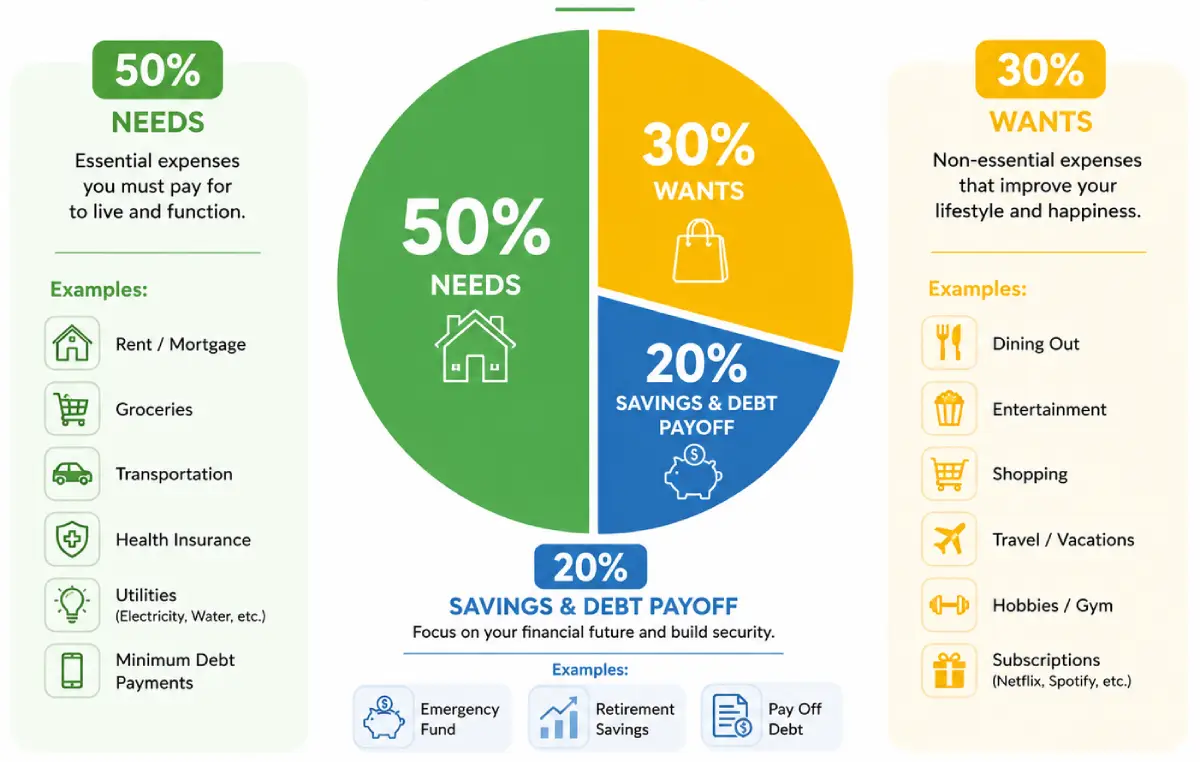
    For years, the 50/30/20 budget rule has been one of the simplest recommendations in personal finance. Financial coaches, budgeting apps, banks, and investment platforms have all promoted it as an easy framework for managing income without becoming overwhelmed by spreadsheets and complicated formulas. Even people who have never created a formal budget have probably heard the advice: spend 50% of your income on needs, 30% on wants, and save or invest the remaining 20%.

    The idea is appealing because it is easy to remember. Instead of tracking dozens of spending categories, you only need to think about three. It removes much of the complexity that causes many people to abandon budgeting after only a few weeks.

    But personal finance has changed dramatically over the past decade. Housing costs have climbed in most American cities, grocery prices remain well above pre-pandemic levels, insurance premiums continue to rise, and many workers are juggling student loan payments alongside higher interest rates on credit cards and auto loans. A budgeting method that worked comfortably in 2015 may feel almost impossible for households in 2026.

    That doesn’t mean the 50/30/20 rule is obsolete. It simply means it should be treated as a flexible guideline rather than a rigid formula. Understanding why it was created—and how to adapt it to today’s financial reality—can make it far more useful than blindly following percentages that don’t fit your circumstances.

    Understanding the three categories

    At its core, the budgeting rule divides your after-tax income into three broad groups.

    The first category, needs, includes expenses that are essential for maintaining your basic lifestyle. Housing, utilities, groceries, transportation to work, health insurance, minimum debt payments, and other unavoidable bills all belong here. If you stopped paying these expenses, your daily life would be directly affected.

    The second category covers wants. These are the purchases that improve your lifestyle but aren’t strictly necessary. Dining out, streaming subscriptions, vacations, entertainment, hobbies, shopping, premium phone upgrades, and many online subscriptions all fall into this group.

    The final 20% is reserved for building your future. That includes emergency savings, retirement contributions, investments, paying extra toward high-interest debt, or saving for major financial goals such as a home down payment.

    The simplicity of these categories is one of the reasons the system became so popular. People rarely fail because budgeting is mathematically difficult—they fail because it becomes emotionally exhausting. Reducing dozens of spending decisions into three larger buckets helps many households stay consistent.

    Why the original formula doesn’t always fit today’s economy

    One of the biggest criticisms of the 50/30/20 rule is that it assumes housing consumes roughly half of your essential expenses. In reality, housing has become the largest financial challenge for millions of Americans.

    According to recent housing market data, many renters now spend well above 30% of their income on rent alone. After adding utilities, transportation, insurance, and groceries, essential expenses can easily reach 65% or even 70% of take-home pay.

    Someone earning $4,500 per month after taxes would ideally spend no more than $2,250 on necessities under the traditional formula. Yet in many metropolitan areas, rent alone can exceed $2,000 before any other monthly bills are considered.

    Inflation has added another layer of pressure. Grocery prices, car insurance, healthcare, and everyday household expenses have all increased significantly compared with only a few years ago. As a result, many families find themselves reducing discretionary spending simply to cover basic living costs.

    This doesn’t necessarily indicate poor financial habits. Often, it reflects economic conditions that are outside an individual’s control.

    Why flexibility matters more than perfection

    Many people abandon budgeting after the first month because they believe they’ve failed. Their essential expenses reached 62% instead of 50%, or they only managed to save 12% instead of 20%.

    In reality, budgeting should be viewed as a direction rather than a scorecard.

    Imagine two households earning the same income. One lives in a low-cost Midwestern city with affordable housing, while the other rents an apartment in New York City or San Francisco. Expecting both families to maintain identical spending percentages ignores enormous regional differences in the cost of living.

    The more useful question isn’t whether your budget matches the textbook formula. Instead, ask whether your financial situation is improving month after month.

    Are your savings growing?

    Is your credit card balance shrinking?

    Are you relying less on debt?

    Can you handle an unexpected expense without panic?

    Positive answers to those questions matter far more than perfectly matching predetermined percentages.

    Adapting the rule for modern households

    Many financial planners now recommend adjusting the percentages to match your current stage of life rather than forcing yourself into an unrealistic budget.

    A recent graduate paying off student loans may temporarily follow a 60/20/20 approach.

    A young family facing childcare costs might operate closer to 65/15/20.

    Someone aggressively paying off high-interest credit card debt could intentionally reduce discretionary spending for a year while directing more than 20% toward debt repayment.

    The percentages themselves are less important than maintaining balance between today’s lifestyle and tomorrow’s financial security.

    The greatest danger isn’t spending 55% on necessities. It’s allowing lifestyle inflation to consume every future raise, leaving nothing available for investing or emergency savings.

    Small improvements often beat major budget cuts

    When people decide to “fix” their finances, they often focus on eliminating coffee purchases or canceling a streaming subscription. While those savings can help, they rarely transform a household budget.

    Much larger gains usually come from optimizing high-cost categories.

    Negotiating car insurance.

    Refinancing expensive debt.

    Reducing housing costs when possible.

    Increasing retirement contributions before lifestyle spending expands.

    Pursuing salary growth through new skills or career advancement.

    These decisions can improve monthly cash flow by hundreds of dollars instead of only a few dollars at a time.

    The 50/30/20 rule works best when paired with thoughtful financial decisions rather than strict deprivation.

    Budgeting should reduce stress – not create it

    The purpose of budgeting is often misunderstood.

    Many people think a budget exists to limit spending. In reality, its primary purpose is to help people spend intentionally.

    A well-designed budget allows someone to enjoy vacations, hobbies, dining out, or entertainment without guilt because those expenses were planned in advance. At the same time, it ensures that future goals—retirement, emergency savings, education, or homeownership—continue moving forward.

    Financial confidence rarely comes from earning a perfect income. It comes from consistently making intentional decisions with the income you already have.

    The 50/30/20 rule remains valuable because it encourages exactly that mindset.

    It provides a simple framework that can evolve as your income, family, career, and financial priorities change. In today’s economy, flexibility has become just as important as discipline. Rather than treating the rule as a strict mathematical formula, think of it as a compass that helps guide your financial decisions in the right direction.